
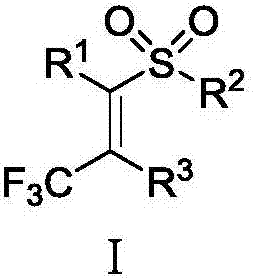
Beta-trifluoromethyl vinyl sulfone compounds as well as preparation method and application thereof
A technology of trifluoromethyl alkenyl sulfone and trifluoromethyl, which is applied in the application field of β-trifluoromethyl alkenyl sulfone and its preparation, anti-tumor cell proliferation, and can solve the reaction configuration selection difficult to control, harsh reaction conditions, narrow substrate range, etc., to achieve good application prospects, mild reaction conditions, and easy operation.
- Summary
- Abstract
- Description
- Claims
- Application Information
AI Technical Summary
Problems solved by technology
Method used
Image



Examples
Embodiment 1
[0026]
[0027] Add DABCO.(SO 2 ) 2 (0.16mmol), p-chlorophenylacetylene (0.2mmol), TMSCF 3 (0.24mmol), p-chlorophenyldiazotetrafluoroborate (0.24mmol) and dimethyl sulfoxide (2mL), under the protection of argon, stirred at room temperature for 8 hours, TLC detected that the reaction was complete, and the reaction solution was used Extracted with ethyl acetate, washed with saturated brine, concentrated and purified by column chromatography to obtain compound Ia.
[0028] Characterization of Compound Ia: 1 H NMR (400MHz, CDCl 3 )δ7.53–7.45(m,4H),7.33–7.28(m,2H),7.23–7.13(m,1H),7.05–6.89(m,2H); 19 F NMR (376MHz, CDCl 3 )δ-58.3(d, J=6.8Hz); 13 C NMR (100MHz, CDCl 3 )δ151.8, 141.5, 136.8, 134.6, 130.9, 130.5, 129.6, 128.6, 126.2 (q, J = 36.2Hz), 126.0, 121.3 (q, J = 274.1Hz); HRMS (ESI) calcd for C 15 h 10 Cl 2 f 3 o 2 S:380.9725(M+H + ), found: 380.9708..
Embodiment 2
[0030]
[0031] Add DABCO.(SO 2 ) 2 (0.16mmol), 3-ethynylpyridine (0.2mmol), TMSCF 3(0.24mmol), phenyldiazonium tetrafluoroborate (0.24mmol) and dimethyl sulfoxide (2mL), under the protection of argon, stirred at room temperature for 8 hours, TLC detected that the reaction was complete, and the reaction solution was washed with ethyl acetate The ester was extracted, washed with saturated brine, concentrated and purified by column chromatography to obtain compound Ib.
[0032] Characterization of compound Ib: 1 H NMR (400MHz, CDCl 3 )δ8.47(s,1H),7.74(s,1H),7.65–7.60(m,3H),7.47–7.43(m,3H),7.30(d,J=6.0Hz,1H),7.26–7.16 (m,1H); 19 F NMR (376MHz, CDCl 3 )δ-59.2(d, J=5.5Hz).; 13 C NMR (100MHz, CDCl 3 )δ151.5, 149.4, 141.5, 136.4, 134.4, 132.7, 129.2, 129.1, 126.4 (q, J = 36.7Hz), 125.5, 124.3, 121.3 (q, J = 273.8Hz); HRMS (ESI) calcdfor C 14 h 11 f 3 NO 2 S:314.0457(M+H + ), found: 314.0463..
Embodiment 3
[0034]
[0035] Add DABCO.(SO 2 ) 2 (0.16mmol), p-acetylphenylacetylene (0.2mmol), TMSCF 3 (0.24mmol), phenyldiazonium tetrafluoroborate (0.24mmol) and dimethyl sulfoxide (2mL), under the protection of argon, stirred at room temperature for 8 hours, TLC detected that the reaction was complete, and the reaction solution was washed with ethyl acetate The ester was extracted, washed with saturated brine, concentrated and purified by column chromatography to obtain compound Ic.
[0036] Characterization of Compound Ic: 1 H NMR (400MHz, CDCl 3 )δ7.85(d, J=8.5Hz, 2H), 7.63(t, J=7.3Hz, 1H), 7.58–7.55(m, 2H), 7.45(t, J=7.8Hz, 2H), 7.19( q, J=7.1Hz, 1H), 7.10(d, J=8.3Hz, 2H), 2.59(s, 3H); 19 F NMR (376MHz, CDCl 3 )δ-58.3(d, J=7.2Hz); 13 C NMR (100MHz, CDCl 3 )δ197.2, 152.3, 137.9, 135.9, 134.6, 132.5, 129.9, 129.3, 129.1, 127.8, 125.8 (q, J = 36.1Hz), 121.3 (q, J = 273.5Hz), 26.6; HRMS (ESI) calcd for C 17 h 14 f 3 o 3 S:355.0610(M+H + ), found: 355.0617..
PUM
 Login to View More
 Abstract
Description
Claims
Application Information
 Login to View More