
Feature classification method for liver ultrasonic image
An ultrasound image and feature classification technology, applied in the field of liver ultrasound image feature classification, can solve the problems of inconvenient operation, limited value, and inability to perform real-time dynamic inspection.
- Summary
- Abstract
- Description
- Claims
- Application Information
AI Technical Summary
Problems solved by technology
Method used
Image

Examples
Embodiment 1
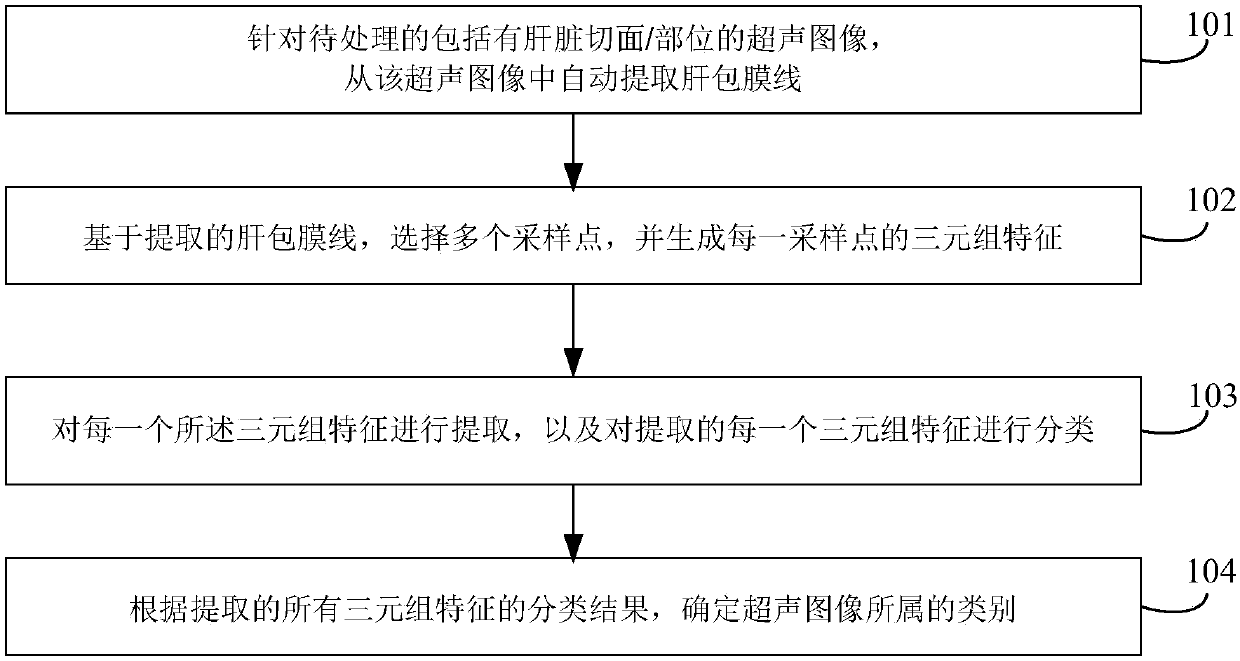
[0103] Such as figure 1 as shown, figure 1 It shows a schematic flowchart of a feature classification method for liver ultrasound images provided by an embodiment, and the method of this embodiment includes the following steps:
[0104] 101. For an ultrasound image including liver sections / parts to be processed, automatically extract the liver capsule line from the ultrasound image.
[0105] For example, step 101 may include:
[0106] The first step, for the ultrasound image to be processed including liver sections / parts, use a sliding window detector to process the ultrasound image, and establish multiple channels in the image block corresponding to the window of the sliding window detector, from the established Extracting pre-selected random rectangular features from multiple channels to obtain a detection response map; the random rectangular features are determined in advance through training samples;
[0107] In the second step, a complete liver envelope line is extract...
Embodiment 2
[0199] The method of the present embodiment includes steps not shown in the following figures:
[0200] Step 601. Obtain the liver capsule line in the ultrasound images of the liver marked as lesions and normal training samples;
[0201] Step 602, select a certain number of sampling points on each liver envelope line in step 601, three adjacent sampling points form a group, intercept the image block, extract features, and train the support vector machine SVM classifier;
[0202] Step 603, randomly select a certain number of sampling points in the area above the liver envelope line in the training sample in step 601, select three image blocks of different sizes at each sampling point, extract features, and train the SVM classification device;
[0203] Step 604, randomly select a certain number of sampling points in the area below the liver capsule line in the training sample in step 601, select three image blocks of different sizes at each sampling point, extract features, and...
PUM
 Login to View More
 Abstract
Description
Claims
Application Information
 Login to View More