
Yellowing-resistant UV screen printing ink
A screen printing ink, anti-yellowing technology, applied in the printing field, can solve the problems of product yellowing, affecting printing quality and effect, and easy yellowing
- Summary
- Abstract
- Description
- Claims
- Application Information
AI Technical Summary
Problems solved by technology
Method used
Image


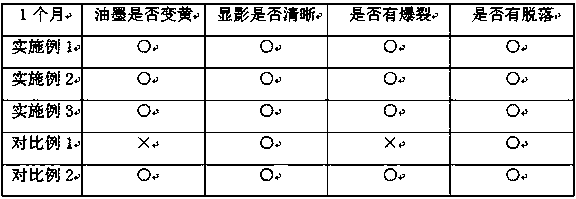

Examples
Embodiment 1
[0021] Mix 20 parts of tripropylene glycol diacrylate and 5 parts of trimethylolpropane triacrylate to obtain acrylate monomer; mix 1 part of CTBN, 2 parts of epoxy resin, 1 part of aluminum oxide and 1 part of silicon dioxide Uniform and pre-dispersed to obtain modified epoxy resin; 7-hydroxy-4-methyl coumarin was obtained by Pechmann method. Then react with 0.5 part of cyanuric chloride, 0.3 part of 7-hydroxyl-4-methylcoumarin and 0.6 part of 2,4-dihydroxy-benzophenone to generate macromolecules, and then react with polyethylene glycol series products 0.6 parts were subjected to polycondensation reaction, and a polymer light stabilizer was synthesized.
[0022] Mix 25 parts of the obtained acrylate monomer, 5 parts of modified epoxy resin, 2 parts of light stabilizer, 5 parts of urethane acrylate resin, 50 parts of mercapto-modified urethane acrylate and 2 parts of KIP150, and disperse, Grind and filter to finally obtain a yellowing-resistant UV screen printing ink.
Embodiment 2
[0024] Mix 23 parts of tripropylene glycol diacrylate and 7 parts of trimethylolpropane triacrylate to obtain acrylate monomer; mix 2 parts of CTBN, 4 parts of epoxy resin, 2 parts of aluminum oxide and 2 parts of silicon dioxide Uniform and pre-dispersed to obtain modified epoxy resin; 7-hydroxy-4-methyl coumarin was obtained by Pechmann method. Then react with 0.6 part of cyanuric chloride, 0.4 part of 7-hydroxyl-4-methylcoumarin and 0.7 part of 2,4-dihydroxy-benzophenone to generate macromolecules, and then react with polyethylene glycol series products 0.8 parts were subjected to polycondensation reaction, and a polymer light stabilizer was synthesized.
[0025] Mix 30 parts of the obtained acrylate monomer, 10 parts of modified epoxy resin, 2.5 parts of light stabilizer, 10 parts of urethane acrylate resin, 55 parts of mercapto-modified urethane acrylate and 6 parts of KIP150, and disperse, Grind and filter to finally obtain a yellowing-resistant UV screen printing ink. ...
Embodiment 3
[0027] Mix 25 parts of tripropylene glycol diacrylate and 10 parts of trimethylolpropane triacrylate to obtain acrylate monomer; mix 3 parts of CTBN, 6 parts of epoxy resin, 3 parts of aluminum oxide and 3 parts of silicon dioxide Uniform and pre-dispersed to obtain modified epoxy resin; 7-hydroxy-4-methyl coumarin was obtained by Pechmann method. Then react with 0.7 part of cyanuric chloride, 0.5 part of 7-hydroxyl-4-methylcoumarin and 0.8 part of 2,4-dihydroxy-benzophenone to generate macromolecules, and then react with polyethylene glycol series products One part was subjected to polycondensation reaction to synthesize a polymer light stabilizer.
[0028] Mix 35 parts of the obtained acrylate monomer, 15 parts of modified epoxy resin, 3 parts of light stabilizer, 15 parts of urethane acrylate resin, 60 parts of mercapto-modified urethane acrylate and 8 parts of KIP150, and disperse, Grind and filter to finally obtain a yellowing-resistant UV screen printing ink.
PUM
 Login to View More
 Abstract
Description
Claims
Application Information
 Login to View More