[0004] In addition to the limitation of the measurement range by the verification code, there are still some problems in the indoor large-space detection method: ①The cost is very expensive and the construction is difficult, which is difficult for general testing institutions. Taking Zhejiang Institute of
Metrology as an example, the indoor length of 50 meters The cost of the standard device is as high as 1.425 million yuan; ②It covers a large area, and it is difficult for general laboratory conditions to meet the
space requirements of tens of meters or even hundreds of meters; ③The detection efficiency is low, such as the requirements of JJG966-2010 Handheld
Laser Rangefinder
Verification Regulations , To detect the indication error within 50 meters, at least 12 points need to be measured, and the distance that a tester needs to walk to measure a
laser rangefinder is close to 600 meters, and the testers are overwhelmed
However, in the actual verification process, there are many problems in the field baseline
field detection: ① It is very difficult to establish a baseline field, and it is very difficult to select hundreds or even thousands of meters of straight areas in cities without natural obstacles and interference from animals and animals
② The occasions that meet the above conditions must be found far away from the city, which brings great inconvenience to the verification work, and consumes time, energy and energy
③The field baseline field is arranged on the ground or on ground piles. The erection and alignment of instruments and reflectors are very laborious. Not only does it require more than two people to operate, but it is often impossible to obtain correct and reliable results due to inaccurate alignment.
④ Operations in the field under natural climate conditions are greatly affected by the weather. Due to weather changes, the verification efficiency is often low, and the
work quality cannot be improved.
Existing problems: ① In the long-distance range, the
optical path calibration technology is very difficult, and at the same time, the flatness of the large
flat mirror and the parallelism between the mirrors will introduce a large
measurement uncertainty, and the stability of the measurement
system is poor
②The accuracy of the incident angle of the rangefinder and the parallelism between the plane mirrors will seriously affect the accurate position of the laser beam in the three-dimensional space, making it extremely difficult to adjust the
optical path and capture the target spot by the reflective target, and the measurement is not easy to implement
[0009] (2) In 2013, Li Qian of Xi'an University of Technology and others used a right-angle mirror group to fold the light multiple times in the dynamic space, shortened the 50m measurement distance to a space of more than ten meters, and calibrated the
optical path of the
total station to detect the handheld In 2016, Jiangsu Province Surveying and Mapping Products Quality Supervision and Inspection
Station proposed to use right-angle prisms to perform optical path folding and simulate length baseline field verification of total stations. At the level of technical difficulty evaluation, no in-depth research has been conducted
The application number is 2013100161742, and the patent name is "Handheld
Laser Rangefinder
Verification System and
Verification Method". Problems: ① The reflection characteristics of the right-angle mirror group and the right-angle
prism ensure that the
laser beams remain parallel in the horizontal plane, However, there is still the problem of ensuring beam parallelism in the
vertical plane, especially during the dynamic movement of the
pallet, it is very difficult to constrain the position of the beam
② Three sets of right-angle reflective devices are required to realize four times the optical path in the
system, with a total of 6 reflectors, and the structure is too complicated
[0012] To sum up, the current optical path multiplication method still lacks a high-accuracy measurement method that can be applied to front-line detection. There are problems such as difficult optical path calibration technology,
complex system structure, poor measurement stability, and difficult operation. The position constraint during the folding process is the key to improving the measurement accuracy, especially how the reflective device can improve the adaptive ability of the laser beam during the dynamic movement process needs to be further explored



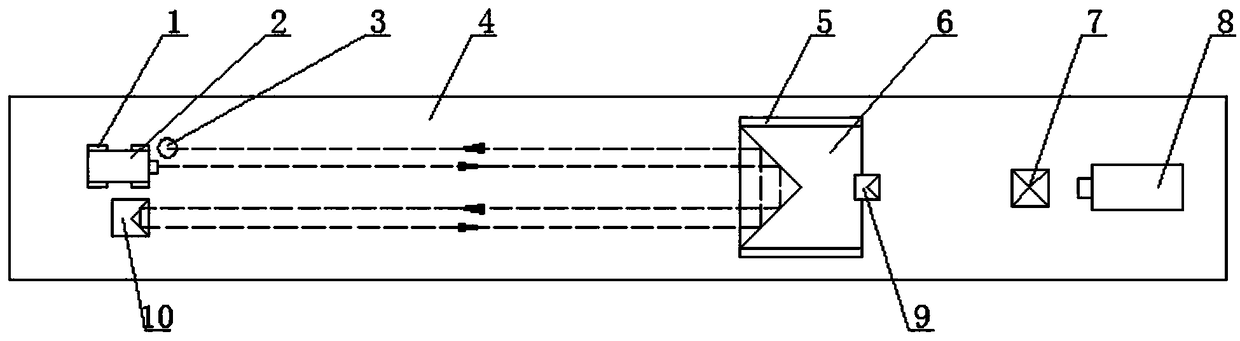
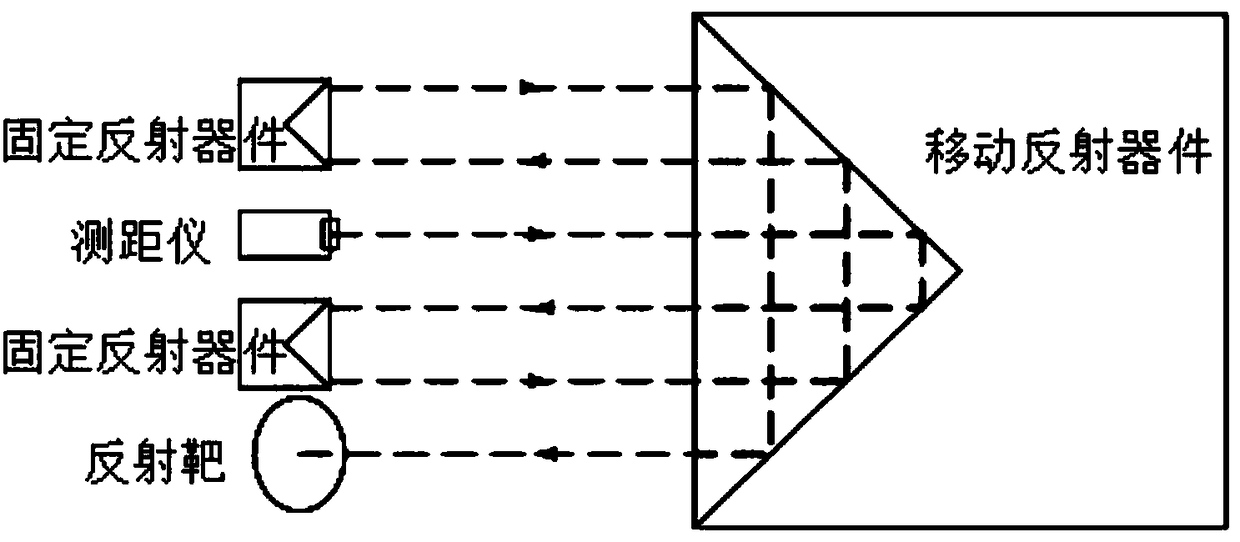
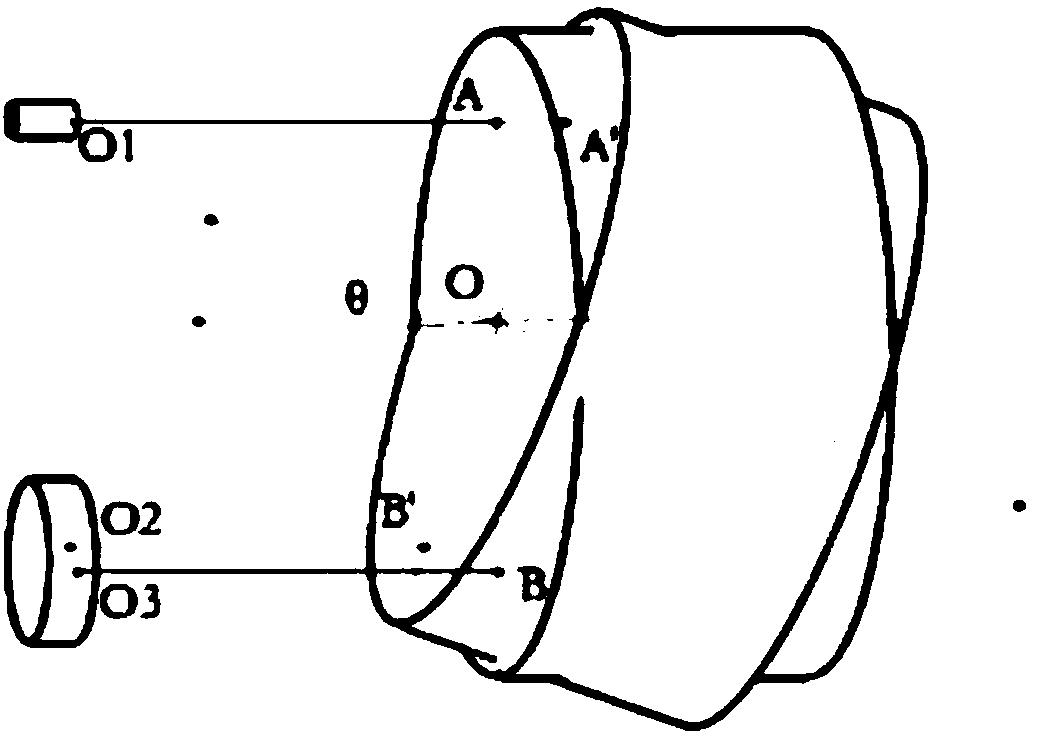
 Login to View More
  Login to View More