Unlock instant, AI-driven research and patent intelligence for your innovation.

Nano-titanium dioxide photocatalytic composite material and preparation method thereof

A technology of nano-titanium dioxide and composite materials, applied in the field of nano-titanium dioxide photocatalytic composite materials and its preparation, can solve the problems of easy compounding, difficult fixation, loss of specific surface area, etc., and achieve the effect of facilitating adsorption, solving the loss of specific surface area, and promoting improvement

Inactive Publication Date: 2019-08-09
CHONGQING UNIV
View PDF6 Cites 0 Cited by
  • Summary
  • Abstract
  • Description
  • Claims
  • Application Information

AI Technical Summary

Problems solved by technology

[0006] Aiming at the existing problems such as easy agglomeration and difficult fixation of nano-titanium dioxide, and easy recombination of its own electrons and hole pairs, the technical problem to be solved by the present invention is to provide a nano-titanium dioxide photocatalytic composite material, which can solve the loss of specific surface area caused by material agglomeration , and can reduce the recombination of photogenerated electron-hole pairs, enhance the adsorption capacity of organic molecules on the surface of photocatalytic composite materials, and improve the photocatalytic performance of the composite

Method used

the structure of the environmentally friendly knitted fabric provided by the present invention; figure 2 Flow chart of the yarn wrapping machine for environmentally friendly knitted fabrics and storage devices; image 3 Is the parameter map of the yarn covering machine
View more

Image

Smart Image Click on the blue labels to locate them in the text.
Viewing Examples
Smart Image
  • Nano-titanium dioxide photocatalytic composite material and preparation method thereof
  • Nano-titanium dioxide photocatalytic composite material and preparation method thereof
  • Nano-titanium dioxide photocatalytic composite material and preparation method thereof

Examples

Experimental program
Comparison scheme
Effect test

Embodiment 1

[0027] 1. In a CVD tube furnace, heat 0.7 g of diatomite from room temperature to 1000 °C under the conditions of argon and hydrogen for 60 minutes; keep the supply of argon and hydrogen, and feed methane gas to make the diatomite React at 1000 °C for 90 minutes; stop the supply of methane and hydrogen, let the sample cool down to 300 °C naturally, and then quickly cool down to obtain powder 1.

[0028] 2. Put 0.372 g TiF 4 and 0.03 g Powder 1 (Powder 1 accounted for TiF 4 8.06% of its mass) was dissolved in 70 mL of deionized water, stirred for 20 minutes, poured into the reaction kettle, the hydrothermal temperature was 140 °C, and the holding time was 12 h; after that, the reaction kettle was naturally cooled to obtain a cloudy liquid.

[0029] 3. The turbid liquid is washed several times and dried to prepare a nano-titanium dioxide photocatalytic composite material.

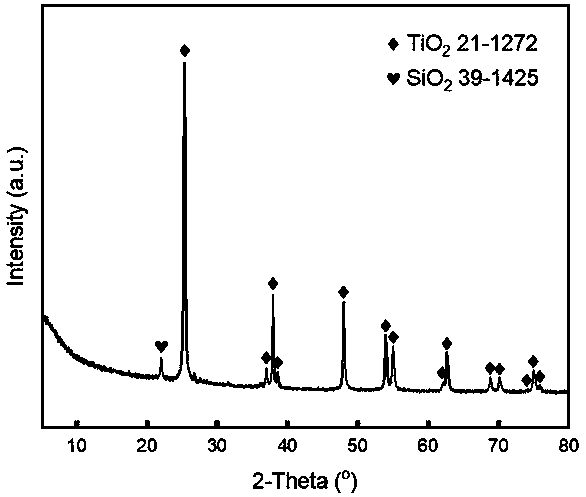
[0030] figure 1 It is the XRD figure of the nano-titanium dioxide photocatalytic composite material tha...

Embodiment 2

[0033] 1. In a CVD tube furnace, 0.3 g of diatomite is heated from room temperature to 1100 °C under the condition of argon and hydrogen, and the heating time is 70 minutes; maintain the supply of argon and hydrogen, and feed methane gas to make the diatomite React at 1100 °C for 100 minutes; stop the supply of methane and hydrogen, let the sample cool down to 200 °C naturally, and then quickly cool down to obtain powder 2.

[0034] 2. Put 18.0 g TiF 4 and 0.18 g Powder 2 (Powder 2 accounted for TiF 4 1% of its mass) was dissolved in 210 mL of deionized water, stirred for 30 minutes, and poured into a reactor with a hydrothermal temperature of 140 °C and a holding time of 12 h; after that, the reactor was naturally cooled to obtain a cloudy liquid.

[0035] 3. The turbid liquid is washed several times and dried to prepare a nano-titanium dioxide photocatalytic composite material.

[0036] The concrete steps of the photocatalytic performance evaluation of nano titanium dioxid...

Embodiment 3

[0040] 1. In a CVD tube furnace, 0.3 g of diatomite is heated from room temperature to 900 °C under the condition of argon and hydrogen, and the heating time is 80 minutes; keep the supply of argon and hydrogen, and feed methane gas to make the diatomite React at 1100 °C for 100 minutes; stop the supply of methane and hydrogen, let the sample cool down to 100 °C naturally, and then quickly cool down to obtain powder 3.

[0041] 2. Add 1.80 g TiF 4 and 0.36 g Powder 3 (Powder 3 accounted for TiF 4 20% of its mass) was dissolved in 70 mL of deionized water, stirred for 40 minutes, poured into the reaction kettle, the hydrothermal temperature was 180 ℃, and the holding time was 5 hours; after that, the reaction kettle was naturally cooled to obtain a turbid liquid;

[0042] 3. The turbid liquid is washed several times and dried to prepare a nano-titanium dioxide photocatalytic composite material.

the structure of the environmentally friendly knitted fabric provided by the present invention; figure 2 Flow chart of the yarn wrapping machine for environmentally friendly knitted fabrics and storage devices; image 3 Is the parameter map of the yarn covering machine
Login to View More

PUM

No PUM Login to View More

Abstract

The invention discloses a nano-titanium dioxide photocatalytic composite material and a preparation method thereof. The preparation method includes: firstly compounding graphene on a diatomite surfaceby chemical vapor deposition method, and then compounding nano-titanium dioxide on the basis of the diatomite compounded with graphene on the surface by hydrothermal method, thus obtaining the nano-titanium dioxide photocatalytic composite material. The method is simple in steps and low in cost, the obtained nano-titanium dioxide photocatalytic composite material has high activity, and can be applied to photocatalytic treatment of organic pollutants in the environment.

Description

technical field [0001] The invention belongs to the field of nano-photocatalytic materials, and in particular relates to a nano-titanium dioxide photocatalytic composite material and a preparation method thereof. Background technique [0002] As an efficient, simple and ideal pollutant degradation technology, photocatalysis has been widely used in the degradation of organic pollutants. However, the photocatalytic degradation efficiency is still low due to the fast recombination of photoexcited electrons and holes in semiconductors and the low absorption rate of organic pollutants on the surface. Therefore, in order to improve the photodegradability, it is necessary to find a new way to suppress the recombination of photoexcited electrons and holes and enhance the absorption of organic pollutants. [0003] TiO 2 With the advantages of good chemical stability, non-toxicity, low cost, and strong oxidation ability, it is one of the most promising catalysts at present, and is w...

Claims

the structure of the environmentally friendly knitted fabric provided by the present invention; figure 2 Flow chart of the yarn wrapping machine for environmentally friendly knitted fabrics and storage devices; image 3 Is the parameter map of the yarn covering machine
Login to View More

Application Information

Patent Timeline
no application Login to View More
Patent Type & Authority Applications(China)
IPC IPC(8): B01J21/18B01J35/10C02F1/32C02F1/28C02F101/36C02F101/38
CPCB01J21/18C02F1/32C02F1/288C02F2305/10C02F2101/36C02F2101/38C02F2101/40B01J35/39B01J35/61
Inventor 曾皓张育新杨璐杉贺增燚张文正代思越荆川
Owner CHONGQING UNIV
Features
  • R&D
  • Intellectual Property
  • Life Sciences
  • Materials
  • Tech Scout
Why Patsnap Eureka
  • Unparalleled Data Quality
  • Higher Quality Content
  • 60% Fewer Hallucinations
Social media
Patsnap Eureka Blog
Learn More