Optical fiber preform and preparation method thereof
A technology of optical fiber prefabricated rods and core rods, applied in glass manufacturing equipment, manufacturing tools, etc., can solve the problems of fluorine element dissipation in the fluorine-doped layer, product performance fluctuations, and the inability to guarantee the stability of the fluorine-doped layer during the sintering process. Exposure time, effect of reducing impact
- Summary
- Abstract
- Description
- Claims
- Application Information
AI Technical Summary
Problems solved by technology
Method used
Image



Examples
preparation example Construction
[0031] The present invention also provides a method for preparing the optical fiber preform 100, which specifically includes the following steps:
[0032] Step S21, using a VAD deposition process to prepare a mandrel loose body;
[0033] Step S22, preparing a second fluorine-doped sinking layer outside the mandrel loose body;
[0034] Step S23, preparing an outer cladding layer outside the second fluorine-doped sinking layer to form an optical fiber preform.
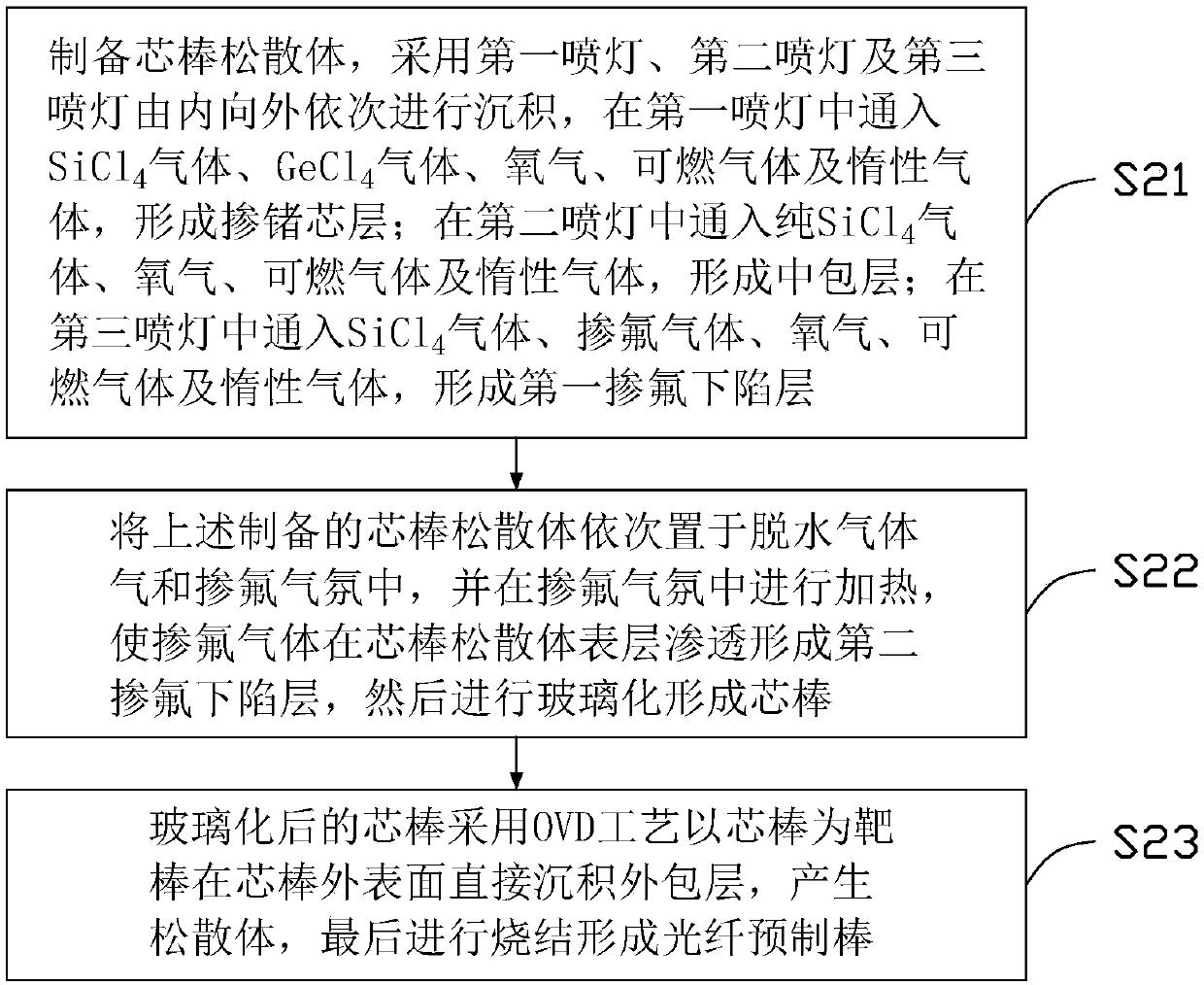
[0035] see figure 2 , figure 2 It is a schematic flow chart of the method for preparing the optical fiber preform 100 in the first embodiment of the present invention, which specifically includes the following steps:
[0036] Step S21, preparing the mandrel loose body, using the first blowtorch, the second blowtorch and the third blowtorch to deposit sequentially from the inside to the outside, and injecting SiCl into the first blowtorch 4 Gas, GeCl 4 gas, oxygen, combustible gas and argon to form a germanium-dope...
Embodiment 1
[0052] Prepare the mandrel loose body, pass SiCl into the first blowtorch 4 Gas, GeCl 4 Gas, oxygen, hydrogen and argon form a germanium-doped core layer, in which SiCl 4 Gas and GeCl 4 The gas is passed into the first torch through argon as a transport carrier, GeCl 4 The flow rate of the gas is 200ml / min, the temperature is 105°C, the corresponding flow rate of argon is 200ml / min; the flow rates of hydrogen and oxygen are 4ml / min and 35ml / min respectively; SiCl 4 The gas flow rate is 5ml / min, the temperature is 95°C, and the corresponding argon flow rate is 150ml / min; the flame temperature of the first torch is 725°C. Pure SiCl is introduced into the second blowtorch 4 Gas, oxygen, hydrogen and argon form the middle cladding, in which pure SiCl 4 The gas is passed into the second torch through argon as a transport carrier, and the flow rates of hydrogen and oxygen are 6ml / min and 60ml / min respectively; pure SiCl 4 The gas flow rate is 15ml / min, the temperature is 100°C...
Embodiment 2
[0054] Prepare the mandrel loose body, pass SiCl into the first blowtorch 4 Gas, GeCl 4 Gas, oxygen, hydrogen and argon form a germanium-doped core layer, in which SiCl 4 Gas and GeCl4 gas are passed into the first blowtorch through argon as a transport carrier, the flow rate of GeCl4 gas is 200ml / min, the temperature is 105°C, the corresponding flow rate of argon gas is 200ml / min; the flow rates of hydrogen and oxygen are 4ml respectively / min and 35ml / min; SiCl 4 The gas flow rate is 5ml / min, the temperature is 95°C, and the corresponding argon flow rate is 150ml / min; the flame temperature of the first torch is 725°C. Pure SiCl is introduced into the second blowtorch 4 Gas, oxygen, hydrogen and argon form the middle cladding, in which pure SiCl 4 The gas is passed into the second torch through argon as a transport carrier, and the flow rates of hydrogen and oxygen are 6ml / min and 60ml / min respectively; pure SiCl 4 The gas flow rate is 15ml / min, the temperature is 100°C,...
PUM
| Property | Measurement | Unit |
|---|---|---|
| width | aaaaa | aaaaa |
| width | aaaaa | aaaaa |
| diameter | aaaaa | aaaaa |
Abstract
Description
Claims
Application Information
 Login to View More