
Etchant for displaying austenite structure of heat-resistant steel for air valve and using method
A technology of steel austenite and etchant, which is applied in the field of etchant for displaying heat-resistant steel austenite structure for air valves, can solve the problems of inability to obtain clear and complete microstructure, achieve low cost, improve quality, and prepare simple effect
- Summary
- Abstract
- Description
- Claims
- Application Information
AI Technical Summary
Problems solved by technology
Method used
Image

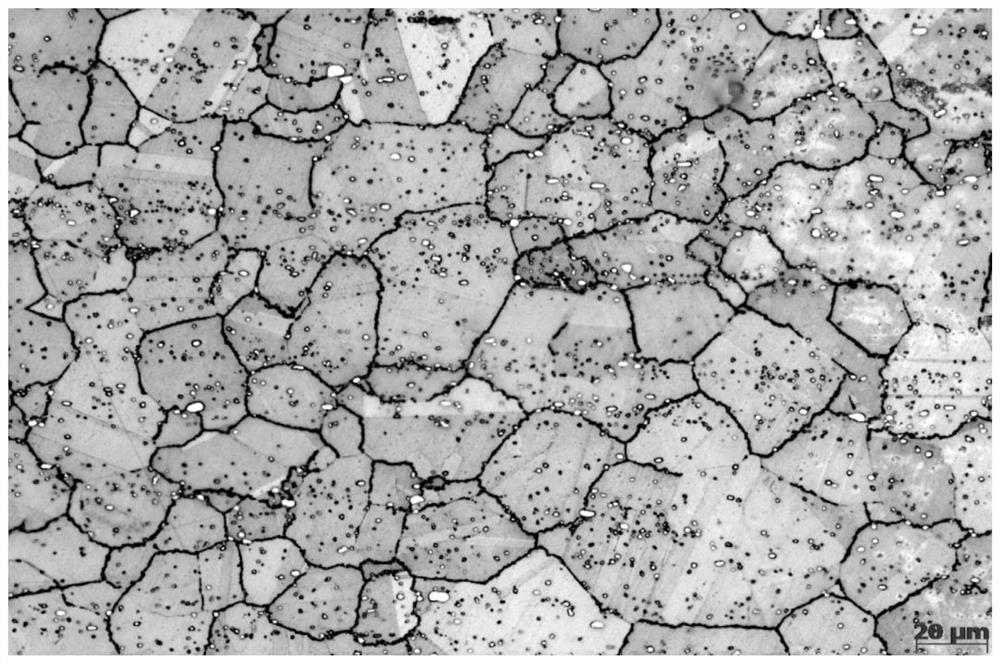
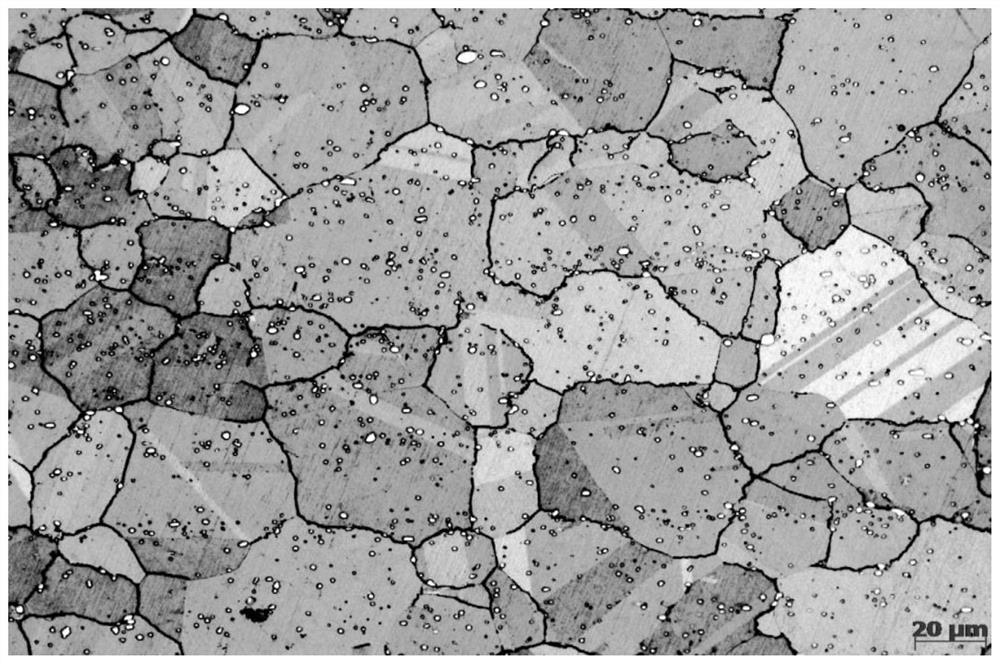
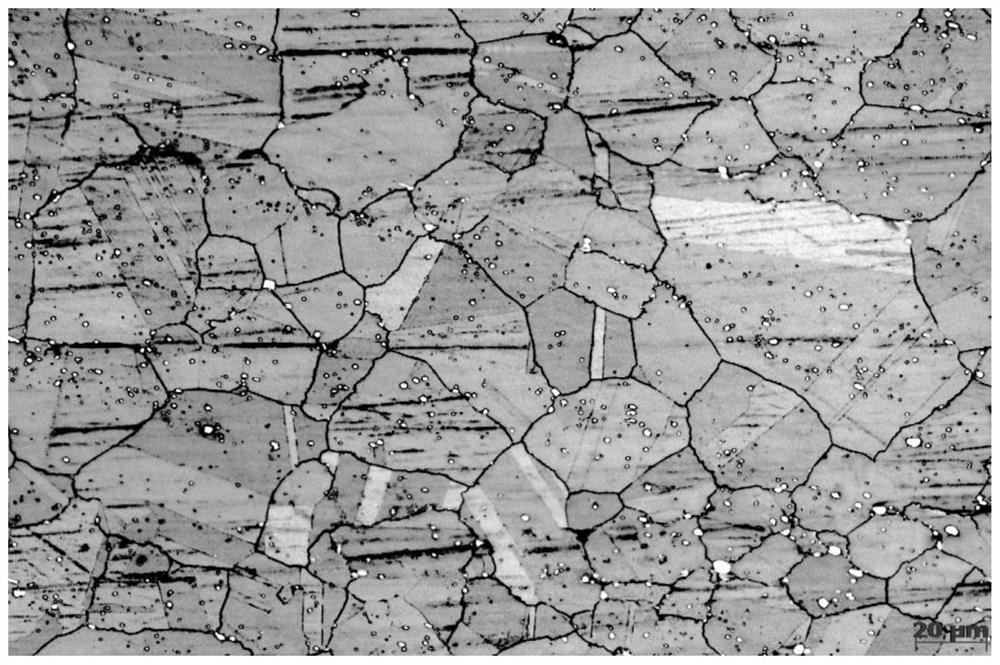
Examples
Embodiment 1
[0033] In this embodiment, the heat-resistant steel for air valves is taken as an example. The sample is hot-rolled at a temperature of 1150° C. for 15 minutes, air-cooled, and the method for displaying the austenite structure at room temperature includes the following steps:
[0034] 1) Etching agent preparation: Add 5g of ferric chloride and 35ml of hydrochloric acid with a mass fraction of 37% to 100ml of water in sequence, stir evenly, and prepare etchant 1; respectively add 10g of anhydrous copper sulfate, 10ml of sulfuric acid, and 5ml of Slowly add triol into 100ml of hydrochloric acid with a mass fraction of 37%, stir evenly, and prepare etching agent 2;
[0035] 2) Sample preparation: cut out the heat-resistant steel sample for the gas valve, grind and polish the surface of the sample to be inspected, the polished surface is mirror-like, and has no scratches, rinse it with tap water, and then use a mass fraction of 99.5% Rinse with absolute ethanol and blow dry;
[0...
Embodiment 2
[0039] In this embodiment, the heat-resistant steel for air valves is taken as an example. The sample is hot-rolled at a temperature of 1150° C. for 30 minutes, air-cooled, and the method for displaying the austenite structure at room temperature includes the following steps:
[0040] 1) Etching agent preparation: Add 5g of ferric chloride and 35ml of hydrochloric acid with a mass fraction of 37% to 100ml of water in sequence, stir evenly, and prepare etchant 1; respectively add 10g of anhydrous copper sulfate, 10ml of sulfuric acid, and 5ml of Slowly add triol into 100ml of hydrochloric acid with a mass fraction of 37%, stir evenly, and prepare etching agent 2;
[0041] 2) Sample preparation: cut out the heat-resistant steel sample for the gas valve, grind and polish the surface of the sample to be tested. Rinse with water and ethanol and dry;
[0042] 3) Sample erosion: Immerse the metallographic sample prepared in step (2) face down into a petri dish containing etchant 1, ...
Embodiment 3
[0045] In this embodiment, the heat-resistant steel for air valves is taken as an example. The sample is hot-rolled at a temperature of 1150° C. for 45 minutes, air-cooled, and the method for displaying the austenite structure at room temperature includes the following steps:
[0046] 1) Etching agent preparation: Add 5g of ferric chloride and 40ml of hydrochloric acid with a mass fraction of 37% to 100ml of water in turn, stir well, and prepare etchant 1; respectively add 10g of anhydrous copper sulfate, 15ml of sulfuric acid, and 5ml of Slowly add triol into 100ml of hydrochloric acid with a mass fraction of 37%, stir evenly, and prepare etching agent 2;
[0047]2) Sample preparation: cut out the heat-resistant steel sample for the gas valve, grind and polish the surface of the sample to be tested. Rinse with water and ethanol and dry;
[0048] 3) Sample erosion: Immerse the metallographic sample prepared in step (2) face down into a petri dish containing etchant 1, stay fo...
PUM
 Login to View More
 Abstract
Description
Claims
Application Information
 Login to View More