Check patentability & draft patents in minutes with Patsnap Eureka AI!

Process for producing plywood by using small fragmental veneers

A plywood and veneer technology, which is applied in the jointing of wooden veneers, other plywood/plywood appliances, applications, etc., can solve the problems of increasing production time, unfavorable production efficiency, unfavorable board durability, etc., to reduce production time, It is beneficial to production efficiency and increases the effect of eating nails

Inactive Publication Date: 2021-11-05
景谷慧通木业有限责任公司
View PDF10 Cites 0 Cited by
  • Summary
  • Abstract
  • Description
  • Claims
  • Application Information

AI Technical Summary

Problems solved by technology

[0003] A Chinese patent discloses a plywood production process (authorized notification number CN106182220A). This patented technology has short pre-pressing and hot-pressing time, fast production speed, small internal stress, and is not easy to open and deform. The adhesive has good thermosetting properties and high viscosity. High strength, good durability, and not easy to deteriorate. However, the above-mentioned devices and the filling putty on the market are generally filled with gypsum, which is easy to drop slag after cutting, which is not conducive to the durability of the board. Generally, after gluing, If it is not treated, there will be more air bubbles in the glue, which is not conducive to the fastness of the subsequent board gluing. The above-mentioned device has undergone multiple hot pressing, which increases the production time and is not conducive to production efficiency.

Method used

the structure of the environmentally friendly knitted fabric provided by the present invention; figure 2 Flow chart of the yarn wrapping machine for environmentally friendly knitted fabrics and storage devices; image 3 Is the parameter map of the yarn covering machine
View more

Image

Smart Image Click on the blue labels to locate them in the text.
Viewing Examples
Smart Image
  • Process for producing plywood by using small fragmental veneers

Examples

Experimental program
Comparison scheme
Effect test

Embodiment 1

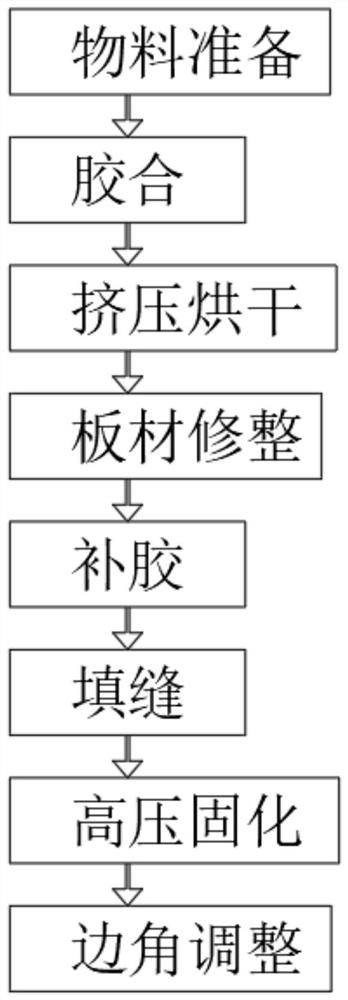
[0021] Step 1. Material preparation: peel the logs, cut them into chips, and then dry them in the sun. Grind the collected small veneers to the same thickness, clean up the wood chips on the materials, soften and flatten the boards, Panels are cut to the desired size;

[0022] Step 2, gluing: Put adhesive on the upper surface of the lower panel, arrange the trimmed small veneers on the upper surface of the lower panel, carry out extrusion pre-solidification, and then glue the broken small veneers on the lower panel Adhesive, extruding the lower surface of the upper panel to the upper surface of the broken small veneer for extrusion pre-solidification;

[0023] Step 3. Squeeze and dry: Place the glued plywood neatly, stack the plywood through the shelf, pressurize, and place it in the drying room for drying;

[0024] Step 4. Board trimming: Saw the edge of the extruded and dried board to obtain regular plywood, grind the corners of the board, polish the upper and lower layers ...

Embodiment 2

[0030] Step 1. Material preparation: peel the logs, cut them into chips, and then dry them in the sun. Grind the collected small veneers to the same thickness, clean up the wood chips on the materials, soften and flatten the boards, Panels are cut to the desired size;

[0031] Step 2, gluing: Put adhesive on the upper surface of the lower panel, arrange the trimmed small veneers on the upper surface of the lower panel, carry out extrusion pre-solidification, and then glue the broken small veneers on the lower panel Adhesive, extruding the lower surface of the upper panel to the upper surface of the broken small veneer for extrusion pre-solidification;

[0032] Step 3. Squeeze and dry: Place the glued plywood neatly, stack the plywood through the shelf, pressurize, and place it in the drying room for drying;

[0033] Step 4. Board trimming: Saw the edge of the extruded and dried board to obtain regular plywood, grind the corners of the board, polish the upper and lower layers ...

the structure of the environmentally friendly knitted fabric provided by the present invention; figure 2 Flow chart of the yarn wrapping machine for environmentally friendly knitted fabrics and storage devices; image 3 Is the parameter map of the yarn covering machine
Login to View More

PUM

No PUM Login to View More

Abstract

The invention relates to the technical field of plywood production, in particular to a process for producing plywood by using small fragmental veneers. The process comprises the following steps of 1, material preparation; 2, gluing; 3, extrusion and drying; 4, plywood trimming; 5, glue supplementing; 6, gap filling; 7, high-pressure curing; and 8, corner adjustment. According to the process, gaps of the plywood are filled with synthetic epoxy resin filler; compared with gypsum filling, the quality of the plywood is improved, the situation of subsequent cracking of the plywood is avoided, and the nail holding effect of the plywood is improved; and compared with putty, chipping falling is avoided after cutting, and the durability of the plywood is improved. According to the device, high-pressure bubble removal is carried out on the filler after gluing after gap filling, the tightness of subsequent plywood gluing is facilitated, the device adopts low-temperature bonding similar to drying in the shade and avoids ultra-high-temperature treatment, the viscosity of glue can be kept, the manufacturing time can be shortened, and the production efficiency can be improved.

Description

technical field [0001] The invention relates to the technical field of plywood production, in particular to a process for producing plywood by using crushed small veneers. Background technique [0002] Shred small veneer waste for waste utilization, and produce plywood to avoid waste of materials. Plywood is a three-layer or multi-layer made of wood sections that are cut into veneers or sliced ​​into thin wood, and then glued with adhesives. It is usually made of odd-numbered layers of veneers, and the fiber directions of adjacent layers of veneers are glued perpendicular to each other. [0003] A Chinese patent discloses a plywood production process (authorized notification number CN106182220A). This patented technology has short pre-pressing and hot-pressing time, fast production speed, small internal stress, and is not easy to open and deform. The adhesive has good thermosetting properties and high viscosity. High strength, good durability, and not easy to deteriorate. H...

Claims

the structure of the environmentally friendly knitted fabric provided by the present invention; figure 2 Flow chart of the yarn wrapping machine for environmentally friendly knitted fabrics and storage devices; image 3 Is the parameter map of the yarn covering machine
Login to View More

Application Information

Patent Timeline
no application Login to View More
Patent Type & Authority Applications(China)
IPC IPC(8): B27D1/04B27D5/00B27N3/06B27N3/02B27N3/10B27G1/00
CPCB27D1/04B27D5/00B27N3/06B27N3/02B27N3/10B27G1/00
Inventor 谢云贵
Owner 景谷慧通木业有限责任公司
Features
  • R&D
  • Intellectual Property
  • Life Sciences
  • Materials
  • Tech Scout
Why Patsnap Eureka
  • Unparalleled Data Quality
  • Higher Quality Content
  • 60% Fewer Hallucinations
Social media
Patsnap Eureka Blog
Learn More