
Rare-earth nano luninous particle based on fluorescent energy transfer principle and its preparing method
A fluorescent energy transfer and nanoparticle technology, applied in luminescent materials, chemical instruments and methods, etc., to achieve excellent luminous intensity and optical stability, easy and cheap preparation, and avoid the effects of complex organic synthesis
- Summary
- Abstract
- Description
- Claims
- Application Information
AI Technical Summary
Problems solved by technology
Method used
Image

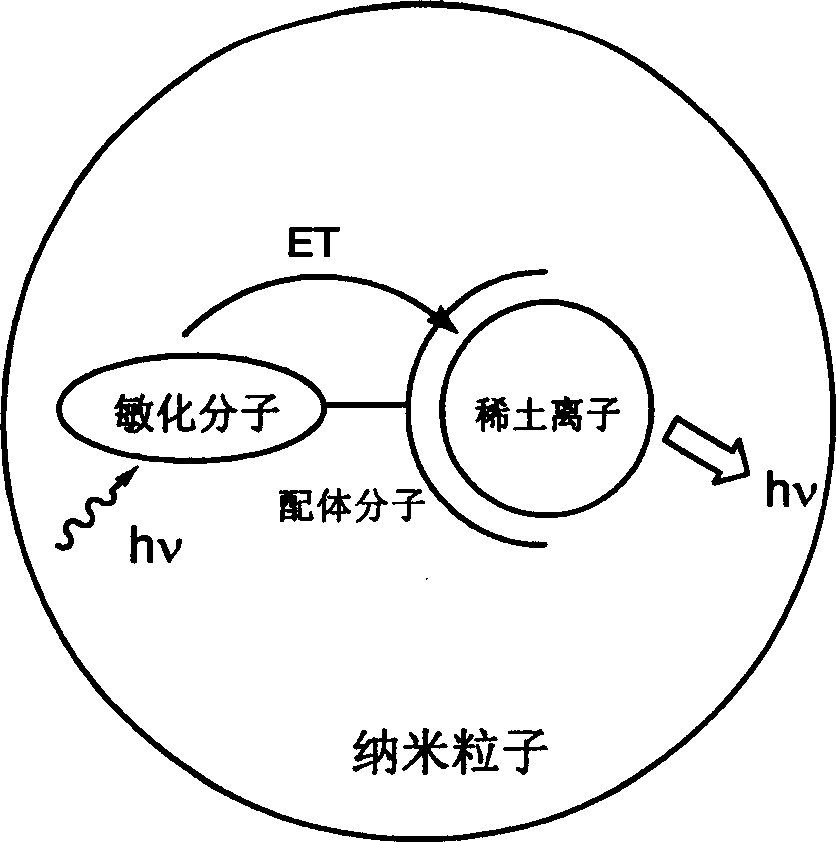

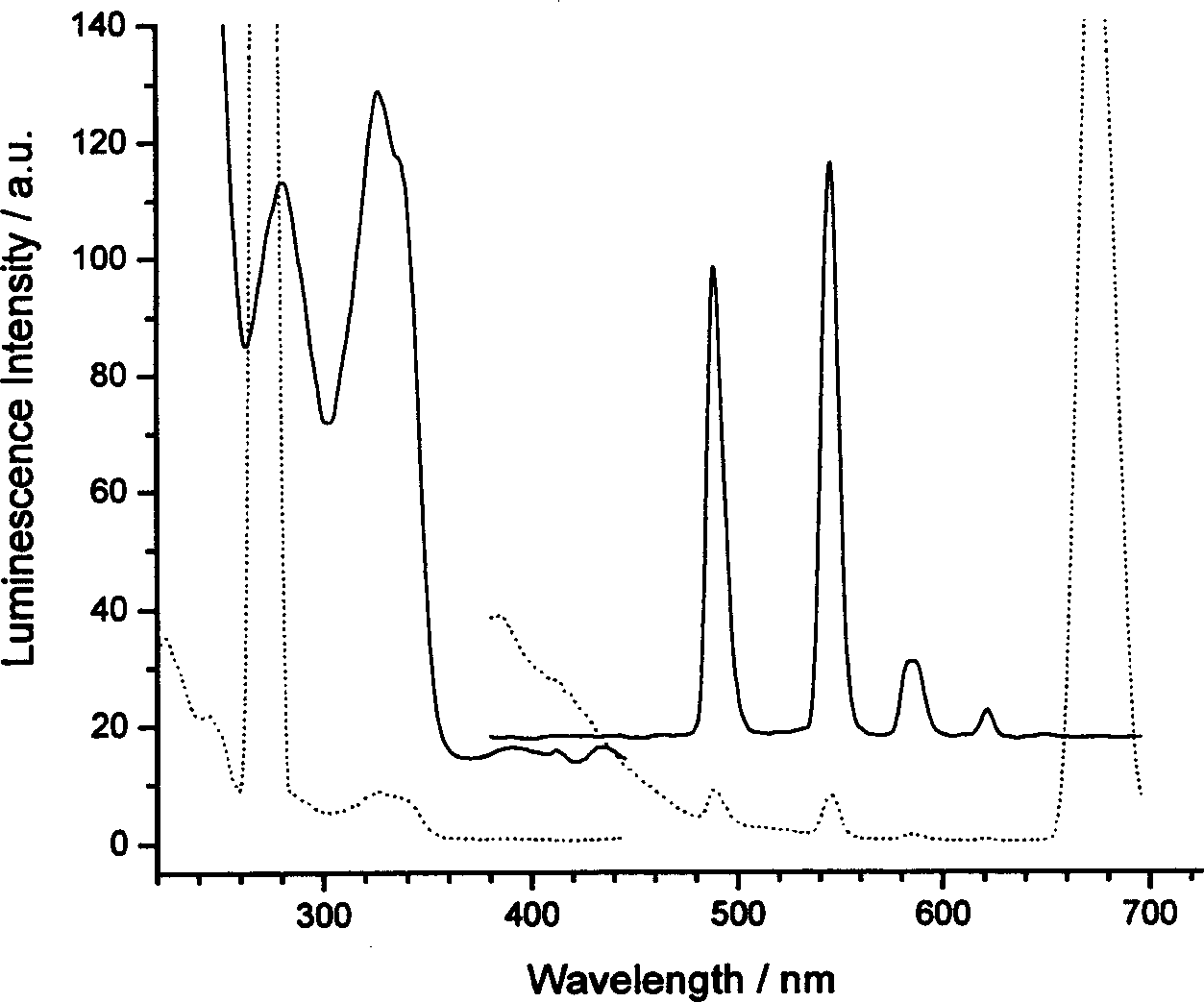
Examples
Embodiment 1
[0026] Embodiment 1: Preparation of 7-amino-4-methyl-2-quinolinone-DTPA-Tb nanoparticles modified by oligonucleotide probe:
[0027] The preparation of the ligand of the rare earth complex and the sensitizing molecule conjugate: dissolve equimolar amounts of 7-amino-4-methyl-2-quinolinone and diethyltriaminepentaacetic dianhydride in anhydrous In dimethylformamide (DMF), add an appropriate amount of anhydrous triethylamine to the DMF solution of diethyltriaminepentaacetic dianhydride and add 7-amino-4-methyl-2-quinolinone with dropwise stirring DMF solution, reacted for 2 hours under the condition of avoiding light and stirring.
[0028] Preparation of rare earth complexes; equimolar amounts of rare earth Tb 3+ Aqueous solution (Tb 3+ Nitrate or hydrochloride) was mixed with the above-mentioned conjugate solution for 10 minutes.
[0029] Preparation of rare earth nanoparticles: Mix cyclohexanone, n-hexanol, Triton X-100 (v / v, 4:1:1) and stir evenly, add an appropriate amoun...
Embodiment 2
[0031] Embodiment 2: Preparation of aminofluorescein-DTPA-Yb nanoparticles:
[0032] The preparation of the ligand of the rare earth complex and the sensitizing molecule conjugate: Dissolve equimolar amounts of aminofluorescein and diethyltriaminepentaacetic dianhydride in anhydrous dimethylformamide (DMF), Add an appropriate amount of anhydrous triethylamine to the DMF solution of diethyltriaminepentaacetic dianhydride, stir the DMF solution of aminofluorescein dropwise, and react for 2 hours under the condition of avoiding light and stirring.
[0033] Preparation of rare earth complexes: equimolar amounts of rare earth Yb 3+ Aqueous solution (Yb 3+ hydrochloride) was mixed with the above conjugate solution for 10 minutes.
[0034] Preparation of rare earth nanoparticles: Mix cyclohexanone, n-hexanol, Triton X-100 (v / v, 4:1:1) and stir evenly, add an appropriate amount of rare earth complex solution (water phase), and fully stir to form After the water microemulsion, add t...
Embodiment 3
[0035] Example 3: Preparation of 7-amino-4-methyl-2-quinolinone-TTHA-Eu nanoparticles:
[0036] The preparation of the ligand of the rare earth complex and the sensitizing molecule conjugate: dissolve a certain molar amount of triethylenetetraminehexaacetic acid (TTHA) in anhydrous dimethylformamide (DMF), and add a small amount of anhydrous Triethylamine was reacted for 12 hours under stirring conditions. The DMF solution of the isobutyl chloroformate of equimolar quantity is added in the above-mentioned mixed solution under being stirred dropwise, after reacting for 30 minutes, add the DMF solution of the 7-amino-4-methyl-2-quinolinone of equimolar quantity, React for 5 hours under the condition of avoiding light and stirring.
[0037] Preparation of rare earth complexes: equimolar amounts of rare earth Eu 3+ Aqueous solution (Eu 3+ hydrochloride) was mixed with the above conjugate solution for 10 minutes.
[0038] Preparation of rare earth nanoparticles: Mix cyclohexano...
PUM
 Login to View More
 Abstract
Description
Claims
Application Information
 Login to View More