[0003] Therefore, it is an object of the present invention to provide a complex flow-path heat exchanger having U-shaped tubes and cantilever combined coils, in order to achieve, in the type heat exchanger, a simple construction, a complex flow path of steam within the same one heat exchanger shell body, a high heat exchange efficiency, and a low
energy loss.
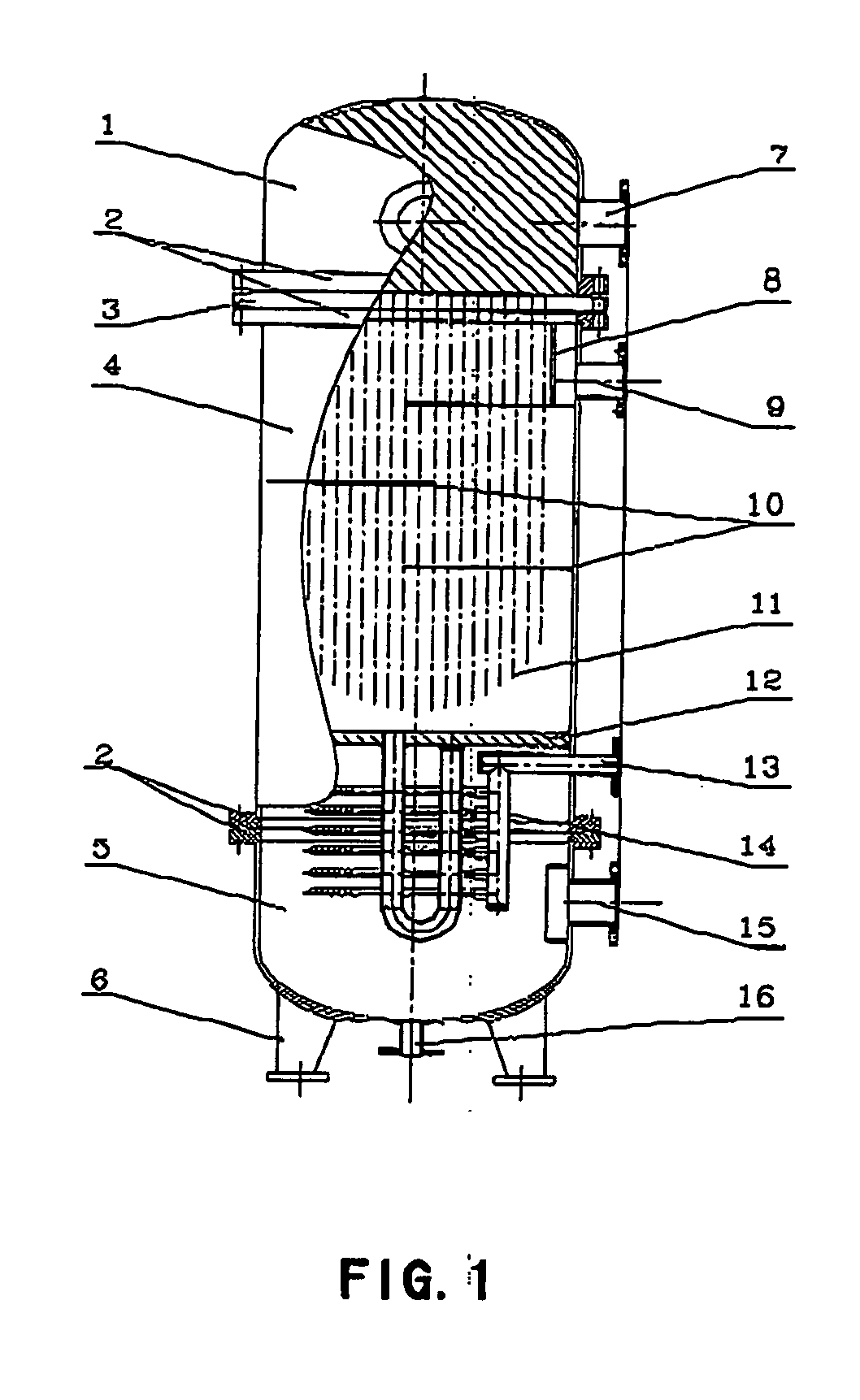
[0005] The technical
gist according to the present invention is as follows: after entering into the heat exchanger, steam is firstly cooled and condensed in the shell side of the U-shaped tube, thereafter entering into tube side of the cantilever combine coils, which are disposed within the same one shell, for a secondary heat exchange, and subsequently flowing out of the heat exchanger after being subcooled. Such steam-water heat exchanger having a complex flow path are advantageous in a small steam flow resistance of shell side of the U-shaped tube; a higher condensate
water flow velocity in the cantilever combined coils; a high heat
exchange coefficient; good coordination of the temperature fields of the hot and cold fluids in the heat exchanger; and a high heat exchange efficiency.
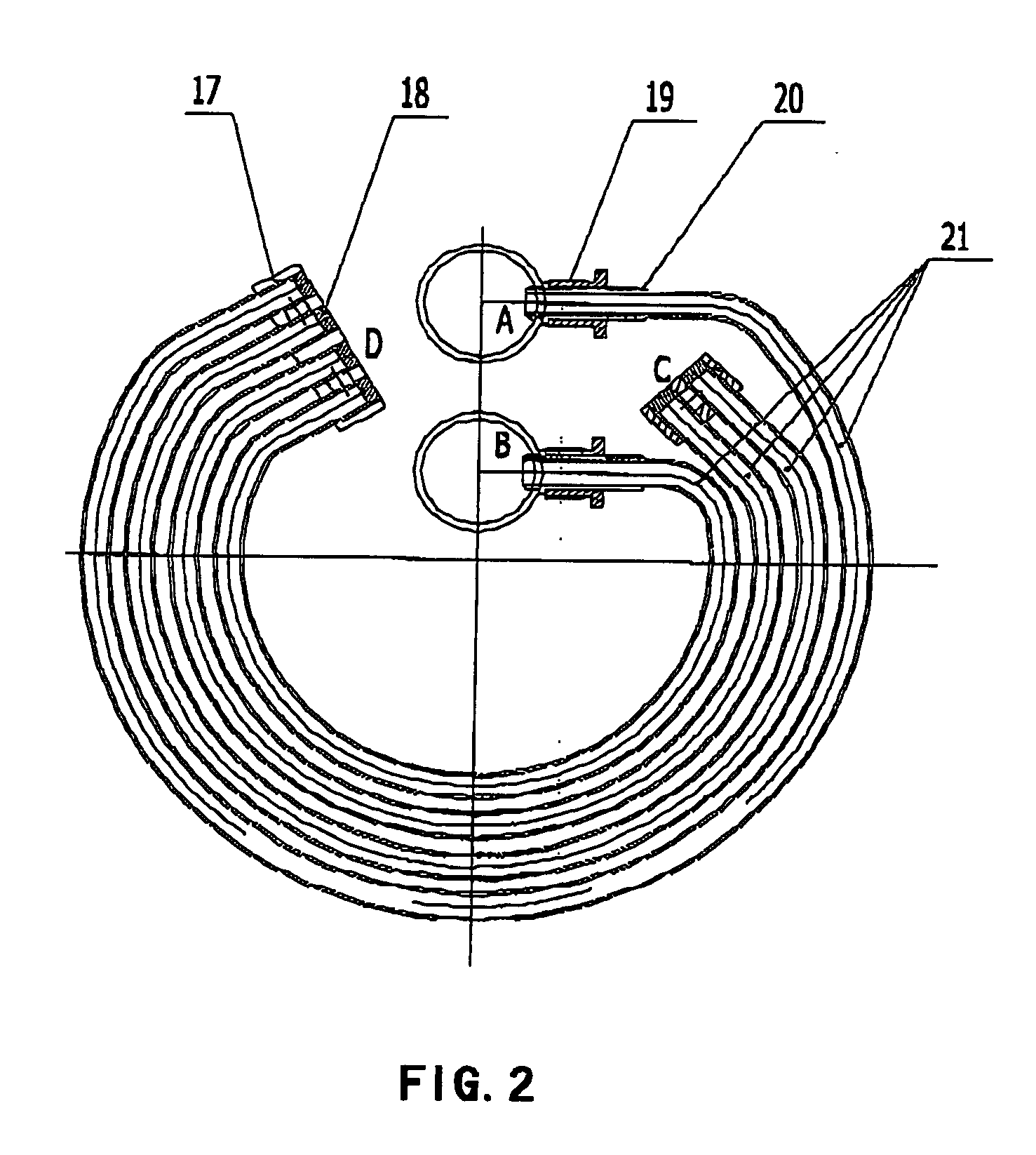
[0006] The cantilever combined coil has a fixed end, an absolutely free end, and a relatively free end. The element exhibits more spring characteristics with respect to vibration, enabling the continuously pulsating
water flow to excite vibration more easily; moreover, the complex structure thereof performs an inhibiting effect during the vibration so that any change of any small force can prevent the
continuation of the existing frequency vibration, while the main flow disturbance rapidly makes vibration to go on. Thus, the
low frequency vibration within a given rang is thereby generated, making disturbance to the water flow, but no damage will be incurred due to strong vibration, and therefore a higher
heat transfer coefficient can be achieved at low flow velocity. The characteristics of the structure of the cantilever combined coil in response to fluid induction vibration have the
resonance characteristic when the flow pulsating frequency is equal to the structural
natural frequency and the sub-
resonance characteristics when the flow pulsate at ½
natural frequency. Consequently, the cantilever combined coil can be induced to vibrate by a lower frequency pulsating, and this vibration is in the sub-
resonance region, so that no damage will be incurred due to violent vibration.
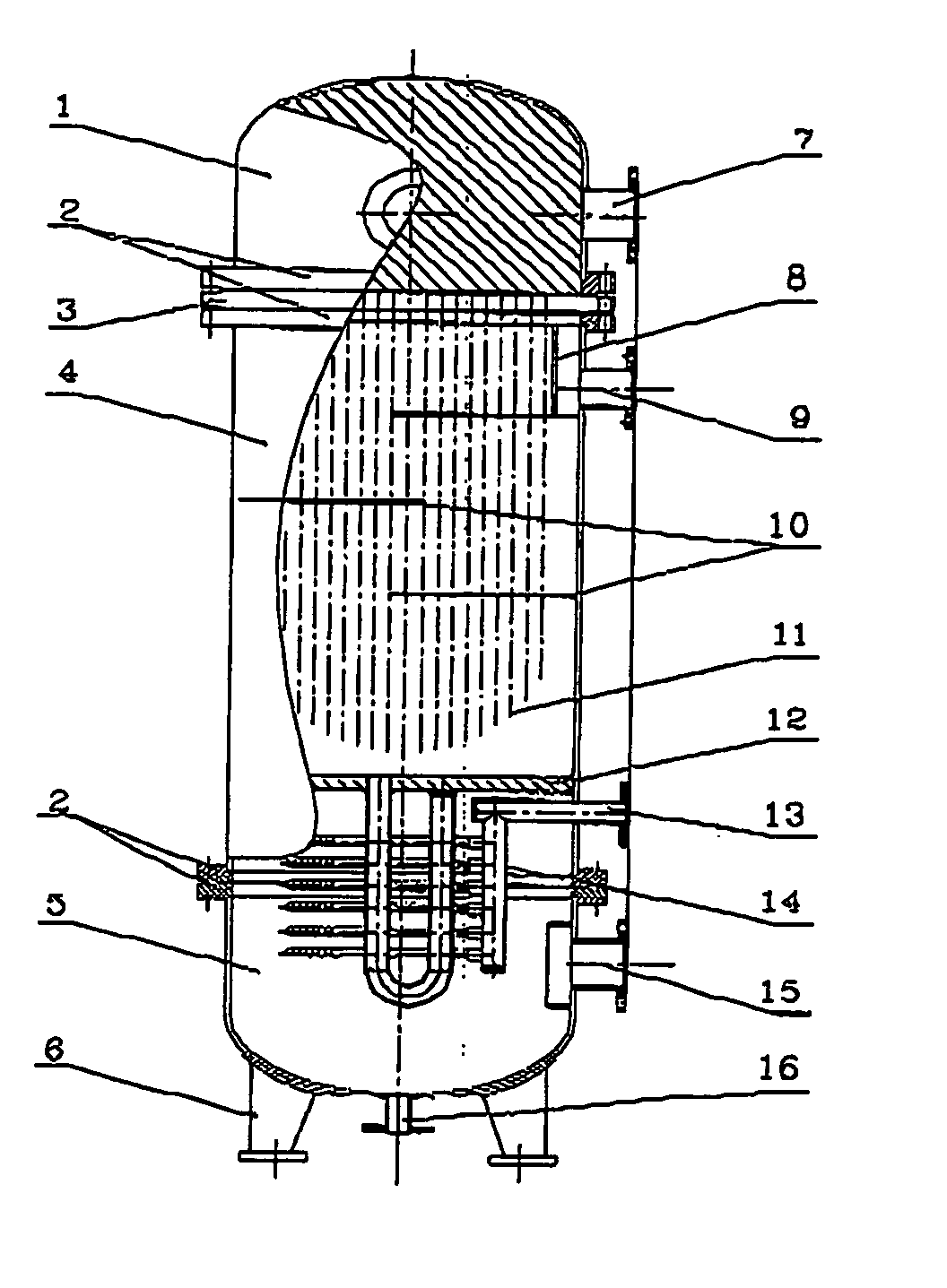
[0007] The present heat exchanger comprises the vertical type and the horizontal type. The arrangement of the cantilever combined coils according to the present invention in the present heat exchanger differs from that of the conventional tubular type heat exchange elements, thereby completely eliminating the need of the tube-plate
coupling structural fashion, and instead directly connecting the cantilever combined coils in a plurality of groups onto the hot media tube in parallel. The structural form of the cantilever combined coils sets the heat exchange elements free out of the conventional tube-plate structure, so that the spatial arrangement of the heat exchanger is made more flexible, and the steam-water and water-water complex heat exchange within the same one shell can be realized; under the inducement of the pulsating flow, the
energy distribution over the cantilever combined coils at respective
natural frequency has a significant influence on the operating condition of the cantilever combined coil bundles. Upon experiments, the bending
radius, and the
diameter and the wall thickness of the circular tube of the cantilever combined coils can be screened out to determine the specific dimension of the different models, so that such constructed inducing vibration
system as above makes the variation of the
water velocity not to have a significant influence on the vibration, consequently, the cantilever combined coils can be adapted to the variation of different loads, while maintaining good vibration characteristics. The
thermal efficiency of the present heat exchanger is more than 98%, and the maximum heat exchange capacity is 7 MW, and on the other hand, the heat source is generally saturated steam at the pressure 0.6 Mpa. The present heat exchanger can maintain the production output quite well, even when the
steam pressure reduces to 0.1 MPa. The advantages of the present heat exchanger include the small size, the simple construction, a
high energy utilization rate, etc., therefore, the present heat exchanger can be a new generation product relative to the currently-used conventional low-temperature, low-pressure and
corrosion-free heat exchangers.


 Login to View More
  Login to View More