Flame retardant and uv absorptive polymethylmethacrylate nanocomposites
- Summary
- Abstract
- Description
- Claims
- Application Information
AI Technical Summary
Problems solved by technology
Method used
Image

Examples
example 1
[0045] In this example, a material of the present invention was made by mixing 81.8 wt % of polymethylmethacrylate from Aldrich Chemical Company, (lot # 10815ES, avg. molecular weight˜120,000) in a twin screw Brabender extractor with 18.2 wt % Montmorillonite Cloisite 6A (Clay lot # 20000626XA-001 from Southern Clay Products, Inc.) at a temperature of 433-443° K. with a shear rate of 20 RPM for 1 minute, then at 100 RPM for 10 minutes. The material was then subjected to various testing procedures that included Cone Calorimetry, TEM, UTVIIS absorption, FT-IR and SAXS.
example 2
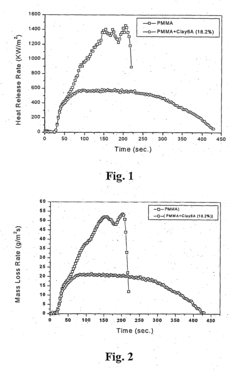
[0046] The Cone Calorimetry test was conducted at an incident heat flux of 50 kW / m2 in National Institute of Standards and Technology for the material formed in Example 1. The results are tabulated in Table 1 and plotted in FIGS. 1 and 2. FIG. 1 shows that the heat release rate (HRR) is far lower and more gradual in the PMMA / clay nanocomposite. This trend is also apparent in the mass loss rate (MLR) shown in FIG. 2.
TABLE 1Cone Calorimetry Test Data For Pure PMMA andPMMA-Clay NanocompositesPeak HeatAverageReleaseAverage HeatAverage SpecificMassRateRelease RateExtinction AreaLoss Rate(kW / m2)(kW / m2)(m2 / Kg)(g / s · m2)PMMA1456.79975.5159.1343.932PMMA / Clay586.32435.24317.5919.351Nano-composites
[0047] The data in Table 1 shows that the peak and average values of the BRR are reduced in the PMMA clay nanocomposite by a factor of 2.5 and 2.2 respectively. The average specific extinction area of the nanocomposite relative to PMMA is increased by a factor of 2.0 while the average MLR is reduce...
example 3
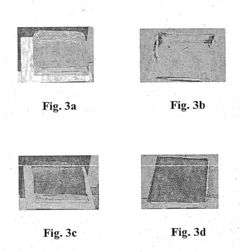
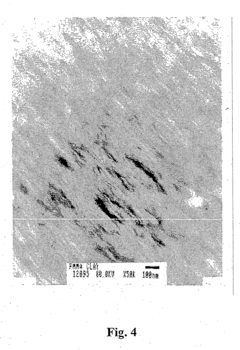
[0048] The compositions in Example 1 were formed into molded materials and cross-sections were sliced on a Reichert Microtome with a diamond knife. Transmission Electron Microscopy (TEM) images of the cross-sections are shown in FIGS. 4 and 5. From these figures, the degree to which the process exfoliates the clay can be estimated. Examination of the figures shows that: 70 percent of the clay platelets observed are fully exfoliated and aligned normal to the direction of the molding force, 15 percent are tactoids with two layers, 12 percent have three layers, and 2 percent have more than 3 layers. When two or more layers are produced, the interlayer spacing is 4.43 nm as compared to the interlayer spacing of pure Cloisite 6A of 3.50 mL The increased spacing is in agreement with X-ray diffraction data and indicates that the process also produced partial intercalation.
PUM
| Property | Measurement | Unit |
|---|---|---|
| Percent by mass | aaaaa | aaaaa |
| Percent by mass | aaaaa | aaaaa |
| Percent by mass | aaaaa | aaaaa |
Abstract
Description
Claims
Application Information
 Login to View More