[0011] As noted hereinabove, electrical feedthroughs beneficially provide electrical communication between internal operative circuitry to electrical components external to an IMD. However, as the number of discrete conductive feedthrough pins and the size of feedthrough arrays has increased while the available surface area has decreased previously acceptable dimensional
instability of the array has been discovered to cause loss of hermeticity and thus, reduce IMD manufacturing yields.
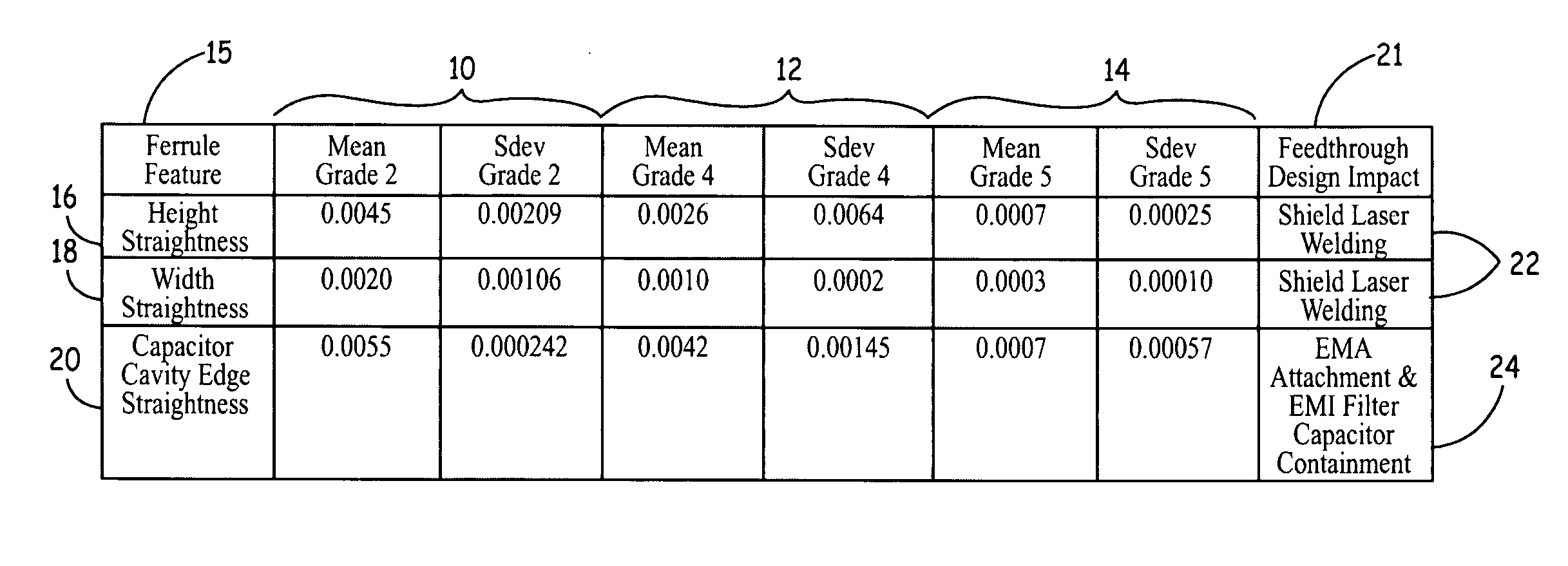
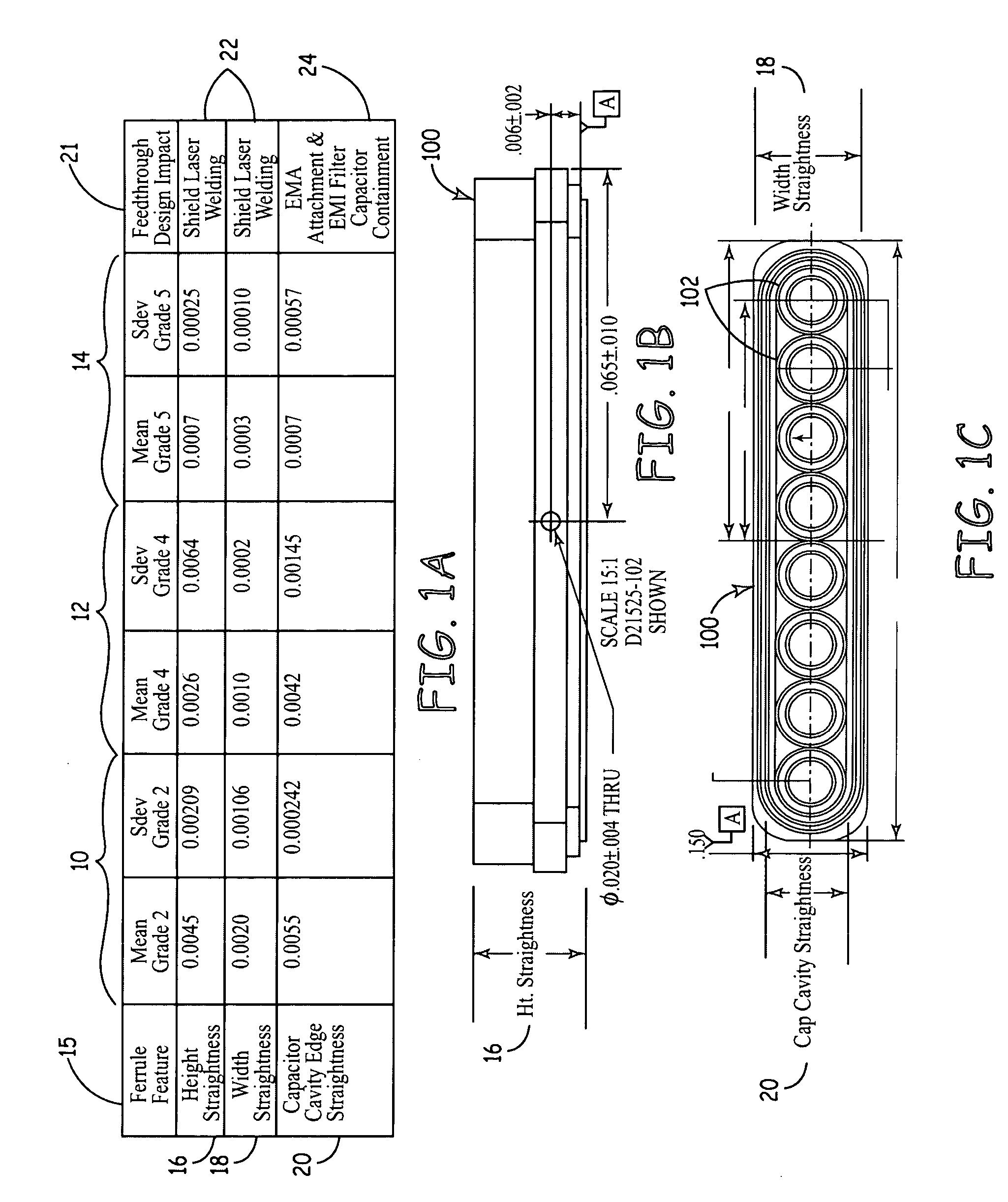
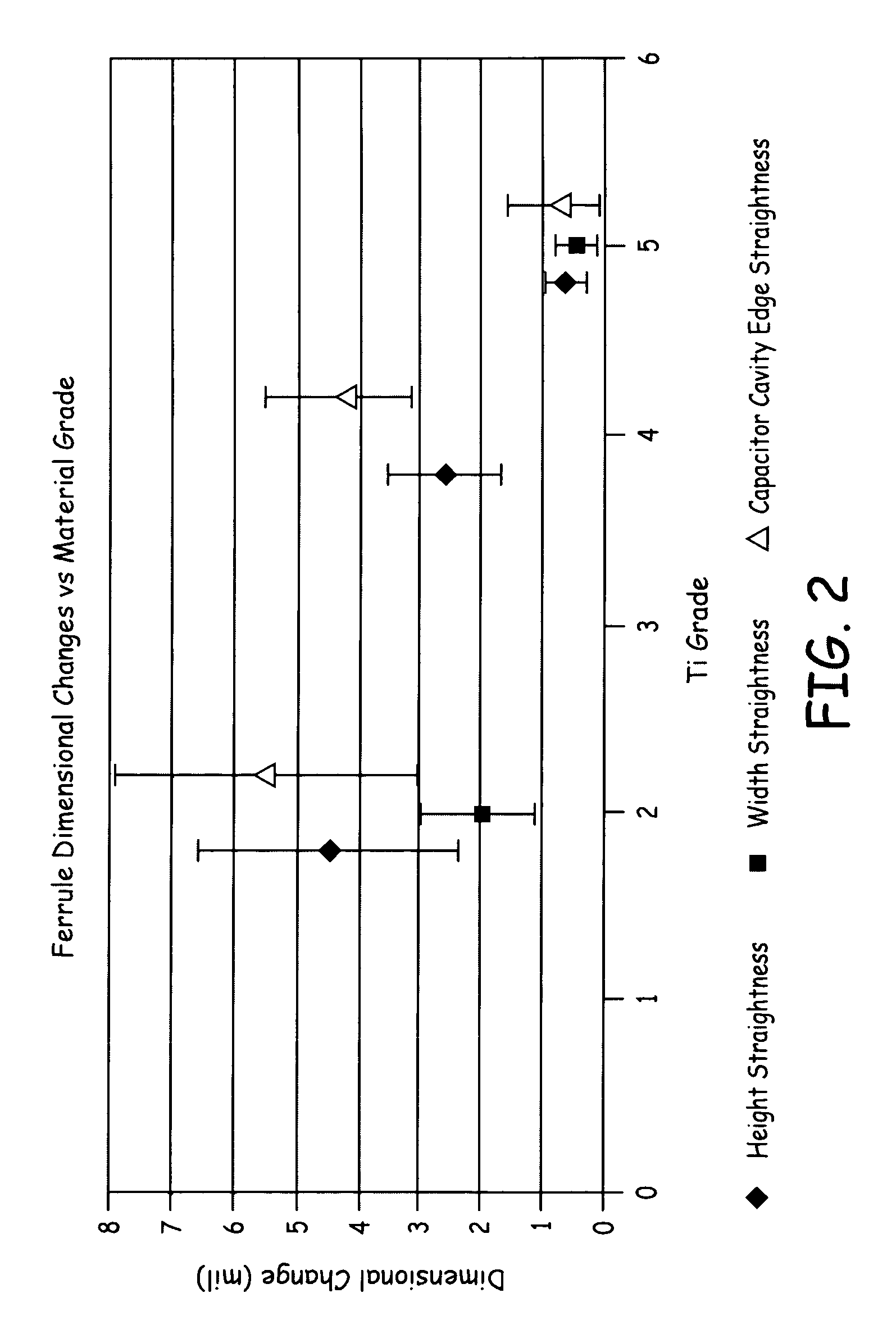
[0012] According to one aspect of the invention, an improved multi-polar feedthrough array employs a particular metallic ferrule material for improved dimensional stability during initial fabrication and sustained hermetic operation. According to the invention, the IMD enclosure consists of grade 2 titanium and the ferrule material comprises grade 4 titanium or grade 5 titanium.
[0014] According to another aspect of the invention, the improved multi-polar feedthrough array incorporates additional pins, thus further increasing the
footprint of the array, and the additional pins provide analog and / or digital electrical communication between operative circuitry inside an IMD and analog and / or digital components external to the IMD. Capacitors attached to a feedthrough (either surface or internally mounted) are generally well known for filtering stray
electromagnetic interference (EMI) signals that are randomly impinging upon the external electrical components and IMD enclosure so the EMI cannot affect internal circuitry of the IMD. However, such capacitive filter feedthrough arrays would also filter or modify desirable analog electrical signals such as those emanating from chronically implanted sensors disposed on, about or spaced from an IMD. Such signals include near- and long-range radio-frequency (RF) communication signals and physiologic sensor signals (e.g., signals related to venous or arterial pressure, temperature, acceleration, flow,
body fluid pH, glucose, metabolites and the like).
[0015] According to this aspect of the invention, in part to reduce the number of hermetically-sealed sites, one or more conductive feedthrough pins are added to a multi-polar feedthrough array to accommodate such sensor signals and / or
RF communication signals, and the like. However, the RF signals and sensor signals require very low
signal noise, therefore the
capacitor structure most be eliminated or modified to minimize stray
capacitance which would degrade such analog and / or digital signals. Grouping the feedthrough pins according to this form of the invention results in getting a larger number of signals through the enclosure substrate in a smaller area, which in turn makes it easier to build the feedthrough and incorporate the feedthrough into the enclosure. Thus, the family of multi-polar feedthrough arrays provided pursuant to the present invention provides RF antenna and / or sensor capability in a reduced volume
package. According to the invention, any capacitors (either surface- or internally-mounted) previously attached to an analog and / or digital
telemetry-antenna circuit or analog and / or digital sensor for filtering stray EMI signals is removed or eliminated. Alternatively, one or more feedthrough pins are added to the multi-polar feedthrough array void of any filtering circuitry. Thus, since the RF antennas and sensor signals require very low
signal noise, the
capacitor structure must be modified to minimize stray
capacitance, which would degrade the signals.
[0016] The incorporation of additional functionality (i.e. antenna and sensing capability) to the feedthrough ultimately saves device volume, thereby reducing overall device volume. The invention also provides a FT with variable EMI filtering based upon the FT wire need(s) (i.e. for RF antenna performance, low
capacitance and
stray inductance are required). In one aspect of this embodiment, one or more spacer members mechanically supports the unfiltered feedthrough pin(s). In another aspect, the unfiltered feedthrough pin(s) are spaced from the capacitive elements to avoid fringing fields and so-called
edge effects of the capacitive elements.


 Login to View More
  Login to View More