[0009] The
advantage of the invention is that a pipeline can be monitored for slow blockage or accumulation solely using the means already available with
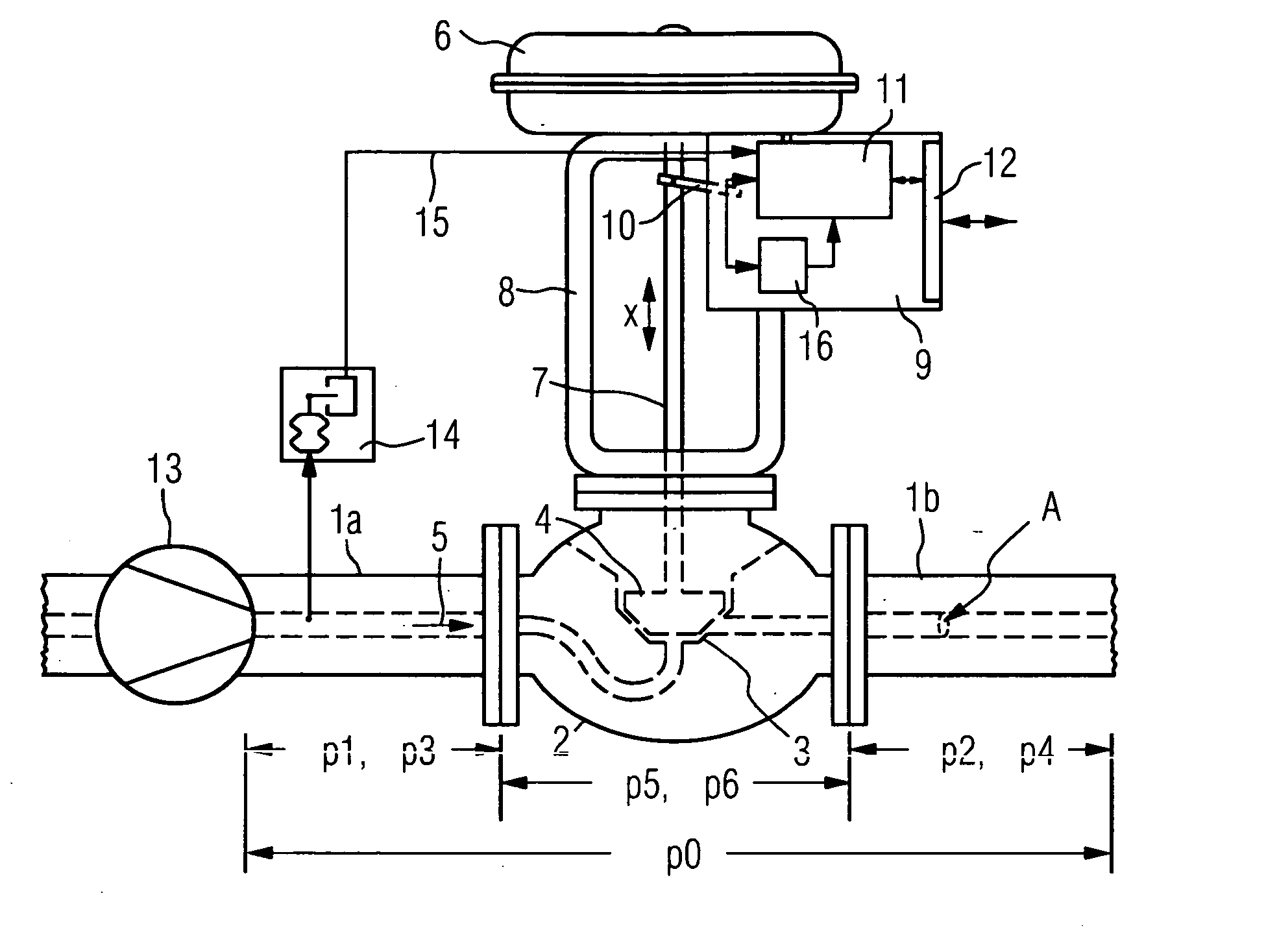
control valves. Only the evaluation unit for the position value of the valve which is recorded by a position generator, which can be viewed as a component of the position
regulator, has to be adapted in order to execute the method. Since such evaluation units are usually implemented by a
processing unit with suitable
software, this merely requires
adaptation of the evaluation program to be processed by the
processing unit in any event. The monitoring function can be easily deactivated if the requirements for monitoring are not available or not available at the time. Especially for an application of a control valve for checking for constant media flow through a pipeline an essentially constant throughflow of the medium for a major part of the
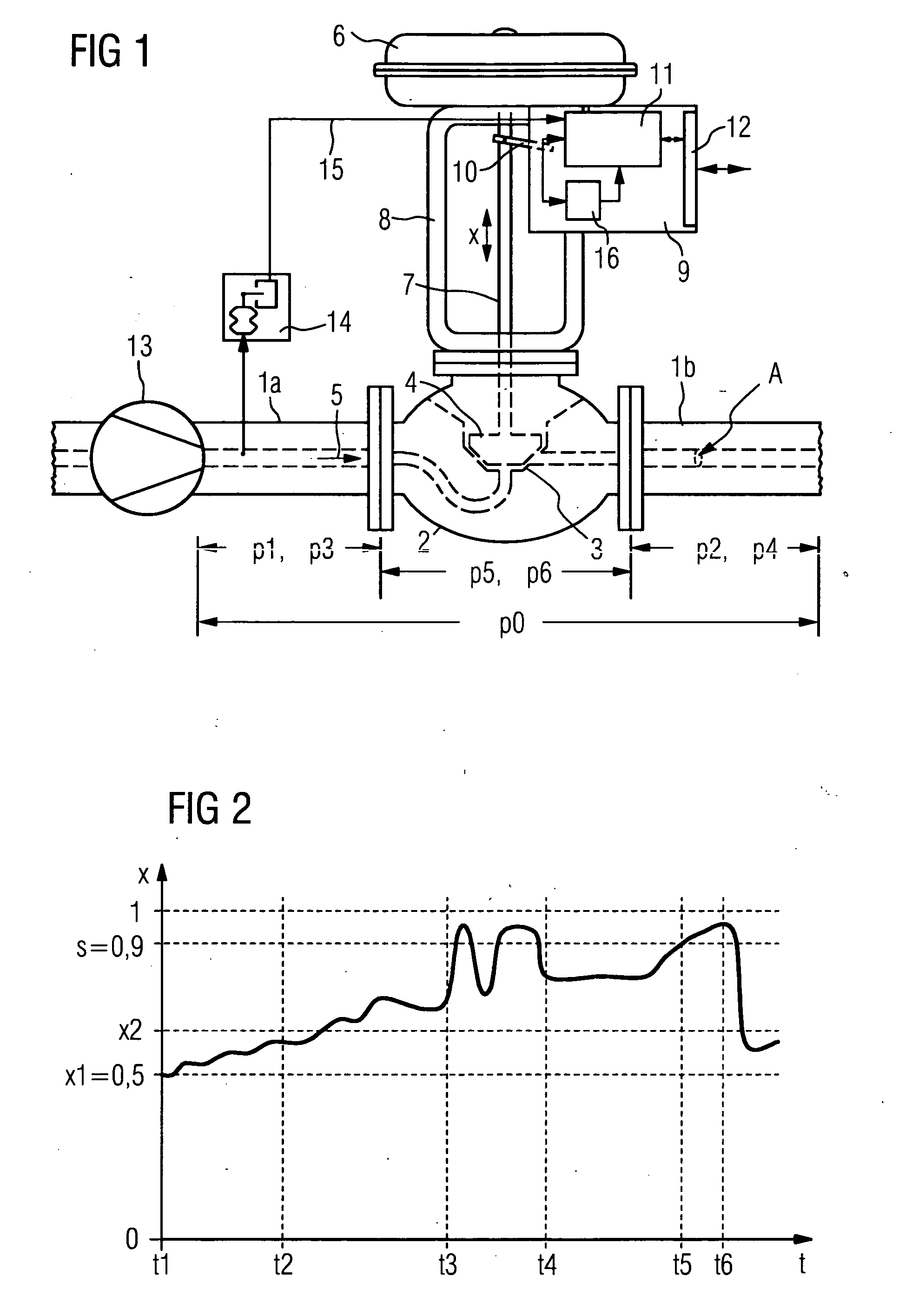
operating time is required. By observing and evaluating the change of the lift position of the control valve over time a slow reduction of the free internal cross section of the pipeline is detected. If with an essentially constant throughflow of a medium the valve has to be opened further than a specifiable threshold, a
signal to indicate the fact that the threshold has been exceeded is output. On the basis of this display
signal suitable countermeasures can be taken at an early stage. For example the signal can be interpreted as an alerting signal for maintenance required, so that the pipeline can be cleaned or changed when maintenance is next performed on the process
system. Operational faults or production outages can thus be avoided.
[0010] Preferably the first position of the control valve at the beginning of the operation of the process system, when the pipeline is still free of deposits, can be determined and stored. On regulation for constant throughflow this produces a degree of opening of the valve which can differ depending on the design of the
plant.
[0011] Advantageously the method can be adapted to the relevant application by specifying the threshold value depending on the first position. The threshold value is set here in the range between full opening of the valve and the first position. The optimum position is again dependent on the relevant application, especially of the speed of depositing and the time intervals between the maintenance cycles. It has proved advantageous and suitable for many applications to output a display signal for a threshold value being exceeded, if the setting range remaining beyond the first setting to the opening of the valve is 80% used. This means that the signal is displayed at a point at which there is still a sufficiently safe interval before the onset of regulation problems, that is before regulation to a constant throughflow is no longer possible because the deposits in the pipeline are too large.
[0012] Since a long-term monotonously progressing deposit process is accompanied by a corresponding long-term monotonous shift in the position of the control valve,
short duration peaks in the shift, which can be caused by pressure variations for example, can be suppressed by a lowpass filter, especially by forming a floating average, as regards their effect on the result of the diagnosis. This avoids a premature triggering of the pipeline monitoring and a premature output of a display signal for such fluctuations. Naturally other options can be applied for checking the plausibility of the relationship between the
valve opening and material being deposited in the pipeline.
[0013] In addition or as an alternative to direct threshold comparison the change over time in the position of the control valve can be determined and the point in time estimated at which the position of the control valve is likely to exceed the specifiable threshold value. This has the
advantage of allowing maintenance to be better planned, since not only the current blockage state of the pipeline, but also the speed of the reduction of the free internal cross section is taken into account.
[0014] To avoid a display signal being output prematurely for a threshold being exceeded It can be advantageous to determine the pressure of the medium in the pipeline and, if a permitted average value of the pressure is exceeded to interrupt the monitoring of the pipeline for blockage. The media pressure in the pipeline can for example be checked with a simple
pressure switch at a
feed point beyond a pump. Usually there are pressure
converters in any event
in process control systems, preferably at the ends of pipelines, for which the measured value can easily be included in the evaluation.


 Login to View More
  Login to View More