Check patentability & draft patents in minutes with Patsnap Eureka AI!

Detection and identification of saxiphilins using saxitoxin-biotin conjugates

Inactive Publication Date: 2006-03-16
CLEVELAND BIOSENSORS PYT LTD
View PDF2 Cites 15 Cited by
  • Summary
  • Abstract
  • Description
  • Claims
  • Application Information

AI Technical Summary

Benefits of technology

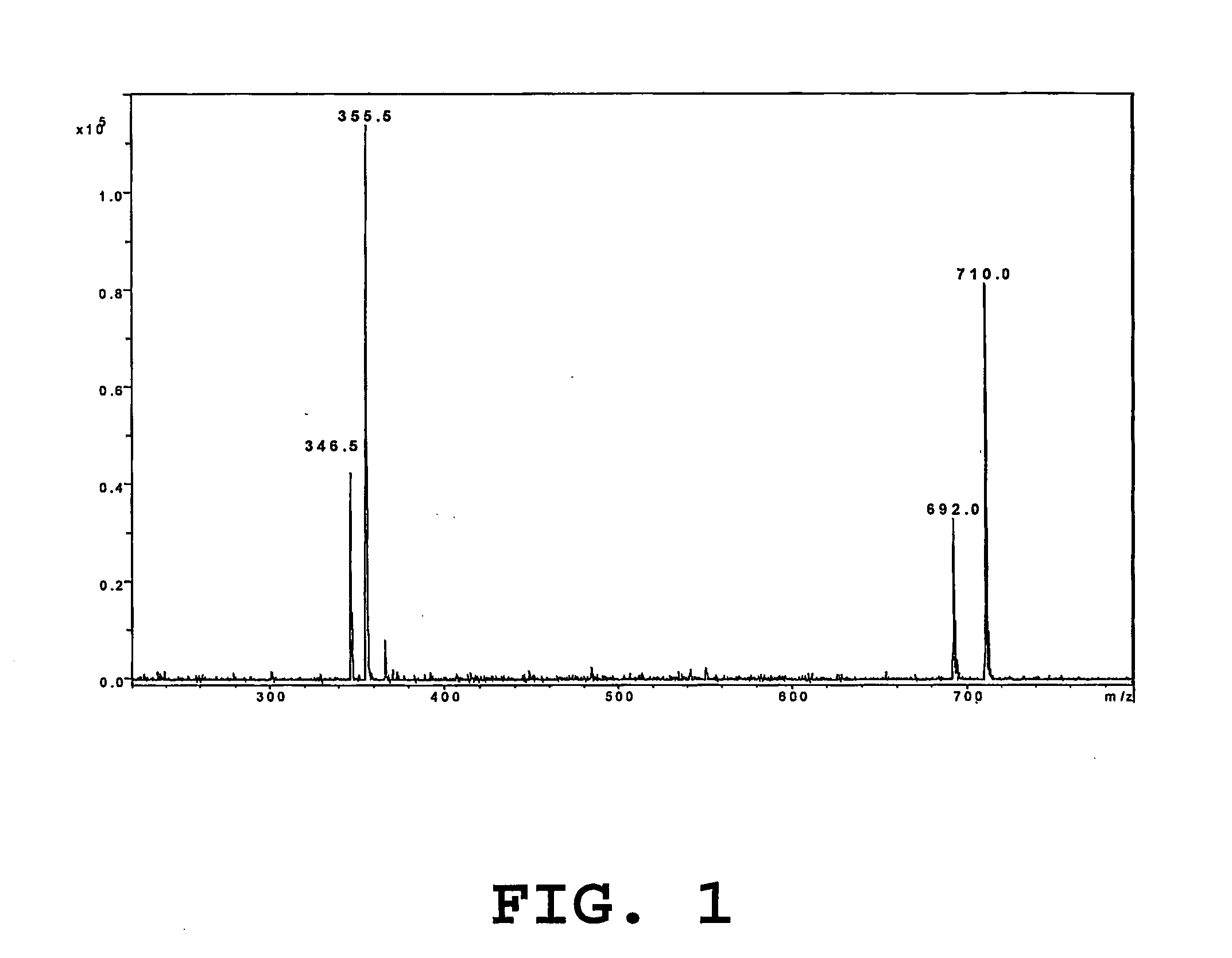
[0052]FIG. 1 is a mass spectrum of the saxitoxin conjugate Biotin-link11-STX prepared in Example 1.
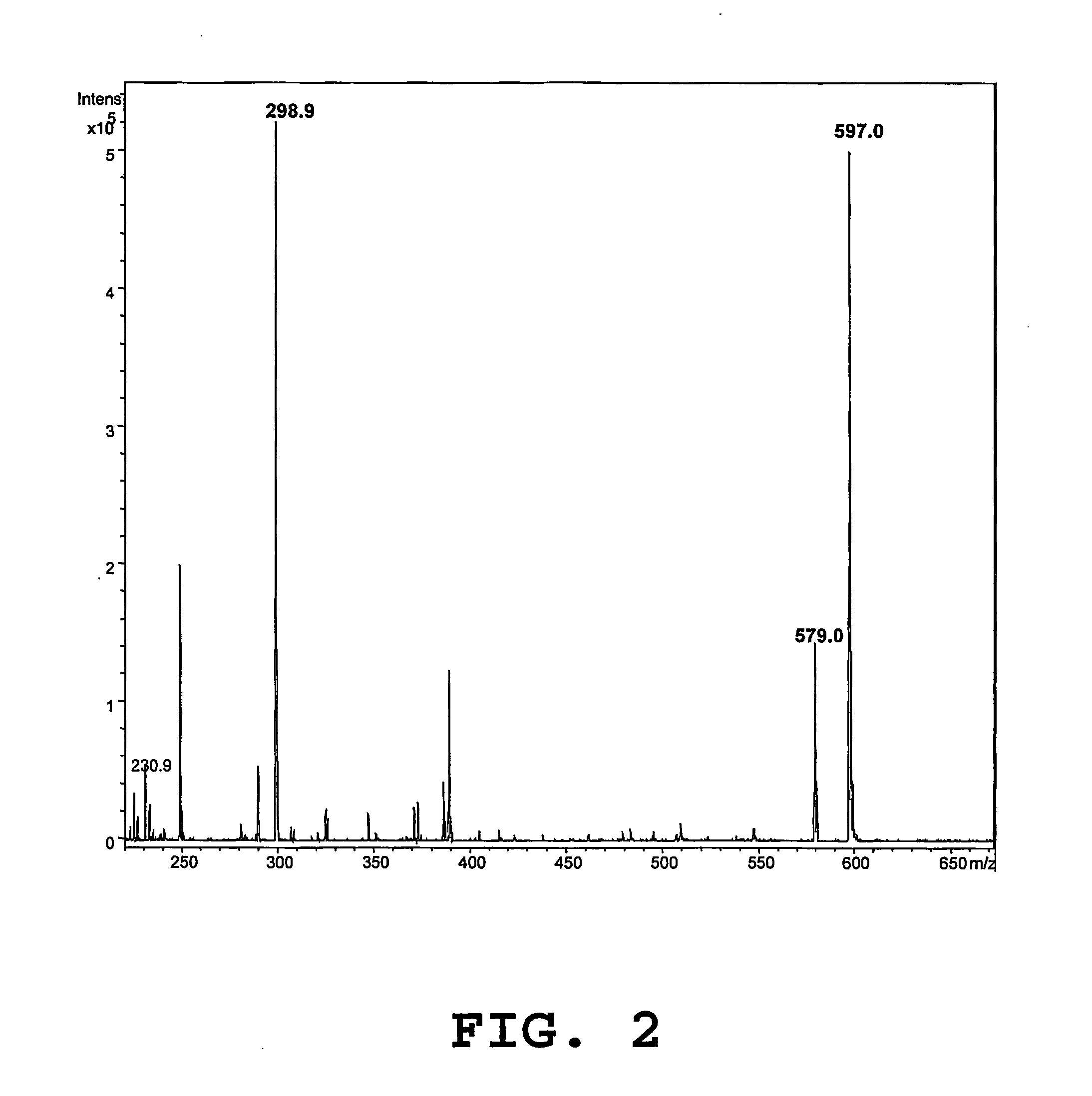
[0053]FIG. 2 is a mass spectrum of the saxitoxin conjugate Biotin-link4-STX prepared in Example 2.

Problems solved by technology

Paralytic shellfish poisoning caused by ingestion of fish, crustaceans or molluscs containing toxins derived from dinoflagellates is a world-wide problem resulting in severe human illness, which often results in death.
In addition, blooms of toxic freshwater algae can contaminate water supplies with the same neurotoxins that cause paralytic shellfish poisoning.
This toxin-contaminated water can have dire consequences for humans, livestock and wildlife.
The toxicity of the PSTs is a result of their binding to voltage-dependent sodium channels, which blocks the influx of sodium ions, and thus blocks neuromuscular transmission.
This causes respiratory paralysis, for which no treatment is available.
It is not possible to detect by gross examination whether an individual marine animal contains the toxin, and therefore there is a risk that humans will inadvertently consume toxin-containing animals.
However, the saxiphilins have proven to be a difficult group of compounds to isolate and purify and, to date, only bullfrog saxiphilin is well characterised.

Method used

the structure of the environmentally friendly knitted fabric provided by the present invention; figure 2 Flow chart of the yarn wrapping machine for environmentally friendly knitted fabrics and storage devices; image 3 Is the parameter map of the yarn covering machine
View more

Image

Smart Image Click on the blue labels to locate them in the text.
Viewing Examples
Smart Image
  • Detection and identification of saxiphilins using saxitoxin-biotin conjugates
  • Detection and identification of saxiphilins using saxitoxin-biotin conjugates
  • Detection and identification of saxiphilins using saxitoxin-biotin conjugates

Examples

Experimental program
Comparison scheme
Effect test

example 1

Synthesis of Biotin-link11-STX and Synthesis of Biotin-Link 4-STX

[0057] Saxitoxin isolated from shellfish was converted to decarbamoyl-saxitoxin (dcSTX) by hydrolysis in HCl 6M in a sealed, evacuated glass tube at 110° C. for 4 hours. The solution was freeze dried. The residue was redissolved in 0.05M acetic acid and the solution passed through a C18 solid phase extraction cartridge. dcSTX was purified by Biogel-P2 chromatography and freeze-dried.

[0058] dcSTX was then redissolved in sodium phosphate buffer 0.1M pH 6.8 and converted to dcSTX-hemisuccinate by reaction with two successive additions of Succinic anhydride (ratio dcSTX:succinic anhydride 1:20) for 2 hours at 10° C. while maintaining the temperature at 10° C. and the pH at 5.7±0.1. dcSTX hemisuccinate was then separated from dcSTX and purified by anion exchange chromatography using sodium phosphate buffer 0.01 M as eluting solvent, and by Carbograph graphitized carbon solid phase extraction using ultrapure water as elut...

example 2

Synthesis of Biotin-link18-STX

[0061] Saxitoxin isolated from shellfish was converted to decarbamoyl-saxitoxin(dcSTX) by hydrolysis in HCl 6M in a sealed, evacuated glass tube at 110° C. for 4 hours. The solution was freeze dried. The residue was redissolved in 0.05 M acetic acid and the solution passed through a C18 solid phase extraction cartridge. dcSTX was purified by Biogel-P2 chromatography and freeze-dried. The residue was redissolved in anhydrous DMF and reacted overnight at room temperature with excess PMPI (N-(p-Maleimidophenyl) isocyanate) to produce PMPI-STX. PMPI-STX was purified by reversed-phase HPLC-MS. NHS-LC-Biotin was reacted with cysteamine in 10 mM sodium phosphate buffer pH 7.7 at room temperature for 3 min. The final product, a sulfhydryl derivative of Biotin was purified by C18 solid phase extraction and freeze-dried overnight. PMPI-STX was redissolved in 10 mM sodium phosphate buffer pH 6.8 and reacted with an excess of sulfhydryl biotin for 15 min at room ...

example 3

Preparation of Avidin.Biotin-link4-STX, Streptavidin.Biotin-link4-STX, Avidin.Biotin-link11-STX and Streptavidin.Biotin-link11-STX Complexes

[0062] Streptavidin.Biotin-link4-STX and Streptavidin.Biotin-link11-STX: 324.8 pmol of Biotin-link4-STX and 90.4 pmol Biotin-link11-STX were mixed each with 30 μg Immunopure Streptavidin in 10 mM phosphate buffer (pH 6.5) and incubated for 2 hours at +4° C. 400 μL 0.1% formic acid were added and the solution filtered down to 30 μL using 5,000 cut-off microdialysis centrifuge tubes. The same step was repeated once. Then 200 μL 0.1% formic acid were added and the solution filtered down to 30 μL again. The final volumes were adjusted to 65 μL for Biotin-link4-STX (final concentration of 5 μM) and to 90 μL for Biotin-link11-STX (final concentration of 1 μM) with water.

[0063] Avidin.Biotin-link4-STX and Avidin.Biotin-link11-STX: 324.8 pmol of Biotin-link4-STX and 90.4 pmol Biotin-link11-STX were mixed each with 50 μg Immunopure Avidin in 10 mM pho...

the structure of the environmentally friendly knitted fabric provided by the present invention; figure 2 Flow chart of the yarn wrapping machine for environmentally friendly knitted fabrics and storage devices; image 3 Is the parameter map of the yarn covering machine
Login to View More

PUM

No PUM Login to View More

Abstract

A method for capturing a saxiphilin to allow for detection, characterisation, isolation an / or purification of said saxiphilin or its ligand, comprising: (1) providing a PST conjugate comprising a PST moiety bound via a linker through a site other than the binding site for saxiphilin directly or indirectly to a biotin moiety; (2) exposing the PST conjugate to a sample putatively containing said saxiphilin to create a reaction mixture and to (strept)avidin; and (3) allowing binding through the PST moiety to the saxiphilin and through the biotin moiety to (strept)avidin to form a captured PST complex.

Description

TECHNICAL FIELD [0001] The present invention is concerned with a paralytic shellfish toxin conjugate. In particular, it is concerned with use of the paralytic shellfish toxin conjugate in the detection, characterisation, isolation and / or purification of molecules of interest, particularly the saxiphilins and their ligands, although its use is not so-limited. BACKGROUND ART [0002] The so-called “saxiphilins” are a diverse class of polypeptides characterised through their ability to bind saxitoxin, one of the paralytic shellfish toxins (or PSTs). The term “saxiphilin” is a coined term including the prefix “saxi” from saxitoxin and the suffix “philic” which denotes a likening for saxitoxin. The saxiphilins do not share any particular chemical structure or physiological function, nor would it seem that the physiological purpose of the saxiphilins is necessarily to bind saxitoxin. For example, so-called “bullfrog saxiphilin” is a molecule which shares over 50% amino acid sequence identit...

Claims

the structure of the environmentally friendly knitted fabric provided by the present invention; figure 2 Flow chart of the yarn wrapping machine for environmentally friendly knitted fabrics and storage devices; image 3 Is the parameter map of the yarn covering machine
Login to View More

Application Information

Patent Timeline
no application Login to View More
IPC IPC(8): G01N33/53C07D487/20G01N33/543
CPCC07D487/20G01N2333/8139G01N33/54306
Inventor ROBILLOT, CEDIC EMILE FRANCOIS
Owner CLEVELAND BIOSENSORS PYT LTD
Features
  • R&D
  • Intellectual Property
  • Life Sciences
  • Materials
  • Tech Scout
Why Patsnap Eureka
  • Unparalleled Data Quality
  • Higher Quality Content
  • 60% Fewer Hallucinations
Social media
Patsnap Eureka Blog
Learn More