
Use of arachidonic acid for normalization of infradian rhythm
a technology of arachidonic acid and infradian rhythm, which is applied in the direction of cardiovascular disorders, drug compositions, metabolic disorders, etc., can solve the problems of affecting the development of the body, and reducing judgment and concentration, so as to promote the action of the circadian rhythm
- Summary
- Abstract
- Description
- Claims
- Application Information
AI Technical Summary
Benefits of technology
Problems solved by technology
Method used
Image

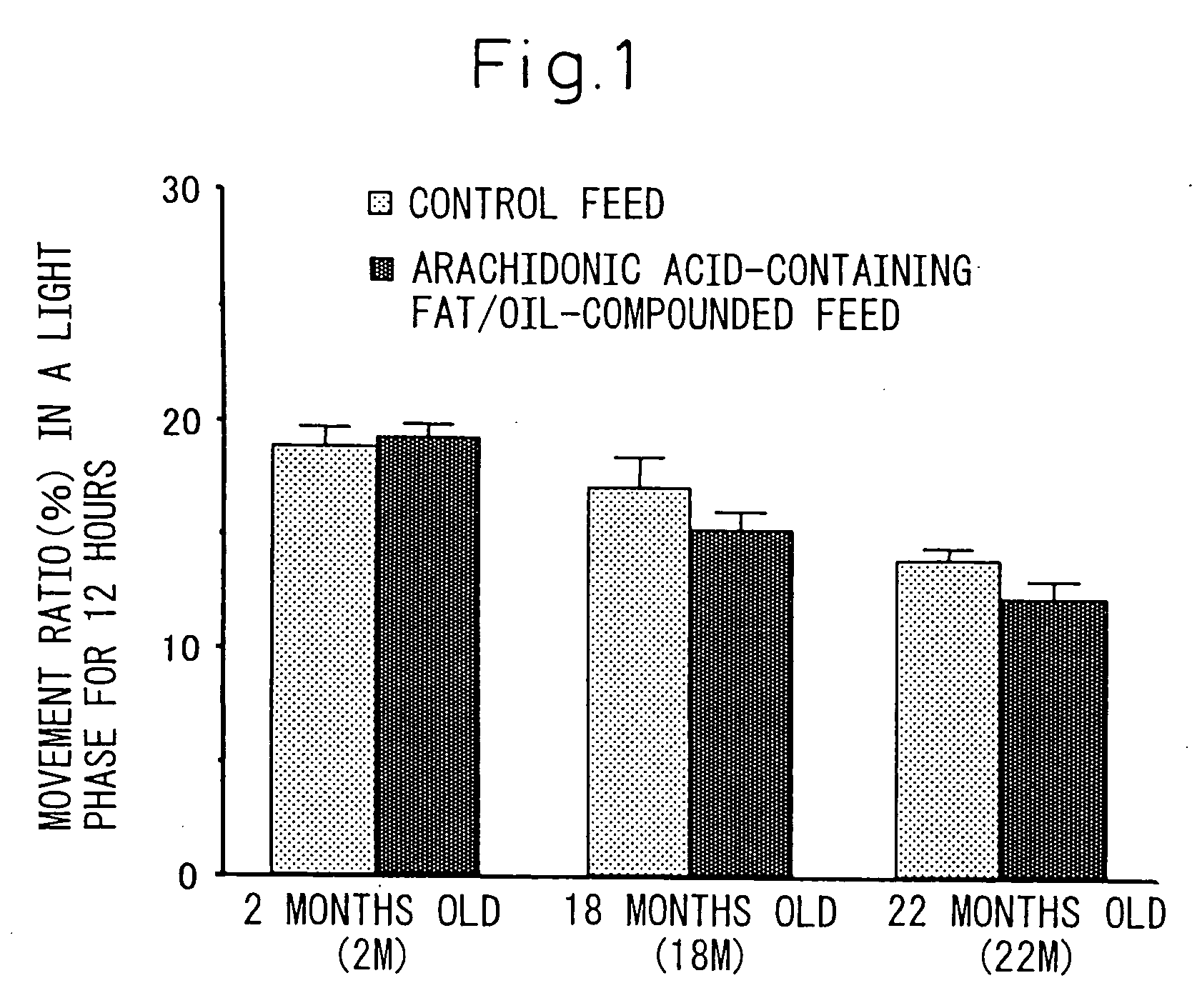
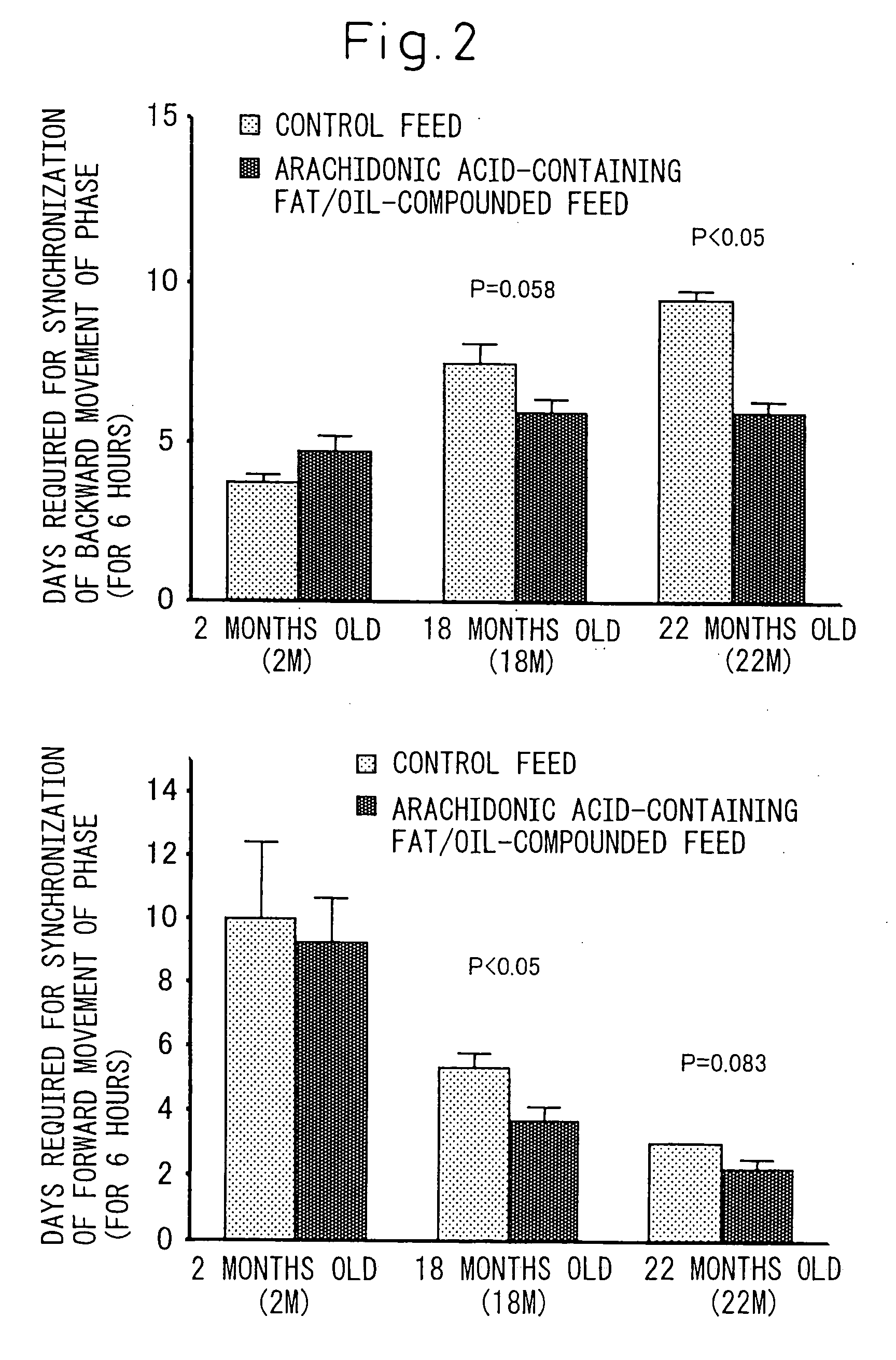
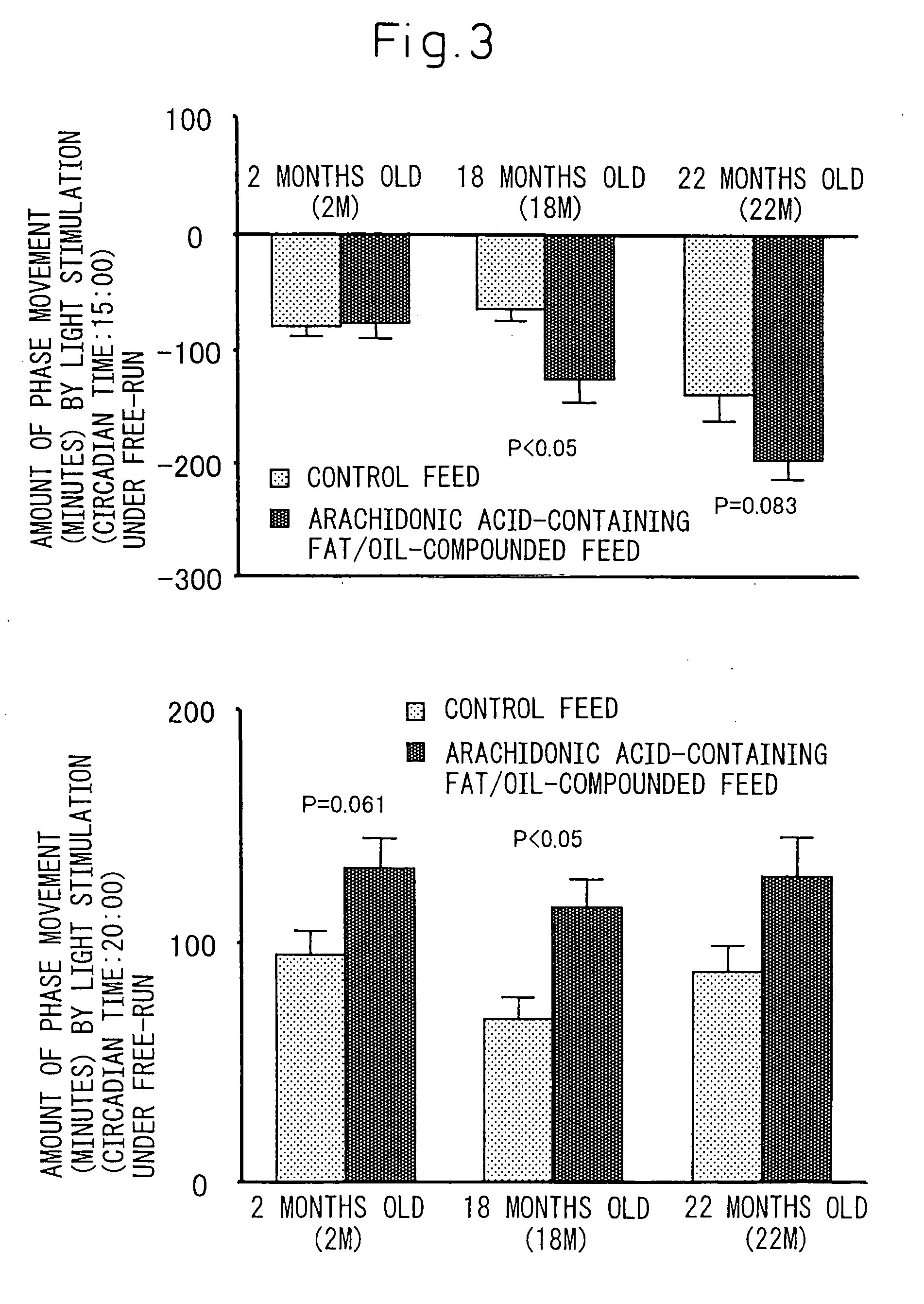
Examples
example 1
Process for the Production of Triglyceride Comprising Arachidonic Acid as a Constituting Fatty Acid
[0077]Mortierella alpine was used as an arachidonic acid-producing microorganism. A medium (6 kL) containing 1.8% of glucose, 3.1% of defatted soybean powder, 0.1% of soybean oil, 0.3% of KH2PO4, 0.1% of Na2SO41 0.05% of CaCl2.2H2O and 0.05% of MgCl2.6H2O was prepared in a 10-kL fermentor and the initial pH was adjusted to 6.0. The pre-cultured solution (30 L) was inoculated and subjected to an aeration culture with stirring for 8 days under the condition where temperature was 26° C., aeration was 360 m3 / hour and inner pressure was 200 kPa. The agitation rate was adjusted so as to keep the dissolved oxygen concentration 10 to 15 ppm. With regard to glucose concentration, the concentration within a medium was made within a range of 1 to 2.5% until the fourth day by means of flowing-down method and, after that, it was kept at 0.5 to 1% (% hereinabove means weight (w / v) %).
[0078] After ...
example 2
Production of Triglyceride Containing not Less than 5% of Triglyceride (8A8) Where Medium-Chain Fatty Acid is Bonded to 1,3-Positions and Arachidonic Acid is Bonded to 2-Position
[0080] An ion-exchange resin carrier (Dowex Marathon WBA; Dow Chemical; Trade Mark) (100 g) was suspended in 80 ml of a 12.5% aqueous solution of Rhizopus delemar lipase (Talipase Powder; Tanabe Seiyaku) and dried in vacuo to give an immobilized lipase.
[0081] After that, a reaction was carried out using 80 g of the triglyceride (TGA 40S) containing 40% by weight of arachidonic acid prepared in Example 1, 160 g of caprylic acid, 12 g of the above immobilized lipase and 4.8 ml water at 30° C. for 48 hours with stirring (130 rpm). After completion of the reaction, the reaction solution was removed to give an activated immobilized lipase.
[0082] Then the immobilized lipase (Rhizopus delemar lipase; carrier: Dowex Marathon WBA, trade mark) (10 g) was filled in a glass column (1.8×12.5 cm; volume: 31.8 ml) equip...
example 3
Synchronization Promoting Action to Phase Change of Light-and-Dark Cycle of Arachidonic Acid-Containing Fat / Oil
[0084] Influence of the triglyceride (arachidonic acid-containing fat / oil) where arachidonic acid is a constituting fatty acid prepared in Example 1 on phase change of light-and-dark cycle was investigated in rats.
[0085] Rats have a habit that they mostly rest (sleep) in a light period while they are active in a dark period. Therefore, the light-and-dark cycle was changed to an extent of 6 hours before and after that whereby influence to synchronization was checked by means of days until synchronization to new light-and-dark cycle was achieved. Incidentally, to evaluate the synchronization, the infradian rhythm of rats was investigated by measuring the amount of daily movements continuously, and examining changes over time in the amounts of movements in the lights period and the dark period.
[0086] Measurement of infradian quantity of motion of rats was carried out in suc...
PUM
| Property | Measurement | Unit |
|---|---|---|
| Temperature | aaaaa | aaaaa |
| Temperature | aaaaa | aaaaa |
| temperature | aaaaa | aaaaa |
Abstract
Description
Claims
Application Information
 Login to View More