
System and method for selective memory module power management
a memory module and power management technology, applied in the field of computer memory systems, can solve the problems of the number of idle states to be observed to maintain memory module power consumption, and achieve the effects of reducing power states, limiting memory module usage, and reducing responsiveness of memory modules
- Summary
- Abstract
- Description
- Claims
- Application Information
AI Technical Summary
Benefits of technology
Problems solved by technology
Method used
Image

Examples
Embodiment Construction
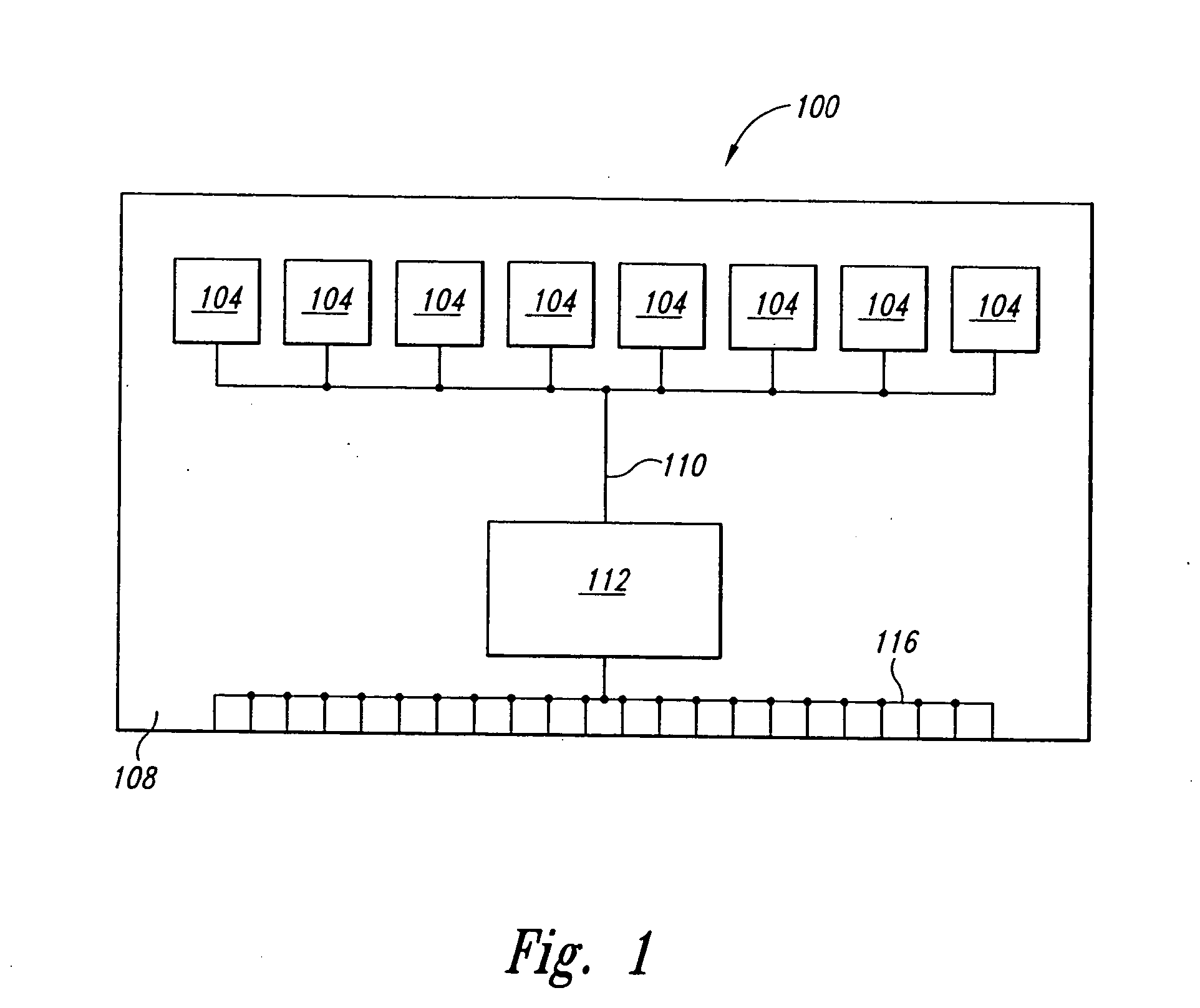
[0022]FIG. 3 shows a memory module 300 equipped with activity monitoring and power saving capabilities employing a first embodiment of the present invention. The memory module 300 comprises a plurality of memory devices 104 mounted on a substrate 108 through which the DRAM devices 104 are operably coupled to a memory hub 312 through communications lines 110 such as conductive traces or other similar signal carrying devices. The memory module shown in FIG. 3 comprises most of the same components used in the memory module shown in FIG. 1 thus, in the interest of brevity, these components have been provided with the same reference numerals, and an explanation of their functions and operations will not be repeated.
[0023] The memory module 300 shown in FIG. 3 comprises three additional devices not included in the conventional memory module of FIG. 1. The memory module 300 includes an activity monitor 350, a power management controller 360, and a temperature sensor 370, the last being co...
PUM
 Login to View More
 Abstract
Description
Claims
Application Information
 Login to View More