Potential crimping composite fiber and method for production thereof, and fiber aggregate, and nonwoven fabric

a composite fiber and composite fiber technology, applied in the direction of synthetic resin layered products, melt spinning methods, transportation and packaging, etc., can solve the problems of poor cardability upon nonwoven production, fiber may not reach the state in which the fibers are fully crimped, etc., to facilitate the development of crimps, high dry heat shrinkage percentage, and soft feeling

a composite fiber and composite fiber technology, applied in the direction of synthetic resin layered products, melt spinning methods, transportation and packaging, etc., can solve the problems of poor cardability upon nonwoven production, fiber may not reach the state in which the fibers are fully crimped, etc., to facilitate the development of crimps, high dry heat shrinkage percentage, and soft feeling

US20070014987A1Active Publication Date: 2007-01-18DAIWABO HOLDINGS CO LTD

Image

Smart Image Click on the blue labels to locate them in the text.
Viewing Examples
Smart Image
  • Potential crimping composite fiber and method for production thereof, and fiber aggregate, and nonwoven fabric
  • Potential crimping composite fiber and method for production thereof, and fiber aggregate, and nonwoven fabric

Examples

Experimental program
Comparison scheme
Effect test

example

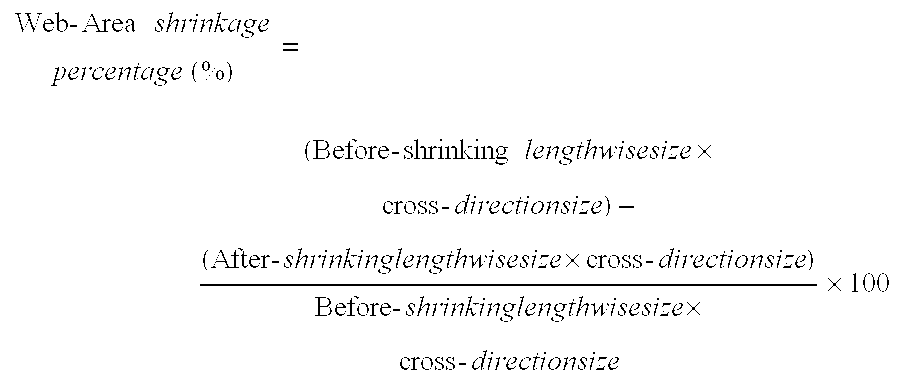
[0057] Hereinafter, the present invention is specifically described by examples. In the following examples, the melting point T1 of a first component employed and the melting point T2 of a second component employed, the after-spinning melting point Tf1 of the first component, the single fiber strength and rupture elongation, the number of crimp, the percentage of crimp, the single fiber dry heat shrinkage percentage, the area shrinkage percentage of a nonwoven, uniformity and processability of the nonwoven were determined as described below.

[0058] [Determination of T1 and T2]

[0059] A differential scanning calorimeter (manufactured by Seiko Instruments Inc.) was employed. A sample amount was 5.0 mg. The sample was maintained at 200° C. for 5 minutes, and cooled to 40° C. at a temperature falling speed of 10° C. / min and then melted at a temperature rising speed of 10° C. / min so that a curve for heat of fusion was obtained for each of the first component and the second component. From...

the structure of the environmentally friendly knitted fabric provided by the present invention; figure 2 Flow chart of the yarn wrapping machine for environmentally friendly knitted fabrics and storage devices; image 3 Is the parameter map of the yarn covering machine
Login to View More

PUM

PropertyMeasurementUnit
tensionaaaaaaaaaa
temperatureaaaaaaaaaa
shrinkage percentageaaaaaaaaaa
Login to View More

Abstract

A latently crimpable conjugate fiber is constructed using a first component containing an ethylene-α-olefin copolymer polymerized with a metallocene catalyst and a second component formed from a thermal plastic polymer having a melting point T2 higher than a melting point T1 of the first component, such that the first component is exposed with an exposed length of at least 20% relative to a peripheral length of the fiber, and which fiber has a single fiber dry heat shrinkage percentage of at least 50%, which is determined according to JIS-L-1015 (dry heat shrinkage percentage) at 100° C. under an initial tension of 0.018 mN / dtex (2 mg / d) for 15 minutes and a single fiber dry heat shrinkage percentage of at least 15%, which is determined under the same condition under an initial tension of 0.450 mN / dtex (50 mg / dtex) for 15 minutes. The latently crimpable conjugate fiber develops crimps and has thermal adhesiveness at a low temperature.

Description

TECHNICAL FIELD [0001] The present invention relates to a latently crimpable conjugate fiber which is excellent in shrinkability and crimp developing during thermal process and has a good thermal adhesiveness. Further, the present invention relates to a fiber assembly with excellent shrinkability and stretchability wherein the latently crimpable conjugate fibers are employed. BACKGROUND ART [0002] Various latently crimpable conjugate fibers used for producing a stretch nonwoven have been proposed. For example, Japanese Patent Kokai (Laid-Open) Publication No. 2-191720(A) (Patent Literature 1) proposes a conjugate fiber wherein polypropylene having a Q value of less than 5 and a melt flow rate of from 15 g / 10 min to 200 g / 10 min is a first component and ethylene-propylene having a melting temperature of from 133° C. to 145° C. is a second component and these components are disposed in a side-by-side structure, or an eccentric sheath-core structure in which the first component is a co...

Claims

the structure of the environmentally friendly knitted fabric provided by the present invention; figure 2 Flow chart of the yarn wrapping machine for environmentally friendly knitted fabrics and storage devices; image 3 Is the parameter map of the yarn covering machine
Login to View More

Application Information

Patent Timeline
18 Jan 2007
Publication
US20070014987A1
IPC
D02G3/00; D01F8/06; D04H1/544
CPC
D01F8/06; D04H1/54; Y10T428/2933; Y10T428/2929; Y10T428/2967; Y10T428/2931; D01D5/34; D04H1/4391
Inventors
USUI, YOSHIJI; KAWAKAMI, SHIGEKI