Unlock instant, AI-driven research and patent intelligence for your innovation.

Method for image processing and image processing apparatus

a technology of image processing and image processing apparatus, applied in the field of image processing, can solve the problems of reduced color development density, difficult to form and erase images using thermal heads, and insufficient light, so as to achieve effective suppression of image erasing

Inactive Publication Date: 2007-02-15
RICOH KK
View PDF9 Cites 47 Cited by
  • Summary
  • Abstract
  • Description
  • Claims
  • Application Information

AI Technical Summary

Benefits of technology

[0027] It is an object of the present invention to provide a method for image processing capable of repetitive forming and erasing of high-contrast images on thermoreversible recording media at high speeds by forming high-density, uniform images and uniformly erasing images in a short period of time, in which degradation of the thermoreversible recording media caused by repetitive forming and erasing is suppressed, and an image processing apparatus suitably used for the method for image processing.
[0031] In the image erasing step of the method for image processing, a laser beam is irradiated in a way so that the distance between the irradiation position of the laser beam and the first image erasing area and the irradiation position of the laser beam and the second image erasing area is 1 / 12 to ¼ of the irradiation spot diameter of the laser beam for erasing the image located in the first image erasing area and the second image erasing area which are adjacent to each other in the thermoreversible recording medium. As a result, images formed on the thermoreversible recording medium are erased uniformly in a short period of time.
[0033] In the image forming step of the method for image processing, the laser beam is irradiated to the second image forming area so as to be overlapped with part of the first image forming area after the organic low-molecular material found in the first image forming area is melted prior to crystallization. As a result, the image formed in the first image forming area is not erased in the overlapped area (boundary portion) of the laser beam irradiation area in the first image forming area and the laser beam irradiation area in the second image forming area, and high-contrast, uniform and appropriate images are obtained.
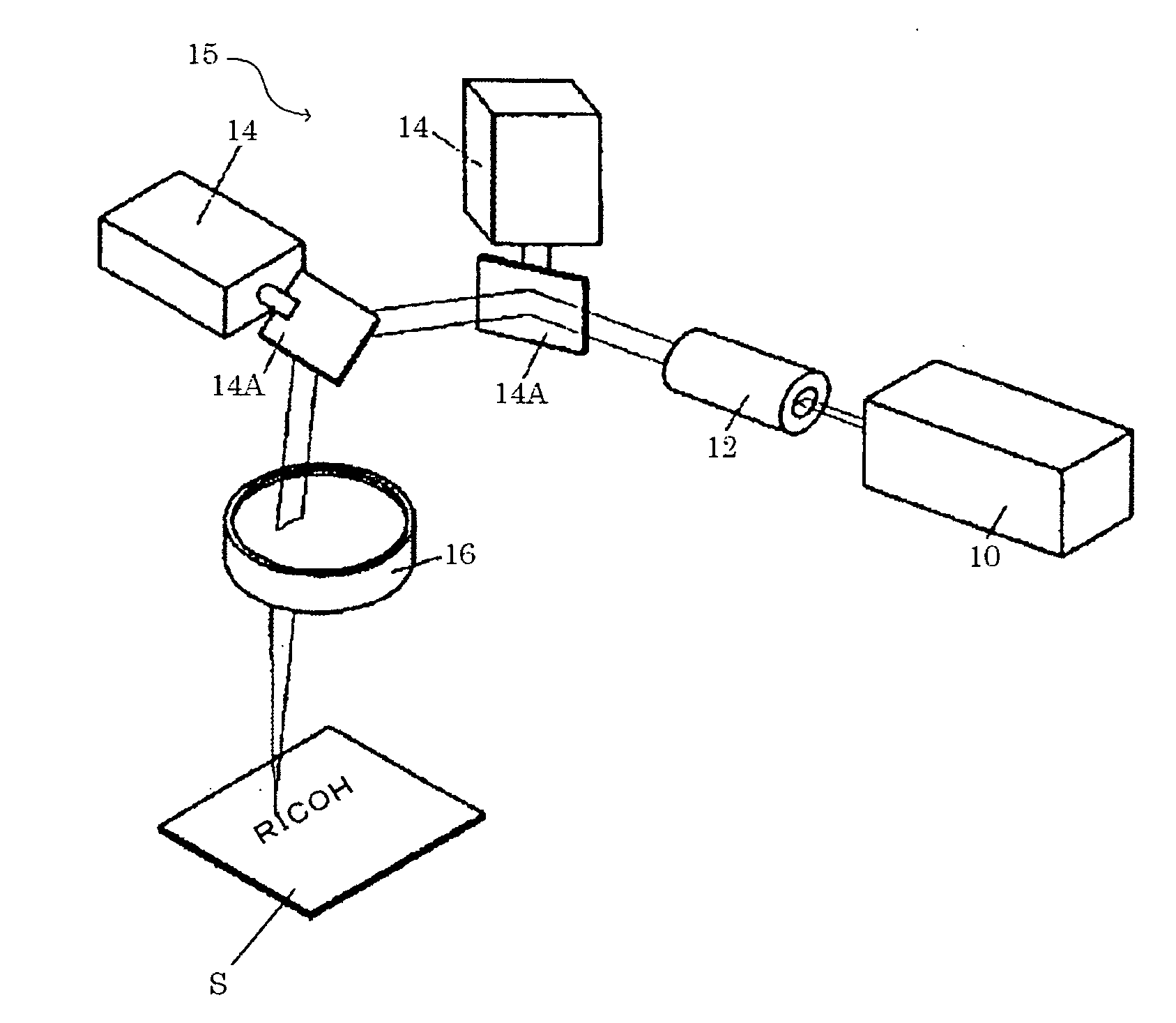
[0035] In the image processing apparatus, a laser beam is irradiated from the laser beam irradiation unit. The light irradiation intensity of the laser beam irradiated from the laser beam irradiation unit is changed by the light irradiation intensity adjusting unit. As a result, the light irradiation intensity of the center becomes equivalent to or less than the light irradiation intensity of the periphery in the light intensity distribution of cross-section in a direction approximately perpendicular to the traveling direction of the laser beam. When an image is formed on the thermoreversible recording medium by using the laser beam of which the light irradiation intensity is adjusted as above, degradation of the thermoreversible recording medium caused by repetitive forming and erasing of images can be suppressed effectively.

Problems solved by technology

Moreover, if irregularity occurs on the surfaces of media, it becomes difficult to form and erase images using thermal heads, etc.
Even though the difference in optical reflectivities between crystalline state and non-crystalline state of optical discs may be satisfactory for electrically detecting the difference in reflectivities by laser irradiation, the difference has been as such that it is faintly visible with eyes and is quite inadequate.
Although laser printing and erasing can be performed by the method as described above, because laser control is not operated during printing, a problem such that local heat damages occur in the places where lines are overlapped with each other or a problem of reduction in color developing density when solid images are being recorded arises during recording.
However, if high-density printing and uniform erasing are performed repeatedly using high-output laser, not only overlapping occurs in the area of laser drawing but phenomenon of gradually degrading thermoreversible recording media occurs even in the area of straight-line images.
This is because energy distribution of irradiated laser beam becomes Gaussian distribution and energy in the center is increased excessively.
The center of recorded linear image is heated excessively, deformation marks of thermoreversible recording media or generation of air bubbles are observed, and material itself, which bears color developing and color erasing properties, is thermally decomposed in the area corresponding to the center of the laser beam which is heated to high temperatures, thereby preventing satisfactory performance to be exhibited.
Therefore, high-density and uniform image forming and uniform image erasing are not performed sufficiently and it is unsatisfactory as a method for recording images which is hardly degraded even when erasing / printing are performed repeatedly.
Furthermore, when thermoreversible recording media are combined with above-mentioned RF-ID tag, or pasted to bulk containers or holders, irregularity occurs on the media surfaces, making focus point of lasers inconstant, and when excessive energy is added to the thermoreversible media or even when an energy for performing erasing is added, the temperature of the media may be raised to the color developing temperature, or contrary, remainder may occur due to insufficient erasing.
Moreover, a method for recording lot numbers or model numbers directly on metals or plastics so-called laser marker is known even though it is not capable of overwriting.
However, when images are formed on thermoreversible recording media, in which transparency or color tone is reversely changed by heat, by focusing laser as similar to normal laser marker, the temperature in the center of laser irradiation is increased too much, and when forming and erasing of images are repeated, the repeated area is degraded, thereby decreasing repeated numbers.
And when laser irradiation energy is reduced so as not to increase the temperature of the center, size of images is reduced resulting in degradation of image contrast or prolonged time for image forming.

Method used

the structure of the environmentally friendly knitted fabric provided by the present invention; figure 2 Flow chart of the yarn wrapping machine for environmentally friendly knitted fabrics and storage devices; image 3 Is the parameter map of the yarn covering machine
View more

Image

Smart Image Click on the blue labels to locate them in the text.
Viewing Examples
Smart Image
  • Method for image processing and image processing apparatus
  • Method for image processing and image processing apparatus
  • Method for image processing and image processing apparatus

Examples

Experimental program
Comparison scheme
Effect test

example 1

[0365] Example 1 is an example corresponding to the first aspect of the method for image processing of the present invention.

[0366] A thermoreversible recording medium in which color tone changes reversibly (between clear state and color developing state) depending on temperatures was prepared as follow.

—Support—

[0367] A milky polyester film (Tetron Film U2L98W by Teijin Dupont Films Japan Limited) of 125 μm thickness was used as a support.

—Under Layer—

[0368] A coating liquid for under layer was prepared by adding 30 parts by mass of styrene-butadiene copolymer (PA-9159 by Nippon A&L Inc.), 12 parts by mass of polyvinyl alcohol resin (Poval PVA103 by Kuraray Co., Ltd.), 20 parts by mass of empty particle (Microsphere R-300 by Matsumoto Yushi-Seiyaku Co., Ltd.) and 40 parts by mass of water to mix for approximately one hour until it is mixed uniformly.

[0369] Next, the support was coated with the obtained coating liquid for under layer by means of a wire bar, heated at 80° C. for ...

example 2

[0385] Example 2 is an example corresponding to the first aspect of the method for image processing of the present invention.

[0386] The fiber coupling type, high-output semiconductor laser apparatus of Example 1 was used and it was adjusted to have a laser output of 25 W, an irradiation distance of 88.0 mm and a spot diameter of approximately 2.0 mm. A laser beam was irradiated to the thermoreversible recording medium prepared in Example 1 at a XY stage feed rate at 1,200 mm / s to form a linear image.

[0387] At this time, five ND filters were used for light extinction to adjust the laser output to be 0.01% or less as similar to Example 1. When a light intensity distribution of cross-section in a direction approximately perpendicular to the traveling direction of the laser beam was measured similarly to Example 1, a light intensity distribution curve as shown in FIG. 9 was obtained. Moreover, the differentiation curve, the light intensity distribution curve which has been differentia...

example 3

[0390] Example 3 is an example corresponding to the first aspect of the method for image processing of the present invention.

[0391] The fiber coupling type, high-output semiconductor laser apparatus of Example 1 was used and it was adjusted to have a laser output of 35 W, an irradiation distance of 86.0 mm and a spot diameter of 3.0 mm. A laser beam was irradiated to the thermoreversible recording medium prepared in Example 1 at a XY stage feed rate of 1,200 mm / s to form a linear image.

[0392] At this time, five ND filters were used for light extinction to adjust the laser output to be 0.01% or less as similar to Example 1. When a light intensity distribution of cross-section in a direction approximately perpendicular to the traveling direction of the laser beam was measured similarly to Example 1, a light intensity distribution curve as shown in FIG. 10 was obtained. Moreover, the differentiation curve, the light intensity distribution curve which has been differentiated once (X′)...

the structure of the environmentally friendly knitted fabric provided by the present invention; figure 2 Flow chart of the yarn wrapping machine for environmentally friendly knitted fabrics and storage devices; image 3 Is the parameter map of the yarn covering machine
Login to View More

PUM

No PUM Login to View More

Abstract

It is an object of the present invention to provide a method for image processing and an image processing apparatus which are capable of performing repetitive forming and erasing of high-contrast images at high speeds by forming high-density, uniform images and uniformly erasing images in a short period of time, and in addition, suppressing the degradation of the thermoreversible recording medium due to repetitive forming and erasing is possible. The method for image processing of the present invention contains at least any one of image forming step wherein an image is formed on a thermoreversible recording medium in which any one of transparency and color tone is changed reversibly depending on temperatures by heating due to laser beam irradiation, and image erasing step wherein an image formed on the thermoreversible recording medium is erased by heating due to laser beam irradiation to the thermoreversible recording medium, and a light irradiation intensity of the center is equal to or less than the light irradiation intensity of the periphery in the light intensity distribution of cross-section in a direction approximately perpendicular to the traveling direction of the laser beam irradiated at least in any one of the image forming step and the image erasing step.

Description

BACKGROUND OF THE INVENTION [0001] 1. Field of the Invention [0002] The present invention relates to a method for image processing on thermoreversible recording media and an image processing apparatus, specifically, a method for image processing capable of repetitive forming and erasing of high-contrast images at high speeds by forming high-density, uniform images and uniformly erasing images in a short period of time, and an image processing apparatus which can be suitably used for the method for image processing. [0003] 2. Description of the Related Art [0004] Until now, forming and erasing of images on thermoreversible recording media (hereinafter may be referred to as “recording media” or “media”) are performed by contact methods in which the media are heated by contact with heat sources. Generally, thermal heads are used for forming images and heat roller and ceramic heater, etc. are used for erasing images. [0005] Such methods for recording by contact are advantageous in being...

Claims

the structure of the environmentally friendly knitted fabric provided by the present invention; figure 2 Flow chart of the yarn wrapping machine for environmentally friendly knitted fabrics and storage devices; image 3 Is the parameter map of the yarn covering machine
Login to View More

Application Information

Patent Timeline
no application Login to View More
IPC IPC(8): G11B11/00G11B7/00
CPCB41J2/315B41J2/4753B41J2/471B41J2/32
Inventor KAWAHARA, SHINYAHOTTA, YOSHIHIKOARAI, SATOSHI
Owner RICOH KK