

Rotating electric machine and manufacturing method thereof
a technology of rotating electric machines and manufacturing methods, which is applied in the direction of electronic commutators, motor/generator/converter stoppers, dynamo-electric converter control, etc., can solve the problems of high manufacturing costs, complicated connection work, and large size of entire devices, and achieve the effect of reducing manufacturing costs
- Summary
- Abstract
- Description
- Claims
- Application Information
AI Technical Summary
Benefits of technology
Problems solved by technology
Method used
Image



Examples
embodiment 1
[0022]FIG. 1 is a sectional side view showing a rotating electric machine to which an inverter is integrally assembled according to a first embodiment of the invention.
[0023] With reference to the drawing, a rotating electric machine 1 is provided with a case formed of a front bracket (not shown) and a rear bracket 2; a shaft 4 rotatably supported via bearings 3 with respect to the case; a rotor 6 that is fixed to this shaft 4, and includes a field winding 5; a stator 7 that is fixed to the case, as well as disposed so as to surround the rotor 6, and further includes an armature winding 7a; fans 8 fixed to two end faces in the axial direction of the rotor 6; a pulley 9 fixed to an end portion of the front side of the shaft 4; a brush holder 10 attached to the rear bracket 2 so as to be located at the perimeter of the rear side of the shaft 4; a pair of slip rings 11 mounted onto the rear side of the shaft 4; a pair of brushes 12 disposed in the brush holder 10 so as to slide in con...
embodiment 2
[0061]FIG. 5 is a side view showing a state that a lower arm 33 and upper arm 31 of U-phase are assembled.
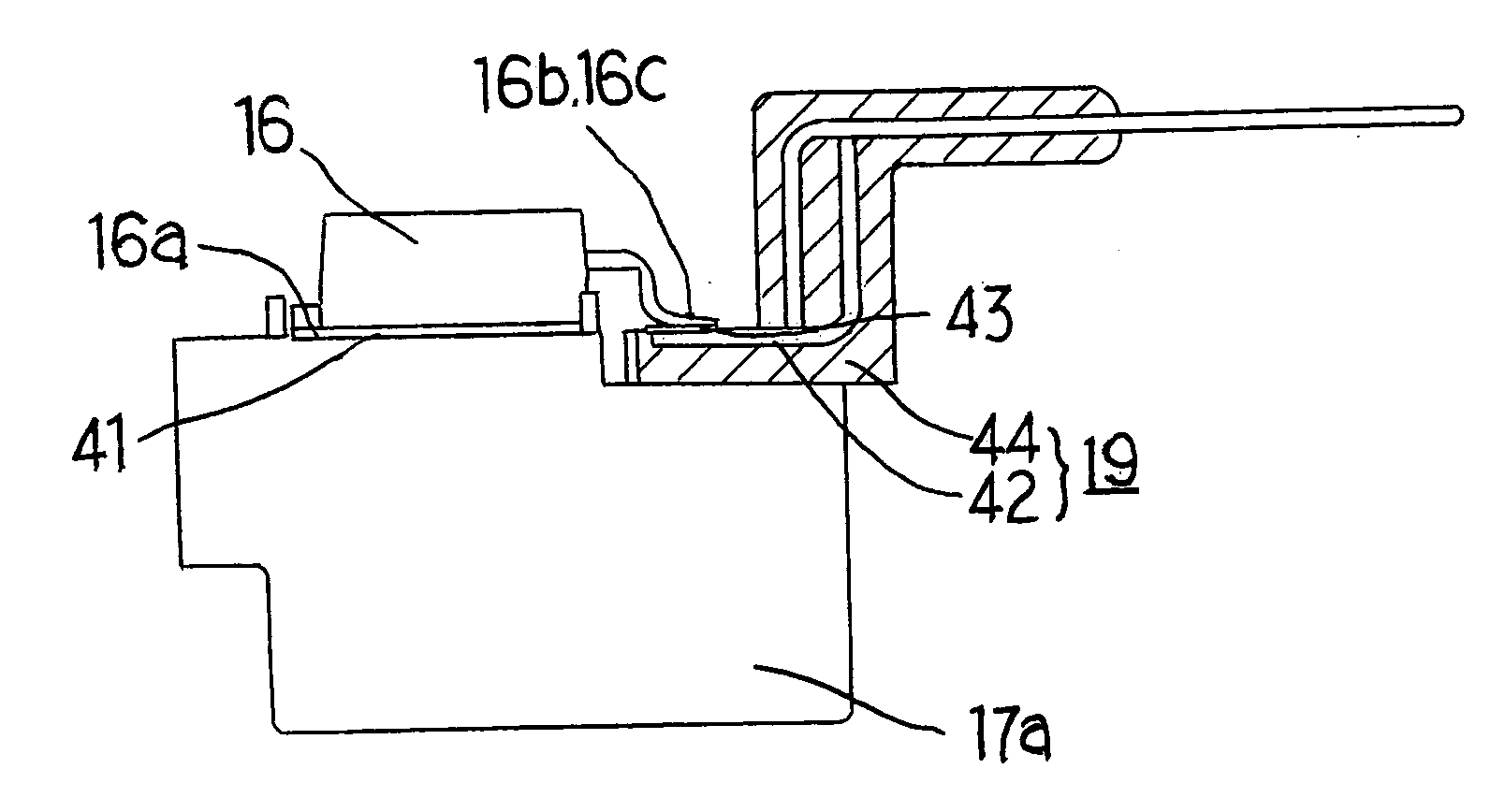
[0062] The lower arm 33 and the upper arm 31 are assembled in the state that the switching elements 16 are opposed. A metal pattern 42 to which a source electrode terminal 16b of the upper arm 31 is joined is extended to a heat sink 17b of the lower arm 33, and the metal pattern 42 is fixed to the heat sink 17b with a screw 51.
[0063] Owing to such construction, the drain electrode terminal 16a of the lower arm 33 and the source electrode terminal 16b of the upper arm 31 are electrically connected. thus, the switching element 16 of the upper arm 31 and the switching element 16 of the lower arm 33 comes to be connected in series.
[0064] Furthermore, to suppress the variation of the DC power source, and to smooth, e.g., the rise of voltage, a smoothing capacitor 52 is used. The smoothing capacitor 52 is joined at the portion exposed outside a resin covering a metal pattern 42 for...
embodiment 3
[0068]FIG. 6 is a plan view showing a lower arm portion of U-phase. With reference to the drawing, drain electrode terminals 16a of a plurality of switching elements 16 are joined to the same heat sink 17b with solders 41. Source electrode terminals 16b and gate electrode terminals 16c are joined to respective metal patterns 42 with solders 43. In this manner, a plurality of switching elements 16 are joined to one connection member 19 in the state of being close to each other, so that they can be connected to the control board 18 via one output terminal. Consequently, it is possible to be unaffected by noises, and further to downsize the entire device.
PUM
 Login to View More
 Abstract
Description
Claims
Application Information
 Login to View More