Check patentability & draft patents in minutes with Patsnap Eureka AI!

Polycarbonate Resin and Electrophotographic Photosensitive Member Using Same

a technology of polycarbonate resin and photosensitive member, which is applied in the direction of optics, instruments, organic dyes, etc., can solve the problems of deterioration of mechanical characteristics, unsatisfactory effect of improving abrasion resistance, and unsatisfactory use of bisphenol a and bisphenol z raw materials, etc., to achieve the effect of improving cleaning properties and reducing surface energy

Active Publication Date: 2007-10-18
IDEMITSU KOSAN CO LTD
View PDF14 Cites 21 Cited by
  • Summary
  • Abstract
  • Description
  • Claims
  • Application Information

AI Technical Summary

Benefits of technology

[0011] According to the present invention, a polycarbonate resin which is chemically stable and which can achieve a reduction in a surface energy is used as a binder resin for a photosensitive layer of an electrophotographic photoreceptor, and therefore an electrophotographic photoreceptor which is improved in a cleaning property, a lubricity and an abrasion resistance can be provided.

Problems solved by technology

However, even the above polycarbonate resins in which the above bisphenol A and bisphenol Z are used as raw materials are unsatisfactory for satisfying the requirements described above.
However, the copolymers disclosed in the above documents are combined via a chemically instable Si—O—C bond and therefore involve problems on deterioration of mechanical characteristics caused by cutting of molecular chains and degradation of charging characteristics brought about by a silanol group remaining at a molecular end.
Photoreceptors using the above polycarbonate resins have a low surface energy and therefore are improved in a cleaning characteristic, but they do not necessarily have a satisfactory effect of improving an abrasion resistance.

Method used

the structure of the environmentally friendly knitted fabric provided by the present invention; figure 2 Flow chart of the yarn wrapping machine for environmentally friendly knitted fabrics and storage devices; image 3 Is the parameter map of the yarn covering machine
View more

Image

Smart Image Click on the blue labels to locate them in the text.
Viewing Examples
Smart Image
  • Polycarbonate Resin and Electrophotographic Photosensitive Member Using Same
  • Polycarbonate Resin and Electrophotographic Photosensitive Member Using Same
  • Polycarbonate Resin and Electrophotographic Photosensitive Member Using Same

Examples

Experimental program
Comparison scheme
Effect test

example 2

[0089] A solution prepared by dissolving 87 mass parts of 1,1-bis(4-hydroxyphenyl)cyclohexane (bisphenol Z; bis Z) in 607 mass parts of a potassium hydroxide aqueous solution having a concentration of 9.4 mass % was mixed with 334 mass parts of methylene chloride, and phosgene gas was blown into the above solution in a proportion of 4.2 mass parts / minute for 15 minutes under cooling while stirring. Then, the above reaction liquid was left standing still to separate an organic layer to obtain a methylene chloride solution of a 1,1-bis(4-hydroxyphenyl)cyclohexane polycarbonate oligomer (hereinafter referred to as the bis Z oligomer) which had a polymerization degree of 2 to 4 and in which a molecular end was a chloroformate group.

[0090] Next, a copolymerized polycarbonate resin (PC-2) was obtained by the same method, except that in Example 1, the bis Z oligomer was used in place of the bis A oligomer.

[0091] A solution of the copolymerized polycarbonate resin thus obtained in which m...

example 3

[0094] A solution prepared by dissolving 83 mass parts of 2,2-bis(3-methyl-4-hydroxyphenyl)propane (bisphenol C; bis C) in 607 mass parts of a potassium hydroxide aqueous solution having a concentration of 9.4 mass % was mixed with 334 mass parts of methylene chloride, and phosgene gas was blown into the above solution in a proportion of 4.2 mass parts / minute for 15 minutes under cooling while stirring. Then, the above reaction liquid was left standing still to separate an organic layer to obtain a methylene chloride solution of a 2,2-bis(3-methyl-4-hydroxyphenyl)propane polycarbonate oligomer (hereinafter referred to as the bis C oligomer) which had a polymerization degree of 2 to 4 and in which a molecular end was a chloroformate group.

[0095] Next, a copolymerized polycarbonate resin (PC-3) was obtained by the same method, except that in Example 1, the bis C oligomer was used in place of the bis A oligomer and that 19.4 g of 1,1-bis(4-hydroxyphenyl)-1-phenylethane was used in pla...

example 4

[0098] A solution prepared by dissolving 140 mass parts of 1,1-bis(3-cyclohexyl-4-hydroxyphenyl)cyclohexane (bisphenol CHZ; bis CHZ) in 607 mass parts of a potassium hydroxide aqueous solution having a concentration of 9.4 mass % was mixed with 334 mass parts of methylene chloride, and phosgene gas was blown into the above solution in a proportion of 4.2 mass parts / minute for 15 minutes under cooling while stirring. Then, the above reaction liquid was left standing still to separate an organic layer to obtain a methylene chloride solution of a 1,1-bis(3-cyclohexyl-4-hydroxyphenyl)cyclohexane polycarbonate oligomer (hereinafter referred to as the bis CHZ oligomer) which had a polymerization degree of 2 to 4 and in which a molecular end was a chloroformate group.

[0099] Next, a copolymerized polycarbonate resin (PC-4) was obtained by the same method, except that in Example 1, the bis CHZ oligomer was used in place of the bis A oligomer and that 28.9 g of bisphenol CHZ was used in plac...

the structure of the environmentally friendly knitted fabric provided by the present invention; figure 2 Flow chart of the yarn wrapping machine for environmentally friendly knitted fabrics and storage devices; image 3 Is the parameter map of the yarn covering machine
Login to View More

PUM

PropertyMeasurementUnit
concentrationaaaaaaaaaa
mass ratioaaaaaaaaaa
Login to View More

Abstract

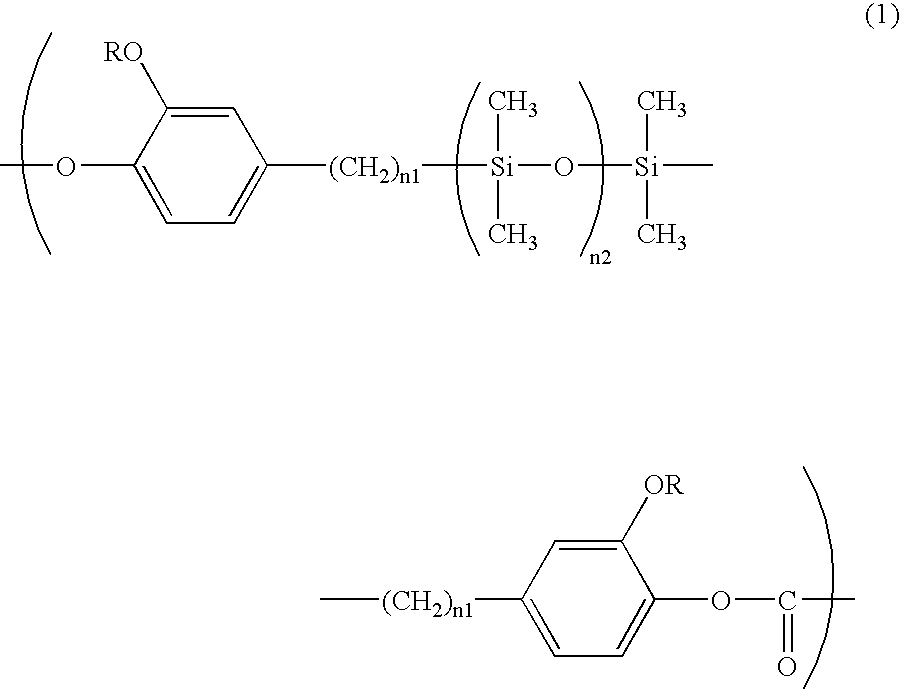
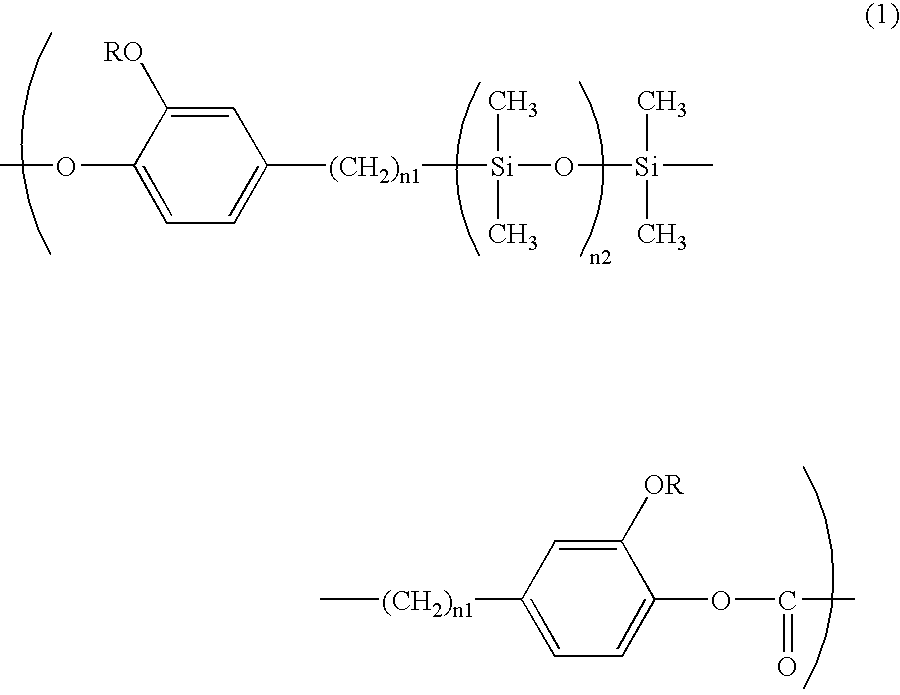
Provided are a polycarbonate resin which can solve problems present in an electrophotographic photoreceptor and an electrophotographic photoreceptor in which the above polycarbonate resin is used and which is improved in a cleaning property, a lubricity and an abrasion resistance. The polycarbonate resin comprises a repetitive unit represented by the following Formula (1), and the electrophotographic photoreceptor in which a photosensitive layer is provided on a conductive substrate contains the above polycarbonate resin in the above photosensitive layer. In the following Formula (1), R represents an alkyl group having 1 to 3 carbon atoms; n1 is an integer of 2 to 4; and n2 is an integer of 1 to 200.

Description

TECHNICAL FIELD [0001] The present invention relates to a polycarbonate resin into which a specific structure is introduced and an electrophotographic photoreceptor in which the above polycarbonate resin is used for a photosensitive layer, more specifically to a polycarbonate resin which is chemically stable and which can achieve a reduction in a surface energy and an electrophotographic photoreceptor in which the above polycarbonate resin is used and which is improved in a cleaning property, a lubricity and an abrasion resistance and can suitably be used in the various electrophotographic fields. BACKGROUND ART [0002] Polycarbonate resins are used as a raw material in various fields including optical materials such as optical films, optical disks and lenses and housings such as electric appliances, and polycarbonate resins which are more excellent in performances are desired to be developed as the application fields are expanded. [0003] On the other hand, in recent years, proposed ...

Claims

the structure of the environmentally friendly knitted fabric provided by the present invention; figure 2 Flow chart of the yarn wrapping machine for environmentally friendly knitted fabrics and storage devices; image 3 Is the parameter map of the yarn covering machine
Login to View More

Application Information

Patent Timeline
no application Login to View More
Patent Type & Authority Applications(United States)
IPC IPC(8): G03G5/05C08G64/18
CPCC08G64/186G03G5/0578G03G5/0564C08G64/18C08G64/00C08G64/40G03G5/05
Inventor HIKOSAKA, TAKAAKI
Owner IDEMITSU KOSAN CO LTD
Features
  • R&D
  • Intellectual Property
  • Life Sciences
  • Materials
  • Tech Scout
Why Patsnap Eureka
  • Unparalleled Data Quality
  • Higher Quality Content
  • 60% Fewer Hallucinations
Social media
Patsnap Eureka Blog
Learn More