
Imidazolopyrazine compounds useful for the treatment of degenerative and inflammatory diseases
a technology of idazolopyrazine and compounds, which is applied in the direction of heterocyclic compound active ingredients, biocide, drug compositions, etc., can solve the problems of long corticosteroid use, serious side effects, and drug use that will not stop the ra-associated joint destruction, etc., and achieves less toxicity, good half-life, and good absorption
- Summary
- Abstract
- Description
- Claims
- Application Information
AI Technical Summary
Benefits of technology
Problems solved by technology
Method used
Image

Examples
example 1
MAPKAP-K5 Assay
[0710] MAPKAP-K5 reactions are performed in FlashPlate format using 0.1 or 0.2 μCi 33P-ATP; 0.6 μM ATP; 1mU MAPKAP-K5; 3 μM MAPKAP-K5 peptide substrate, incubated at room temperature for 30 minutes.
Flashplate Assay:
[0711] The MAPKAP-K5 kinase reaction is performed in a 384 well polypropylene plate (Matrix Technologies) and then transferred to a streptavidin-coated 384 well flashplate (Perkin-Elmer).
[0712] To wells containing 2 μL test compound or standard inhibitor, 13 μL Enzyme mix or diluent are added using a Hydra (Robbins Scientific).
[0713] Reactions are started by addition of 10 μL of [2.5×]substrate cocktail using a Multidrop (Thermo-Labsystems), to give final concentrations in the assay of:
[0714] 1 mU MAPKAP-K5
[0715] 3 μM MAPKAP-K5 peptide substrate
[0716]˜0.6 μM ATP
[0717] 0.004 μCi [33P]-γ-ATP / μL
[0718] 1× reaction buffer
[0719] Plates are incubated at room temperature for 30 minutes.
[0720] Reactions are terminated by the addition of 25 μL EDTA (50 m...
example 2
Development of an Assay for the Identification of Regulators of the Expression of MMP1 by Activated Primary Synovial Fibroblasts
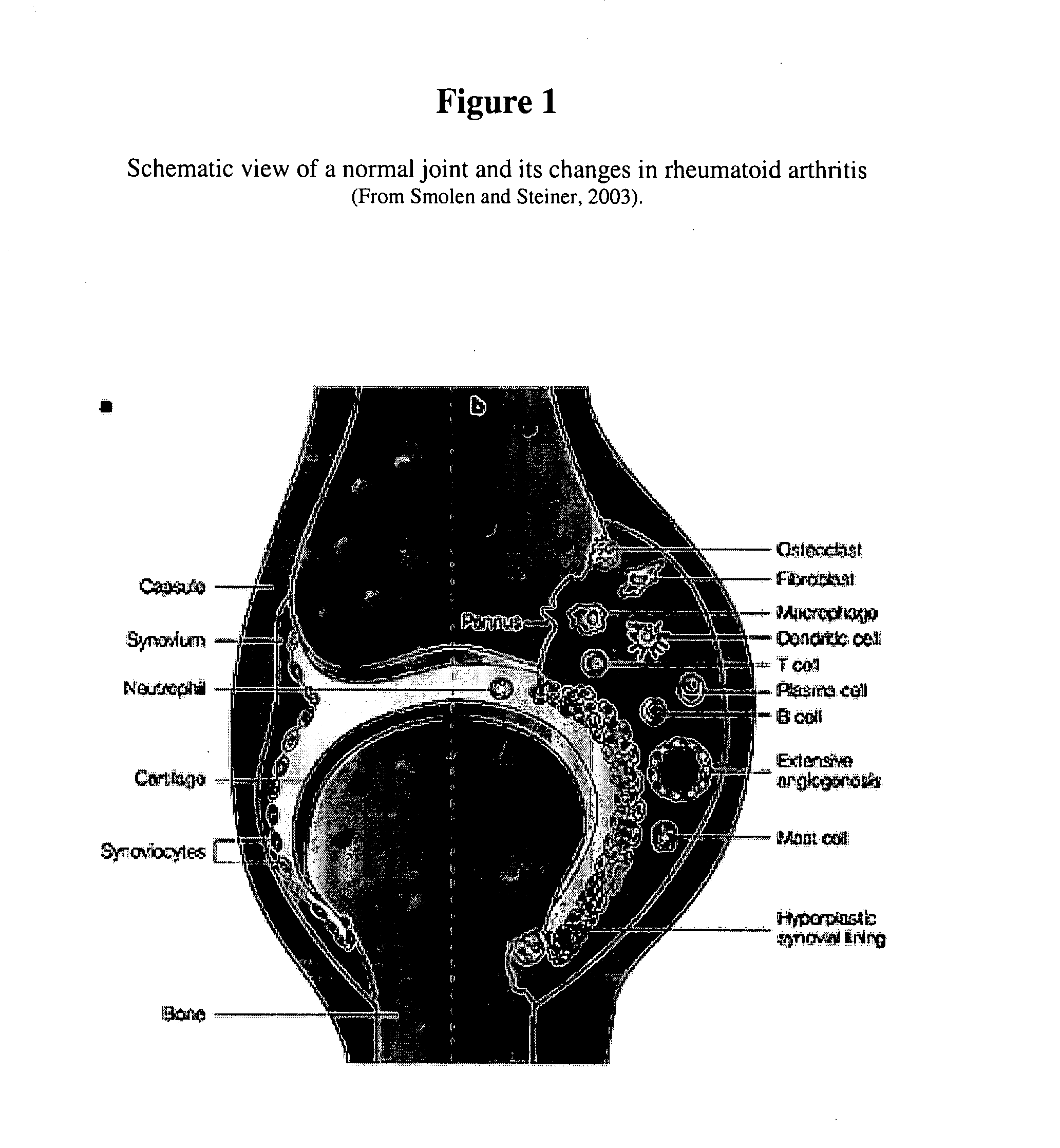
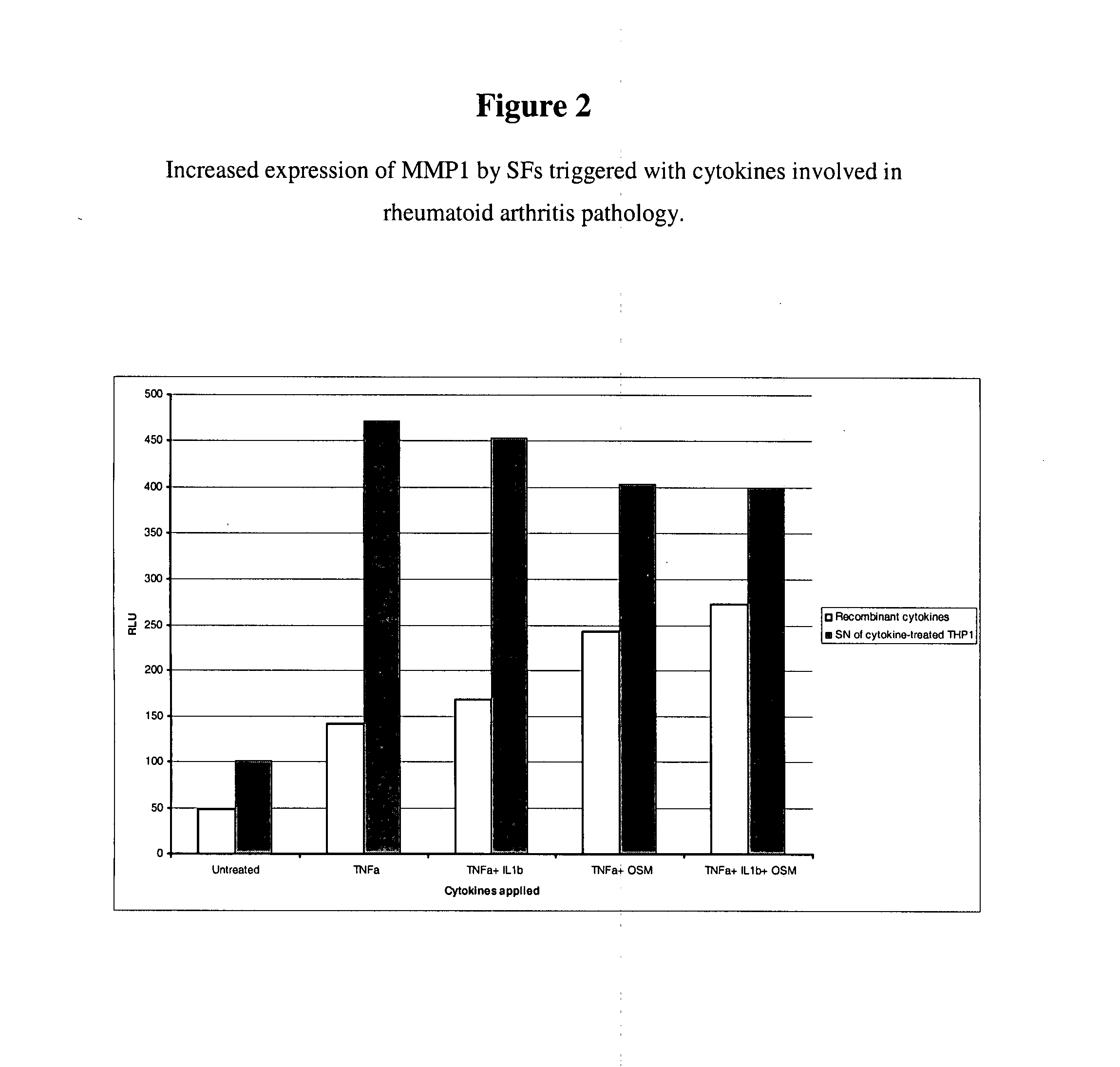
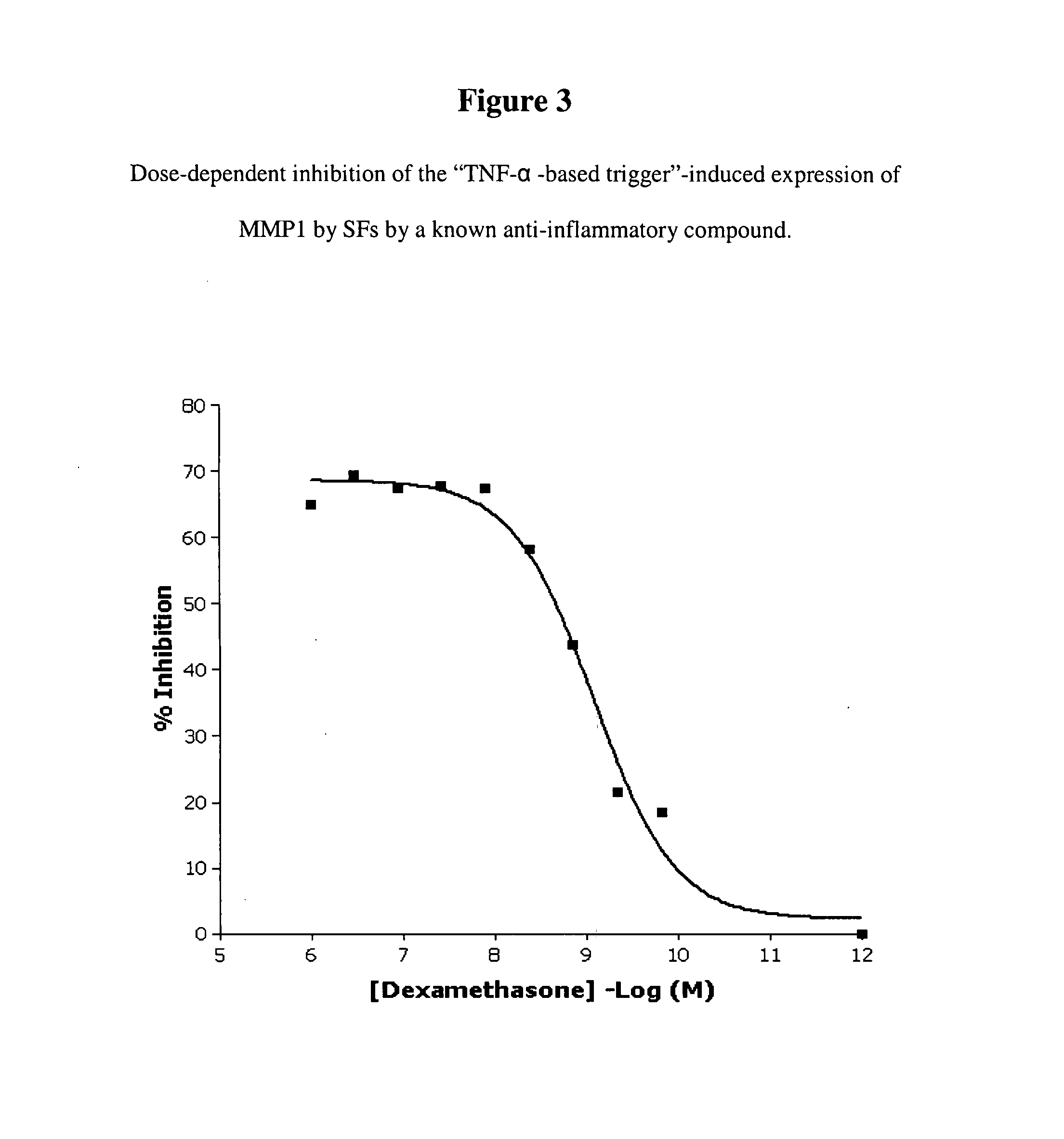
[0734] To identify compounds that decrease the ECM-degrading activity of cells, the ECM-degrading activity of cells may be induced to allow proper detection of this activity, and to achieve a clearer read-out. In the context of RA, the cells of choice are mammalian synovial fibroblasts and the triggers that may be used to induce the ECM-degrading activity are cytokines relevant in the field of arthritis: for instance TNF-α, IL1β, IL6, OSM, IL17, and MIF1-α. This list is not comprehensive due to the plethora of cytokines potentially involved in the RA pathogenesis (Smolen and Steiner, 2003). To set up an in vitro assay that is as close as possible to the complexity of the pathology, the trigger applied should be a mixture of factors generated by contacting cytokine-producing cells relevant in the field of arthritis, such as monocytes, macrophages, T-cells, ...
example 2.1
Development of the MMP Assay
[0744] A 384-well format ELISA for measurement of MMP1 is developed. Various primary antibodies are tested, as well as various ELISA protocols. The following protocol is developed and validated to measure MMP1 levels in SF supernatant in 384 well plates: white Lumitrac 600 384 well plates (Greiner) are coated with 2 μg / mL anti-MMP1 antibody MAB1346 (Chemicon). The antibody is diluted in buffer 40 (1.21 g Tris base (Sigma), 0.58 g NaCl (Calbiochem) and 5 ml 10% NaN3 (Sigma) in 1 L milliQ water and adjusted to pH 8.5). After overnight incubation at 4° C., plates are washed with PBS (80 g NaCl, 2g KCl (Sigma), 11.5 g Na2HPO4.7H2O and 2 g KH2PO4 in 10 L milliQ; pH 7.4) and blocked with 100 μL / well Casein buffer (2% Casein (VWR International) in PBS). Next day, casein buffer is removed from ELISA plates and replaced by 50 μL / well EC buffer (4 g casein, 2.13 g Na2HPO4 (Sigma), 2 g bovine albumin (Sigma), 0.69 g NaH2PO4.H2O (Sigma), 0.5 g CHAPS (Roche), 23.3 g ...
PUM
 Login to View More
 Abstract
Description
Claims
Application Information
 Login to View More