
Curable resin composition
a technology of resin composition and curing product, which is applied in the direction of synthetic resin layered products, elastomeric polymer dielectrics, solid-state devices, etc., can solve the problems of the difficulty of plating the ultrafine circuit having a conductive layer, and the insufficient adhesion between the cured product and the copper foil, etc., to achieve the effect of easy dispersal of dielectric powder
- Summary
- Abstract
- Description
- Claims
- Application Information
AI Technical Summary
Benefits of technology
Problems solved by technology
Method used
Image

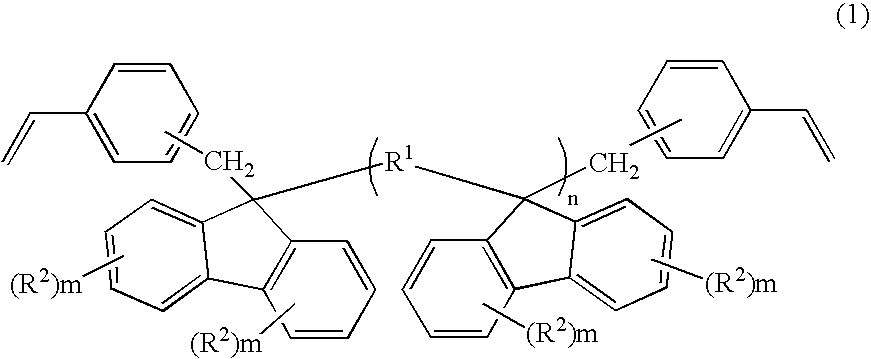
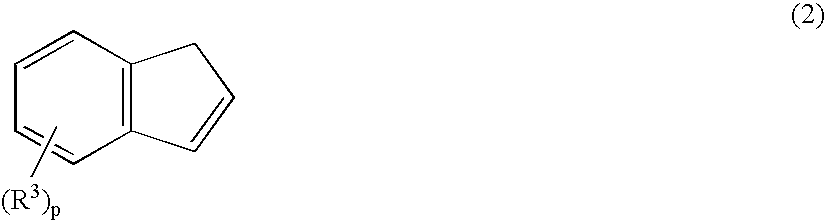
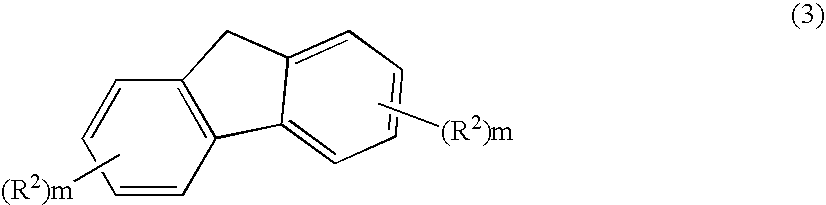
Examples
example 1
[0076] Modified styrene elastomer having an acid anhydride group (modified SEBS) (6 parts by mass, M1913 manufactured by ASAHI KASEI CHEMICALS CORPORATION, styrene content 30%), a strontium titanate powder subjected to a styrylsilane treatment (70 parts by mass) and toluene (18 parts by mass) were added to a toluene varnish of a polyvinylbenzyl compound (37 parts by mass, V5000X manufactured by SHOWA HIGHPOLYMER CO., LTD., nonvolatile content 65%) [resin component 24 parts by mass], and the mixture was stirred to complete dispersion to give a varnish containing a curable resin composition. This varnish was applied to a polyethylene terephthalate (hereinafter to be abbreviated as PET) film of 38 μm thickness, and dried at 70-120° C. for 12 min to give an adhesive film having a curable resin composition layer of 50 μm thickness. Separately, the above-mentioned varnish was applied to an electrolytic copper foil (F2-WS foil, thickness 18 μm, Rz of treated surface=2.3 μm) manufactured by...
example 2
[0077] Modified styrene elastomer having an acid anhydride group (modified SEBS) (5.5 parts by mass, M1913 manufactured by ASAHI KASEI CHEMICALS CORPORATION, styrene content 30%), a strontium titanate powder subjected to a styrylsilane treatment (70 parts by mass) and toluene (18 parts by mass) were added to a toluene varnish of a polyvinylbenzyl compound (33.5 parts by mass, V5000X manufactured by SHOWA HIGHPOLYMER CO., LTD., nonvolatile content 65%) [resin component 21.8 parts by mass], then a trifunctional acrylate monomer (2.7 parts by mass, KAYARAD R790 manufactured by NIPPON KAYAKU CO., LTD.) having an isocyanurate skeleton copolymerizable with a polyvinylbenzyl compound was added, and the mixture was stirred to complete dispersion to give a varnish containing a curable resin composition. This varnish was applied to a PET film of 38 μm thickness, and dried at 70-120° C. for 12 min to give an adhesive film having a curable resin composition layer of 50 μm thickness. Separately,...
example 3
[0078] In the same manner as in Example 1 except that a modified styrene elastomer having a carboxyl group (modified SBBS) (N503M manufactured by ASAHI KASEI CHEMICALS CORPORATION, styrene content 30%) was used instead of the modified styrene elastomer having an acid anhydride group (modified SEBS) (M1913 manufactured by ASAHI KASEI CHEMICALS CORPORATION) and a strontium titanate powder subjected to an acrylsilane treatment was used instead of the strontium titanate powder subjected to the styrylsilane treatment, an adhesive film and an adhesive film with a copper foil were obtained.
PUM
| Property | Measurement | Unit |
|---|---|---|
| relative dielectric constant | aaaaa | aaaaa |
| relative dielectric constant | aaaaa | aaaaa |
| temperature | aaaaa | aaaaa |
Abstract
Description
Claims
Application Information
 Login to View More