
Suture with filaments formed of polyether-ketone variant
a polyether-ketone, braided suture technology, applied in the field of high-strength surgical suture materials, can solve the problem that the knot tie-down characteristics of the knot itself are not acceptable for surgical applications, and achieve the effect of high strength
- Summary
- Abstract
- Description
- Claims
- Application Information
AI Technical Summary
Benefits of technology
Problems solved by technology
Method used
Image

Examples
example 1
[0046]Core: 3 twisted yarns of ultrahigh molecular weight polyethylene (144 decitex each)
[0047]Jacket: 8 yarns PEEK (100 or 94 decitex) braided with 8 yarns ultrahigh molecular weight polyethylene (144 decitex)
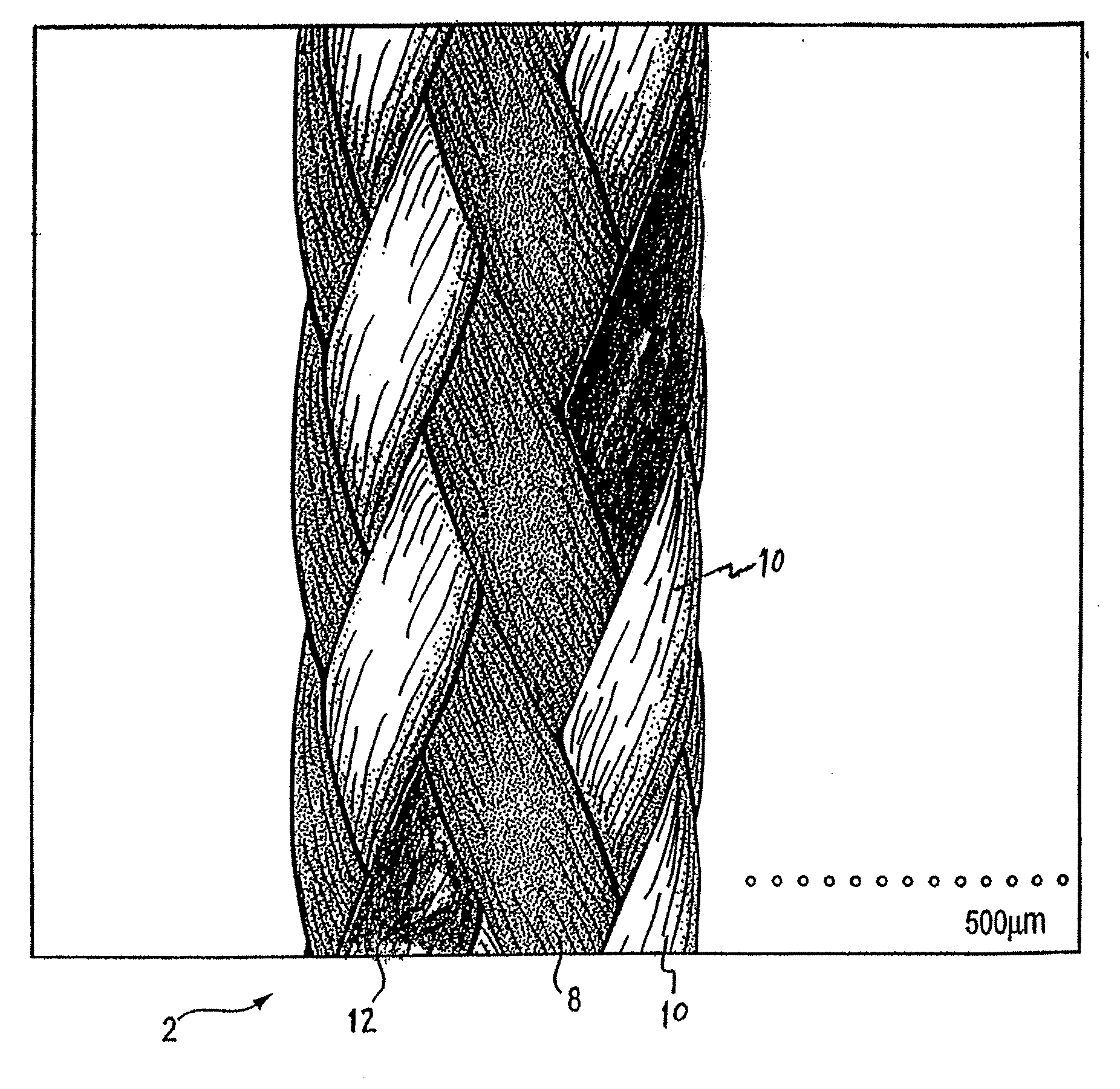
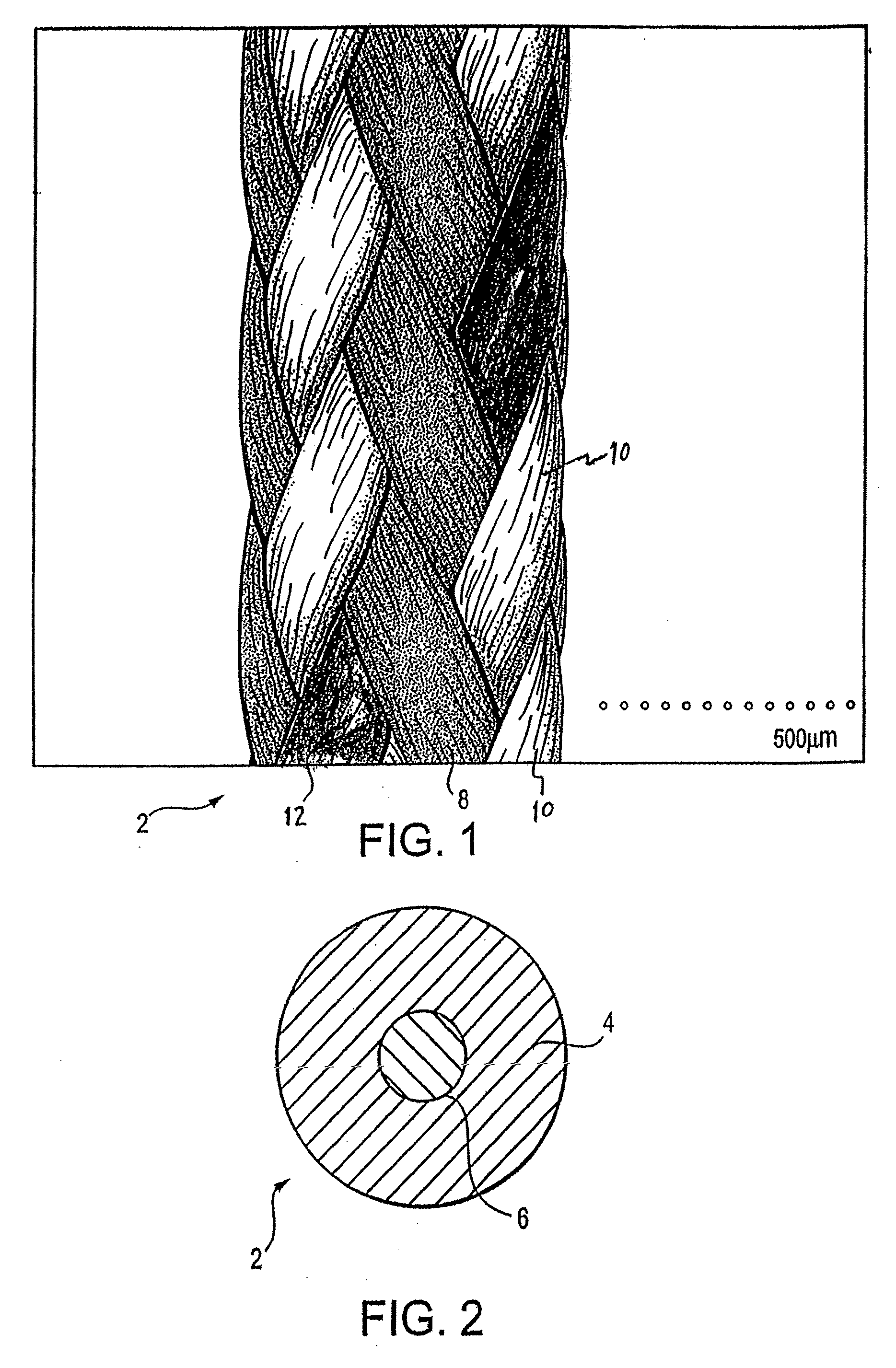
[0048]The suture includes a multifilament jacket formed of ultrahigh molecular weight polyethylene yarn braided with PEEK. The jacket surrounds a yarn core substantially or entirely of ultrahigh molecular weight polyethylene.
[0049]The jacket is formed using eight yarns of 100 or 94 decitex PEEK braided with eight yarns of 144 decitex ultrahigh molecular weight polyethylene. The core is formed of three twisted yarns of 144 decitex ultrahigh molecular weight polyethylene, twisted at about three to six twists per inch.
example 2
[0050]Core: 1 yarn of ultrahigh molecular weight polyethylene (144 decitex)
[0051]Jacket: 8 twisted yarns PEEK (each yarn made of 2 twisted yarns of 45 decitex) braided with 8 yarns ultrahigh molecular weight polyethylene (144 decitex)
[0052]The jacket is formed using eight twisted yarns of PEEK braided, each yarn comprised of two twisted yarns of 45 decitex each, with eight yarns of 144 decitex ultrahigh molecular weight polyethylene. The core is formed of a yarn of 144 decitex ultrahigh molecular weight polyethylene.
example 3
[0053]Core: 3 yarns of PEEK (100 decitex each)
[0054]Jacket: 8 twisted yarns PEEK (94 or 100 decitex) braided with 8 yarns ultrahigh molecular weight polyethylene (144 decitex)
[0055]The jacket is formed using eight yarns of 94 or 100 decitex PEEK braided with eight yarns of 144 decitex ultrahigh molecular weight polyethylene. The core is formed of three twisted yarns of 100 decitex PEEK.
PUM
| Property | Measurement | Unit |
|---|---|---|
| Fraction | aaaaa | aaaaa |
| Fraction | aaaaa | aaaaa |
| Water absorption | aaaaa | aaaaa |
Abstract
Description
Claims
Application Information
 Login to View More