

Method for combined production of paraxylene and benzene with improved productivity
a combined production and productivity technology, applied in the field of combined production of paraxylene and benzene with improved productivity, can solve the problems of limiting production capacity, smb portion, affecting the effect of production efficiency, etc., and achieves the effect of improving the function, increasing the supply flow rate, and improving the function
- Summary
- Abstract
- Description
- Claims
- Application Information
AI Technical Summary
Benefits of technology
Problems solved by technology
Method used
Image

Examples
example 1
In Accordance with the Prior Art
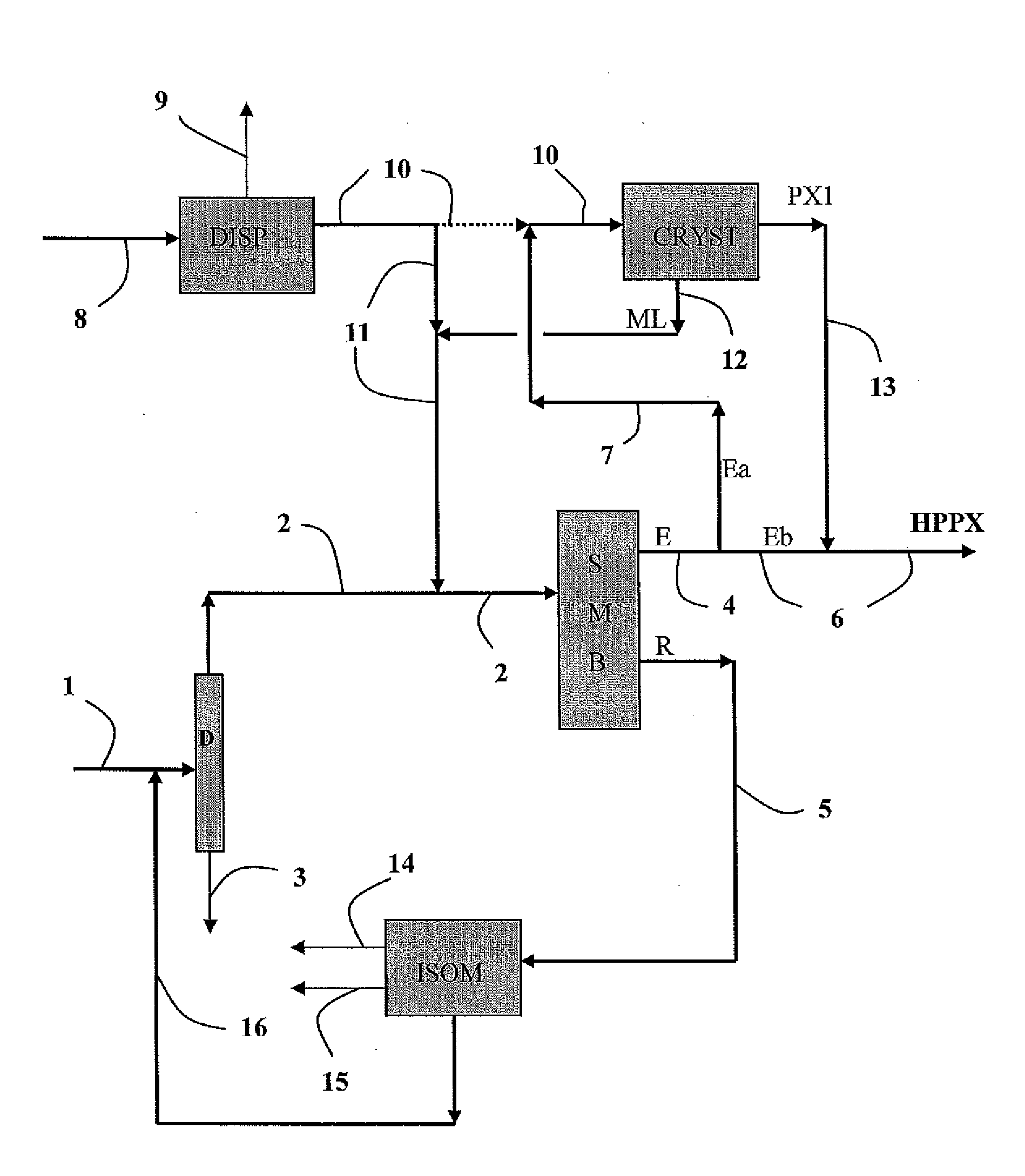
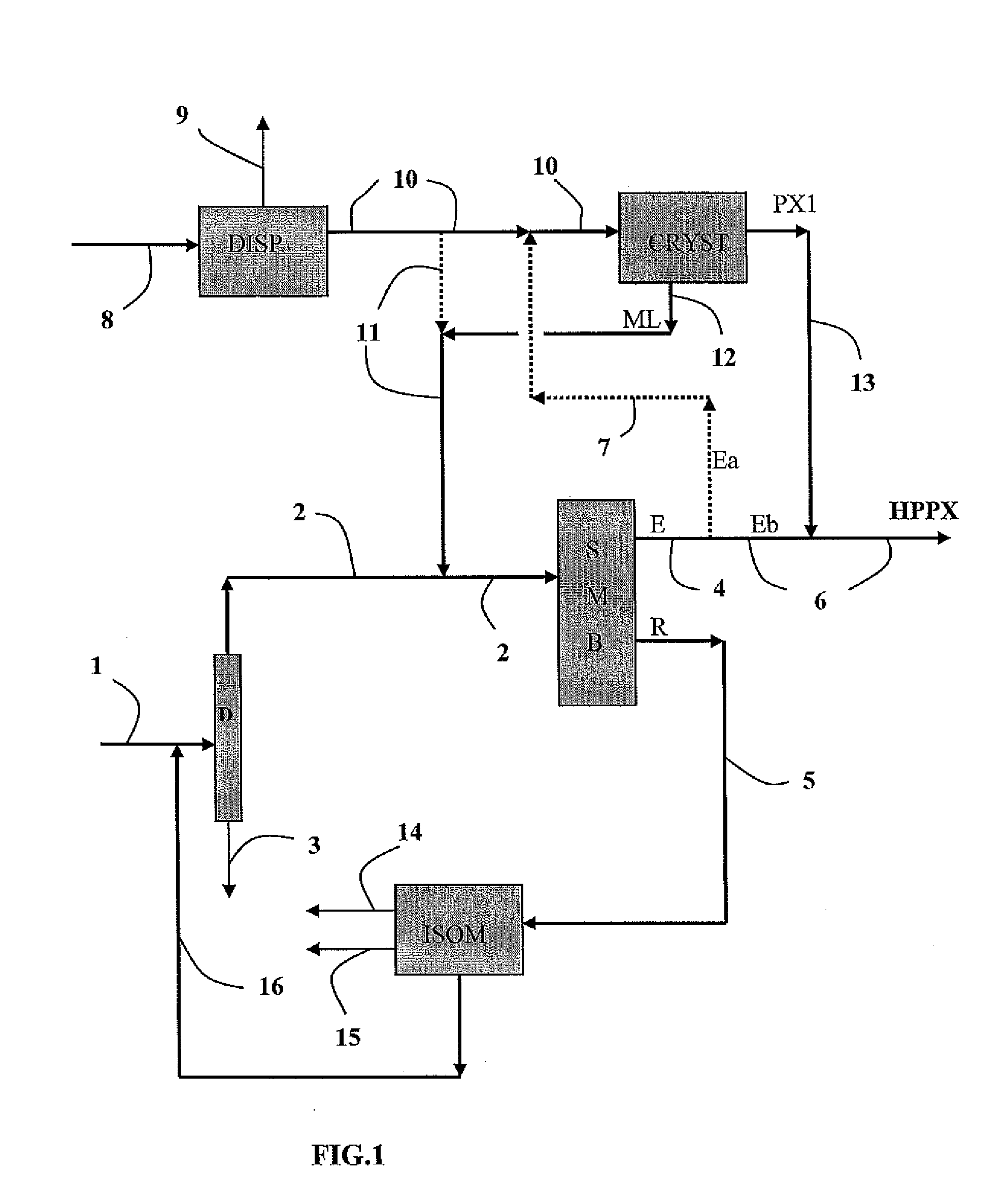
[0084]The facility in the process of Example 1 corresponds to that indicated in FIG. 1, and comprises a SMB unit with a single raffinate and a dealkylation isomerization. However, the lines shown as dotted lines in said figure (line 7 and the first portion of line 11) are not included in this facility.
[0085]The flow chart remains the same, between the start and end of the cycle, but with a flow rate of the first feed which reduces and a PX production leaving the SMB which substantially reduces at the end of the cycle to be able to maintain the required minimum purity (99.7%) for para-xylene. The yield of SMB also falls, along with the benzene production.
[0086]Table 1 shows a material balance (in tonnes per hour) for the various streams referred to in FIG. 1 at the start of the cycle (fresh absorbent) and Table 2 shows the same material balance, bat at the end of the cycle (used absorbent, just before its replacement). The following abbreviations are u...
example 2
In Accordance with the Invention
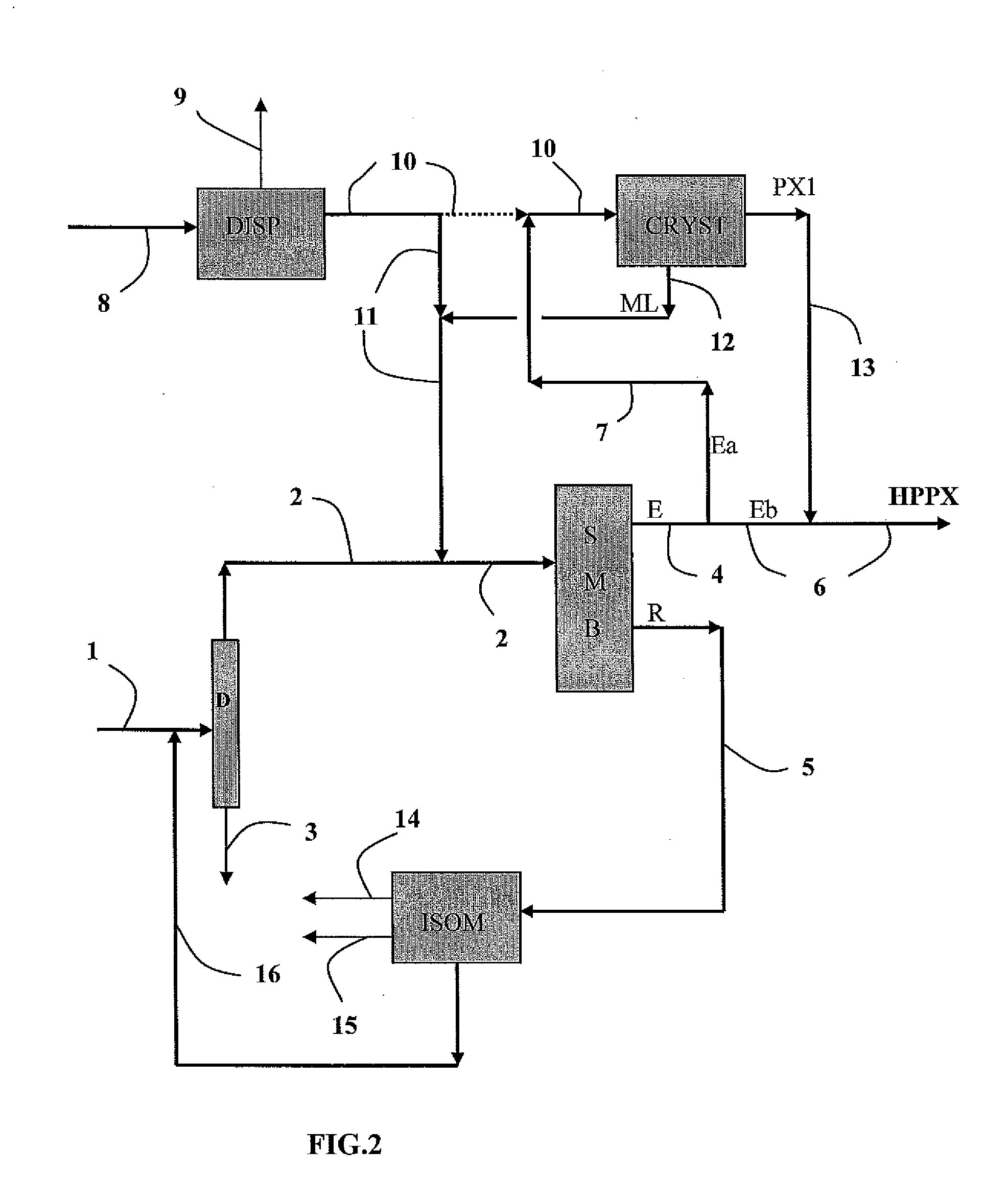
[0088]The operation at the start of the cycle is identical to that of the prior art. In contrast, at the end of the cycle (for example once the purity of the refined extract E approaches 99.7%, at constant flow rates for the first and second feeds), the supply to the crystallization step is replaced by a fraction Ea of E, and the C8 disproportionation cut is sent to the SMB supply, which improves its operation because of its enrichment in PX of the overall feed from the SMB. The SMB supply flow rate may thus be increased, and the material balance is thus as follows:
TABLE 3End ofFeedSMBFeedOutletInletOutletcycle1inletREEa2DISPCRYSTPX1MLHPPXISOMEB1722.422.30.080.03——0.03—0.030.055.4PX19.6106.83.2103.6439.86—1739.8636.013.8599.7866.4MX40177.6177.40.220.09—20.09—0.080.15135.5OX20.490.5590.40.110.04—10.040.010.040.0769.1T—————42 —(*)—————BZ——————20————12.3LPG and——————2————4.6lossesTotal97397.35293.3104.0540.02424240.0236.024100.05293.3
[0089]It can thus b...
PUM
| Property | Measurement | Unit |
|---|---|---|
| temperature | aaaaa | aaaaa |
| purity | aaaaa | aaaaa |
| weight | aaaaa | aaaaa |
Abstract
Description
Claims
Application Information
 Login to View More