Heparin conjugates and methods
a conjugate and heparin technology, applied in the field of heparin conjugates, can solve the problems of anti-angiogenic effect and inability of rbd to vegf to maintain cell growth,
- Summary
- Abstract
- Description
- Claims
- Application Information
AI Technical Summary
Benefits of technology
Problems solved by technology
Method used
Image


Examples
example 1
Synthesis of Heparin-Taurocholic Acid (“HT”) Conjugates
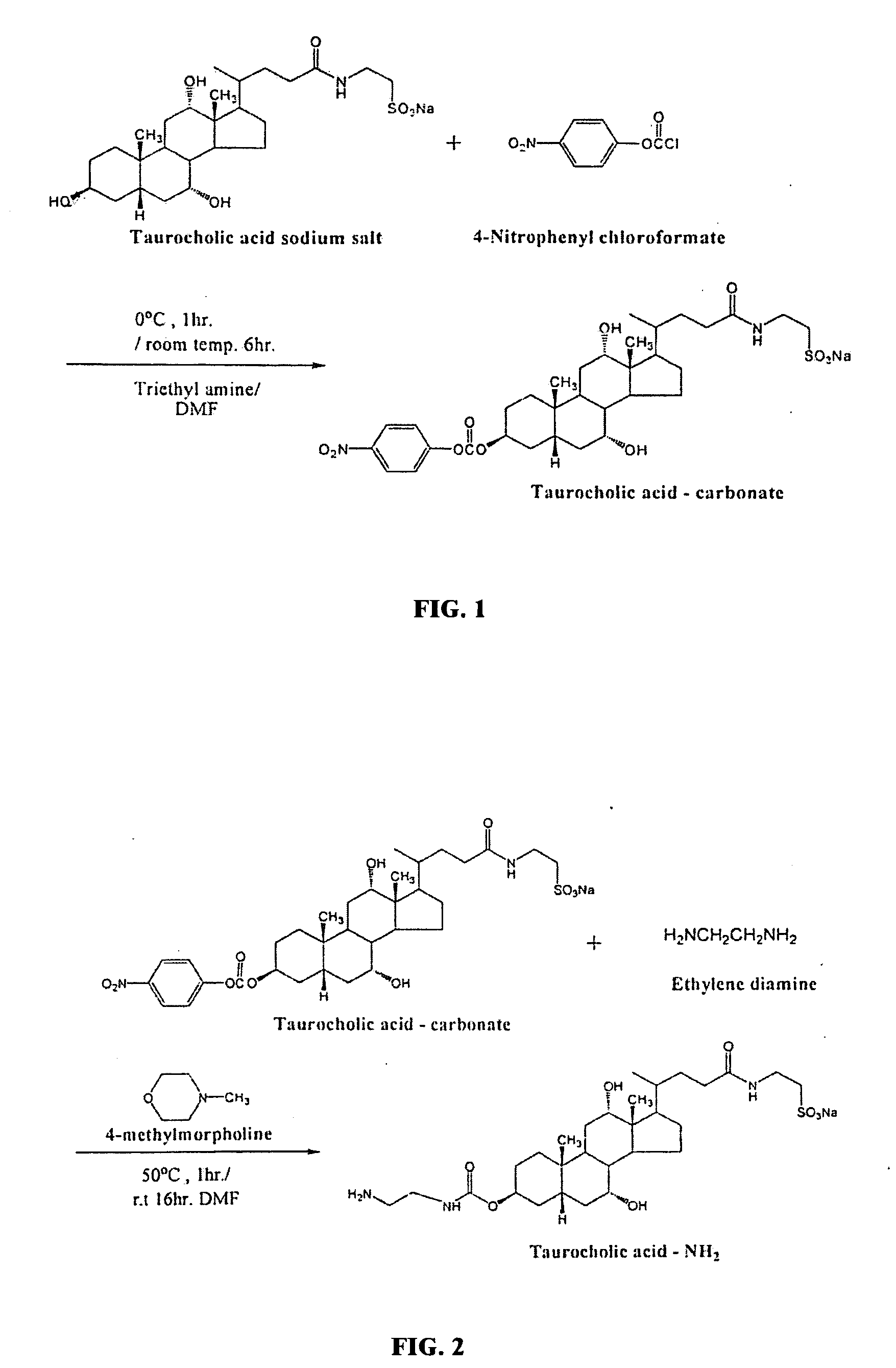
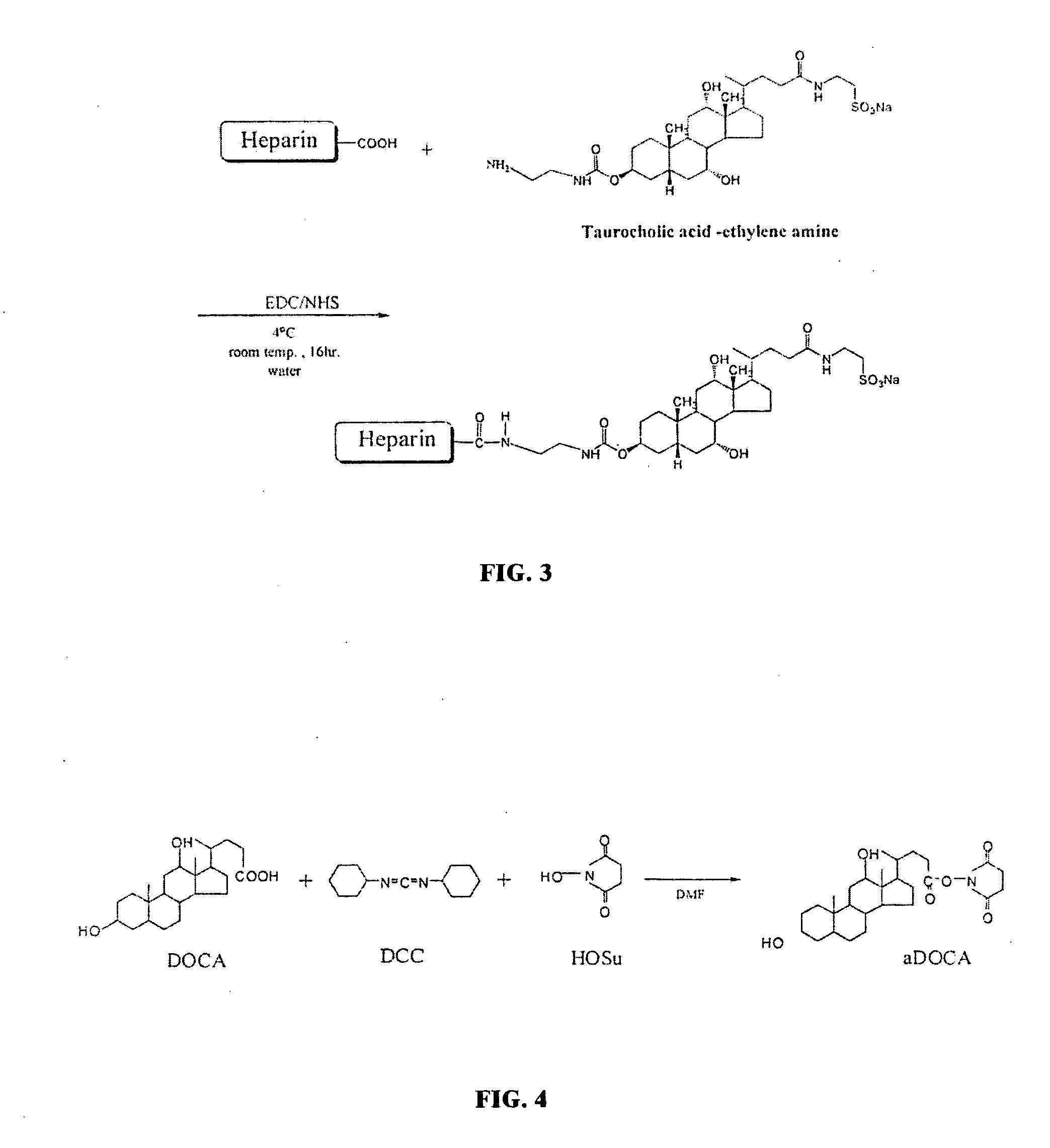
[0052]Taurocholic acid (TCA)-LMWH was synthesized by conjugating carboxyl groups of LMWH with amine groups of TCA-amine derivatives. First, taurocholic acid nitrophenyl carbonate was synthesized (CB-TCA; FIG. 1), which comprises an activated derivative of taurocholic acid. TCA sodium salt (0.5 g; Sigma Chemical Co., St. Louis, Mo.) was mixed with N,N-dimethylformamide (DMF; 4.6 ml; Sigma), and the mixture was agitated at 0° C. Then, triethylamine (0.565 g; Sigma) and 4-nitrophenyl chloroformate (NPC; Sigma) were added to the mixture and reacted for 1 h at 0° C. followed by 6 h at room temperature. This resulted in the 4-nitrophenyl formate group bonding to the 3-hydroxyl group of TCA. The feed mole ratio of TCA, NPC, and triethylamine was 1:5:6.
[0053]Second, an amine derivative of taurocholic acid (Et-TCA) was synthesized (FIG. 2). CB-TCA (0.5 g) was dissolved in 5 ml of DMF. Then, 4-methyl-morpholine (0.144 g; Sigma) was added,...
example 2
Synthesis of Heparin-Lithocholid Acid (“HL”) Conjugates
[0055]A solution of lithocholic acid (LITHO; 23. 5 mmol; Sigma) in 25 ml of methanol was acidified 2 with 0.3 ml of concentrated HCl. This mixture was stirred and heated to reflux at 75° C. for 6 h. The solution was then cooled to 0° C. until crystallization occurred. The product was thrice filtered and washed with cold methanol, followed by vacuum drying at room temperature. The resulting lithocholyl methyl ester (3.8 g) was reacted with 75 ml of ethylenediamine by reflux at 120° C. for 7 h. After cooling to room temperature, the mixture was precipitated in cold distilled water with vigorous stirring, stored at 0° C. for 1 day, filtered, and washed with cold distilled water. The white powder LITHO-NH2 was obtained after drying under partial vacuum.
[0056]Heparin (100 mg) was dissolved in 3 ml of formamide by gentle heating. Different amounts of EDC were mixed with heparin solutions at room temperature, followed by the addition o...
example 3
Synthesis of Folate-HL Derivatives
[0057]Folic acid (1 mmol; Sigma) was dissolved in 20 ml of dimethylsulfoxide (DMSO) with gentle heating (above 50° C.). N,N-dicyclohexylcarbodiimide (DCC; Sigma) and HOSu (2 mmol) were then added to the solution and reacted in the dark for 6 h. After removing precipitants (dicyclohexyl urea) by filtration, the resulting folate-NHS was mixed with 13 mmolar equiv of ethylenediamine plus 500 μl of pyridine and allowed to react at room temperature overnight. The crude product was precipitated by addition of excess acetonitrile, filtered, and washed 10 times with diethyl ether before drying under reduced pressure. For further purification, gamma-linked folate-NH2 was separated from the unwanted folic acid by HPLC.
[0058]HL was dissolved in 20 ml of formamide (Sigma) with EDC (3.38 mg) with 5 μl of DIEA for 24 h. The gamma-linked folate-NH2 (16 mg) dissolved in 2 ml of DMF was then added to the reaction plus TEA (16.5 μl) for 20 h. The unreacted folate-NH2...
PUM
| Property | Measurement | Unit |
|---|---|---|
| Composition | aaaaa | aaaaa |
| Molecular weight | aaaaa | aaaaa |
Abstract
Description
Claims
Application Information
 Login to View More
 - R&D
- Intellectual Property
- Life Sciences
- Materials
- Tech Scout
- Unparalleled Data Quality
- Higher Quality Content
- 60% Fewer Hallucinations
Browse by: Latest US Patents, China's latest patents, Technical Efficacy Thesaurus, Application Domain, Technology Topic, Popular Technical Reports.
© 2025 PatSnap. All rights reserved.Legal|Privacy policy|Modern Slavery Act Transparency Statement|Sitemap|About US| Contact US: help@patsnap.com