Check patentability & draft patents in minutes with Patsnap Eureka AI!

Stable ferrous-ferric nitrate solutions for fischer-tropsch catalyst preparation

a ferrous-ferric nitrate solution and catalyst technology, applied in physical/chemical process catalysts, metal/metal-oxide/metal-hydroxide catalysts, other chemical processes, etc., can solve the problem of sacrificing activity and selectivity for catalyst strength, unable to determine the actual attrition resistance that is sufficient, and breaking down the initial catalyst particles into very small particles

Active Publication Date: 2009-12-03
RES USA LLC
View PDF13 Cites 8 Cited by
  • Summary
  • Abstract
  • Description
  • Claims
  • Application Information

AI Technical Summary

Benefits of technology

[0013]Herein disclosed is a method for producing a stable ferrous nitrate solution, the method comprising dissolving iron in nitric acid having a first nitric acid concentration to form a ferrous nitrate solution and maintaining the solution at a first temperature for a first time period, whereby the Fe(II) content of the ferrous nitrate solution changes by less than about 2 weight percent over a second time period. In embodiments, the first nitric acid concentration is in the range of from about 5 to about 10 weight percent. In embodiments, the first nitric acid concentration is about 6 weight percent. In embodiments, the first temperature is a

Problems solved by technology

One of the primary difficulties encountered in using iron-based catalysts for carrying out the FT reaction in a slurry bubble column reactor (SBCR) is the breakdown of the initial catalyst particles into very small particles, i.e. less than 5 microns in size.
Although the small particle size is advantageous for increasing surface area and reaction rate of the catalyst, the problem lies in separating the small catalyst particles from the wax slurry medium.
It is impossible to determine the actual attrition resistance that is sufficient without knowing the type of reactor system, the type of wax / catalyst separation system and the system operating conditions.
Such approaches sacrifice activity and selectivity for catalyst strength which may exceed that which is sufficient.
The challenge is to strengthen the catalyst without appreciably compromising the activity and selectivity of the catalyst.
Ferrous nitrate solution is reported to be very unstable in the literature.
Production of stable ferrous nitrate solutions and stable solutions comprising a desired ratio of ferrous to ferric iron is challenging, and the production thereof will lead to more consistent iron-catalyst formation and a decrease in the time and costs of catalyst formation.

Method used

the structure of the environmentally friendly knitted fabric provided by the present invention; figure 2 Flow chart of the yarn wrapping machine for environmentally friendly knitted fabrics and storage devices; image 3 Is the parameter map of the yarn covering machine
View more

Image

Smart Image Click on the blue labels to locate them in the text.
Viewing Examples
Smart Image
  • Stable ferrous-ferric nitrate solutions for fischer-tropsch catalyst preparation
  • Stable ferrous-ferric nitrate solutions for fischer-tropsch catalyst preparation
  • Stable ferrous-ferric nitrate solutions for fischer-tropsch catalyst preparation

Examples

Experimental program
Comparison scheme
Effect test

example 1

A. Example 1

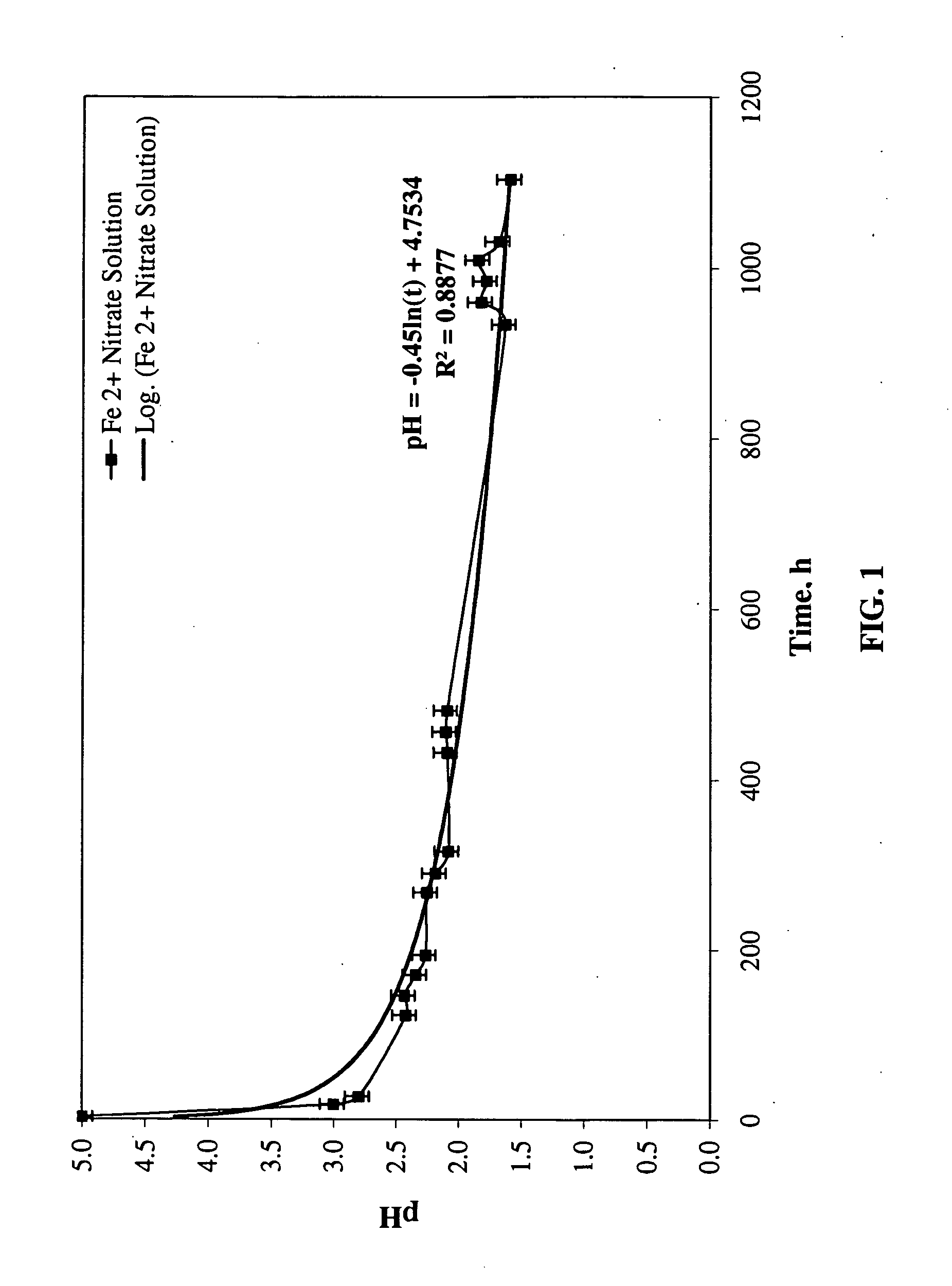
[0095]Stability of Ferrous Nitrate Solutions, Ferric Nitrate Solutions, and Fe(II) / Fe(III) Nitrate Solutions. Iron powder (Hoeganaes) and nitric acid (VWR, 68-70%) were used to make (1) ferrous nitrate, (2) ferric nitrate and (3) 25% ferrous / 75% ferric nitrate solutions. The pH of each solution was measured at room temperature on a regular basis, to study stability.

[0096]Preparation of ferrous nitrate (Fe(II) Nitrate) Solution (1): Ferrous nitrate solution (1) was prepared by dissolving iron powder in nitric acid of specific gravity of 1.03122, which corresponds to nitric acid of 6 weight percent, in an ice bath. The color of the solution was dark green.

[0097]Preparation of ferric nitrate (Fe(III) Nitrate) Solution (2): Ferric nitrate solution (2) was prepared by dissolving iron powder in nitric acid of specific gravity of 1.1469, which corresponds to nitric acid of 25 weight percent, in an ice bath. The color of the solution was green.

[0098]Preparation of ferrous (25 w ...

example 2

B. Example 2

[0105]Stability of Fe(II) / Fe(III) Mixtures. Further experiments were performed to understand the factors that affect Fe(II) stability in mixed Fe(II) / Fe(III) solutions. During these experiments, it was found that the reproducibility of the Fe(II) measurements was greatly increased from ±5% to ±0.5% by excessive rinsing of the sample cells.

[0106]1. AR60-01. Solutions of ferrous nitrate (1) and ferric nitrate (2) were formed. Ferrous nitrate solution (1) was formed by combining iron metal with nitric acid at 35° C. and holding at that temperature for 10 minutes. Ferric nitrate solution (2) was formed by combining iron metal with nitric acid at 35° C. and holding at that temperature for 10 minutes and then heating to 70° C. for 30-40 minutes. The solutions were mixed to form a solution with 10% Fe(II). Ferrous nitrate solution (1) and ferric nitrate solution (2) were not filtered in this experiment, and were not covered during iron dissolution / heating. The pH of the solutio...

the structure of the environmentally friendly knitted fabric provided by the present invention; figure 2 Flow chart of the yarn wrapping machine for environmentally friendly knitted fabrics and storage devices; image 3 Is the parameter map of the yarn covering machine
Login to View More

PUM

PropertyMeasurementUnit
Temperatureaaaaaaaaaa
Timeaaaaaaaaaa
Login to View More

Abstract

A method of producing stable ferrous nitrate solution by dissolving iron in nitric acid to form a ferrous nitrate solution and maintaining the solution at a first temperature for a first time period, whereby the Fe(II) content of the ferrous nitrate solution changes by less than about 2% over a second time period. A method of producing stable Fe(II) / Fe(III) nitrate solution comprising ferrous nitrate and ferric nitrate and having a desired ratio of ferrous iron to ferric iron, including obtaining a stable ferrous nitrate solution; dissolving iron in nitric acid to form a ferric nitrate solution; maintaining the ferric nitrate solution at a second temperature for a third time period; and combining amounts of stable ferrous nitrate solution and ferric nitrate solution to produce the stable Fe(II) / Fe(III) nitrate solution. A method of preparing an iron catalyst is also described.

Description

CROSS-REFERENCE TO RELATED APPLICATIONS[0001]This application claims the benefit under 35 U.S.C. § 119(e) of U.S. Provisional Patent Application No. 61 / 058,104 filed Jun. 2, 2008, the disclosure of which is hereby incorporated herein by reference in its entirety.STATEMENT REGARDING FEDERALLY SPONSORED RESEARCH OR DEVELOPMENT[0002]Not Applicable.BACKGROUND OF THE INVENTION[0003]1. Field of the Invention[0004]The present invention relates generally to iron Fischer-Tropsch catalysts. More particularly, the present invention relates to a method for preparing stable Fe(II) / Fe(III) nitrate and / or ferrous nitrate solutions to produce Fischer-Tropsch synthesis catalyst, and the catalyst produced thereby. Still more specifically, the present invention relates to a method of producing a Fischer-Tropsch catalyst by precipitating iron from an acid solution comprising a desired ratio of ferrous iron to ferric iron and wherein the acid solution is stable for a desired time period.[0005]2. Backgro...

Claims

the structure of the environmentally friendly knitted fabric provided by the present invention; figure 2 Flow chart of the yarn wrapping machine for environmentally friendly knitted fabrics and storage devices; image 3 Is the parameter map of the yarn covering machine
Login to View More

Application Information

Patent Timeline
no application Login to View More
IPC IPC(8): B01J21/08C09K3/00B01J23/745B01J21/06B01J23/78B01J23/72B01J21/02
CPCB01J23/002B01J23/745C10G2/332C07C1/0445C07C1/044B01J2523/00B01J23/78B01J35/002B01J37/03B01J37/10B01J2523/13B01J2523/17B01J2523/41B01J2523/842B01J35/30
Inventor NIKRAD, PANDURANG V.TAYLOR, JESSE W.BLEY, RICHARD A.DUBUISSON, DANNY M.ROLFE, SARA L.DEMIREL, BELMADUVENHAGE, DAWID J.WRIGHT, HAROLD A.
Owner RES USA LLC
Features
  • R&D
  • Intellectual Property
  • Life Sciences
  • Materials
  • Tech Scout
Why Patsnap Eureka
  • Unparalleled Data Quality
  • Higher Quality Content
  • 60% Fewer Hallucinations
Social media
Patsnap Eureka Blog
Learn More