[0012]The current invention provides an apparatus and process to mold very long and very large-
diameter articles without some of the costs and disadvantages of the prior art. In particular, and among other advantages, the
present method facilitates the fabrication of very long articles on-site, in a series of molding shots on the same article, yet maintains complete continuity of fibers and
fiber geometry across the shots within the primary load-bearing portions of the article. As a consequence, although produced as a series of shots, the finished article nevertheless possesses advantageous characteristics of a one-shot molded article.
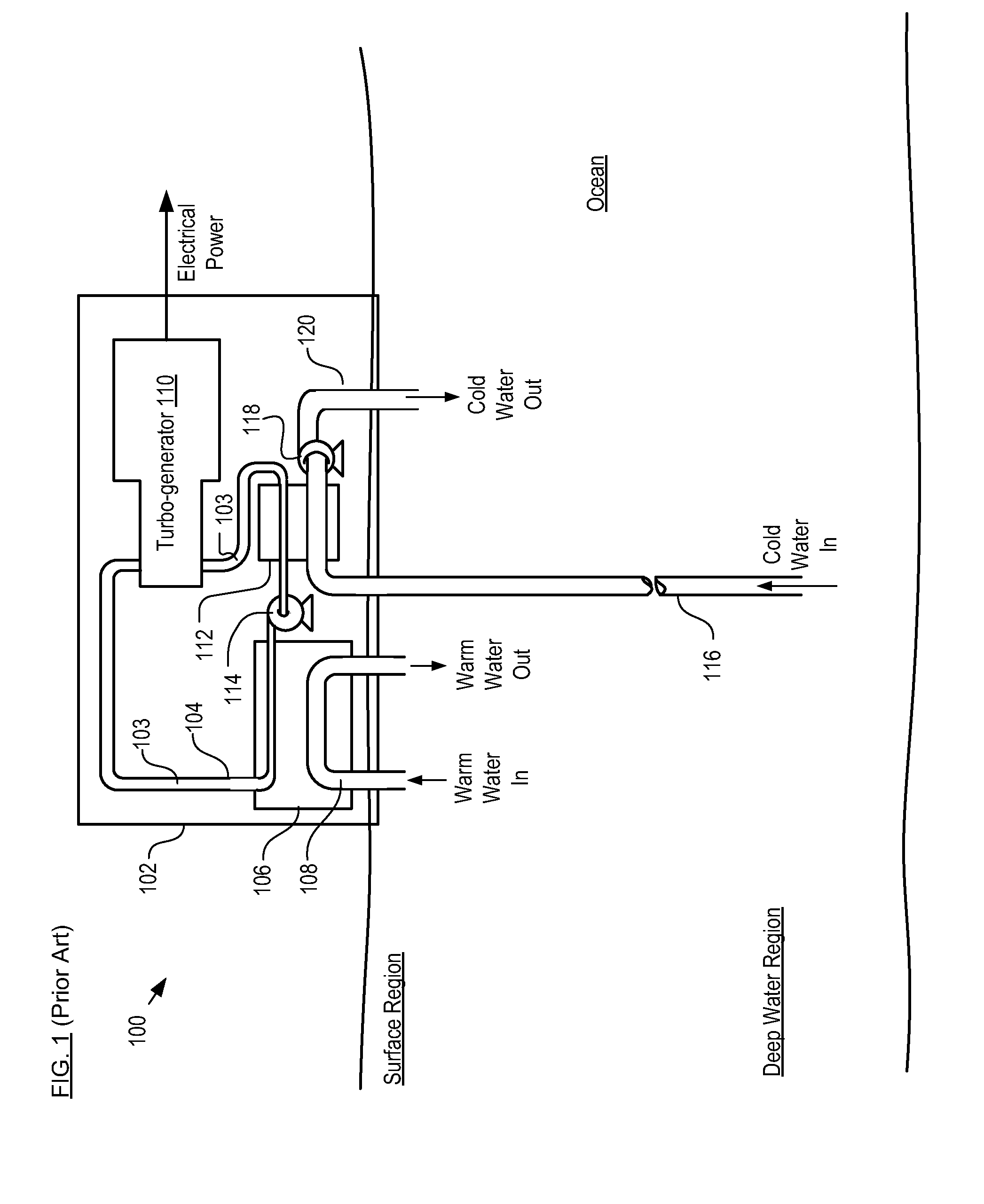
[0013]In the illustrative embodiment, the apparatus and processes disclosed herein are used to fabricate an OTEC cold
water pipe. The fabrication takes place on-site, on a floating ocean platform. In some embodiments, that platform becomes the surface portion of the OTEC
plant. This approach eliminates the need to
handle and transport what would otherwise be many sections of bulky hollow
pipe. Rather, and to great
advantage, the process requires the transport of only the raw fabric (e.g., fiberglass, etc.), resin, and discrete-length pultruded core “planks,” all in
compact form, to the field location (e.g., platform,
barge, etc.).
[0014]For lowest fabrication time and cost, it is desirable to limit the number of molding shots for forming the article (e.g., cold
water pipe, etc.). But the fewer the number of shots, the longer the length of pipe molded per shot. The required height of the working area where the pipe is molded is a function, of course, of this unit pipe length.
[0020]Since the density of the
liquid resin is similar to water (about 1 g / cc) the aforementioned effect places an absolute limit of about 33 feet on the height of a workpiece that can be made by VARTM. At 33 feet there would, however, be one
atmosphere compaction pressure on the composite laminate at the top of the workpiece and zero compaction pressure at the bottom. This would produce very non-uniform laminate properties, such as, for example, fiber
volume fraction. This second effect limits the practical working heights for a single “shot” of VARTM to about 15 feet. To fabricate a cold water pipe having a length of 3000 feet would require an unacceptably high 200 shots, if each shot produced a pipe section having a length of only 15 feet.
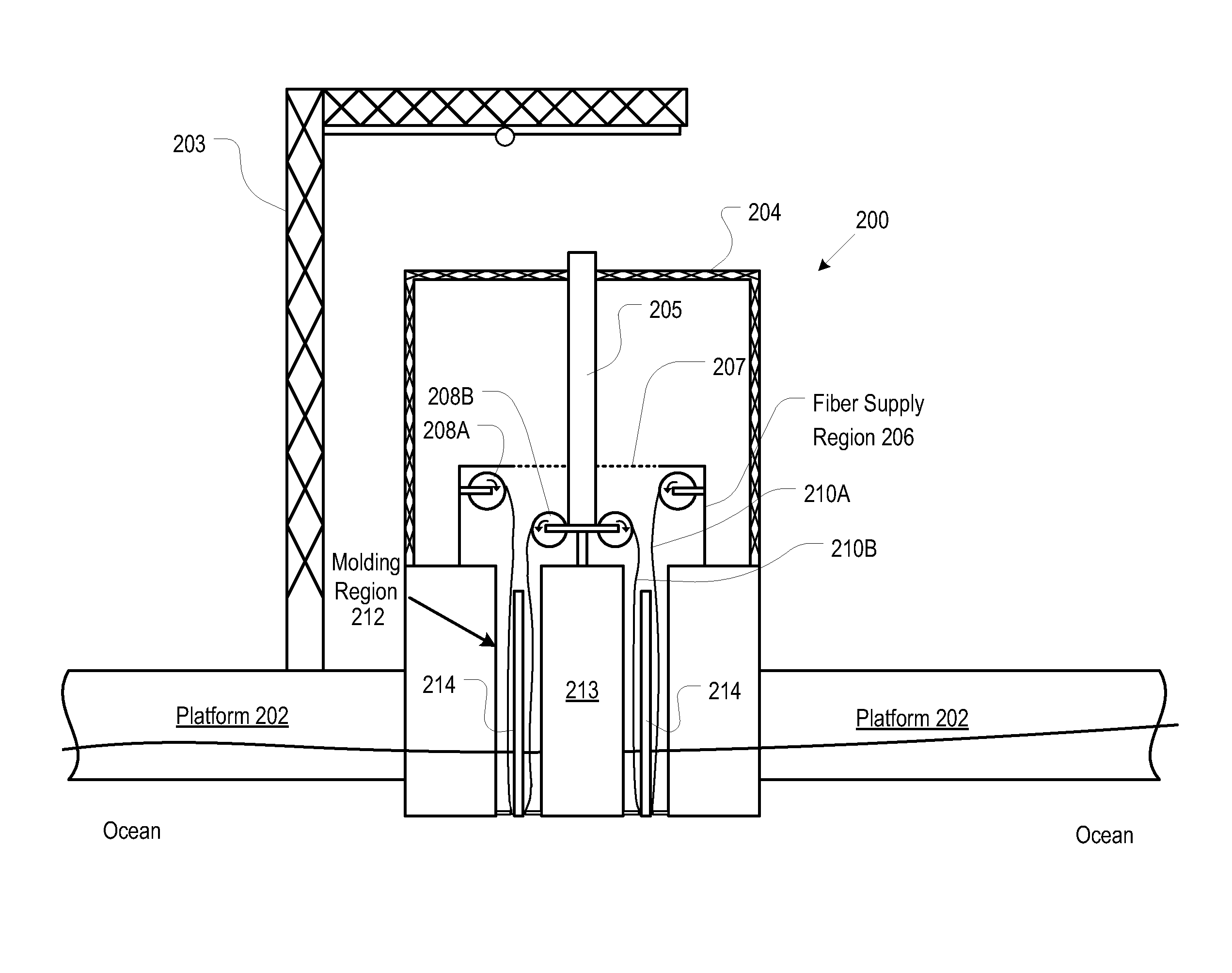
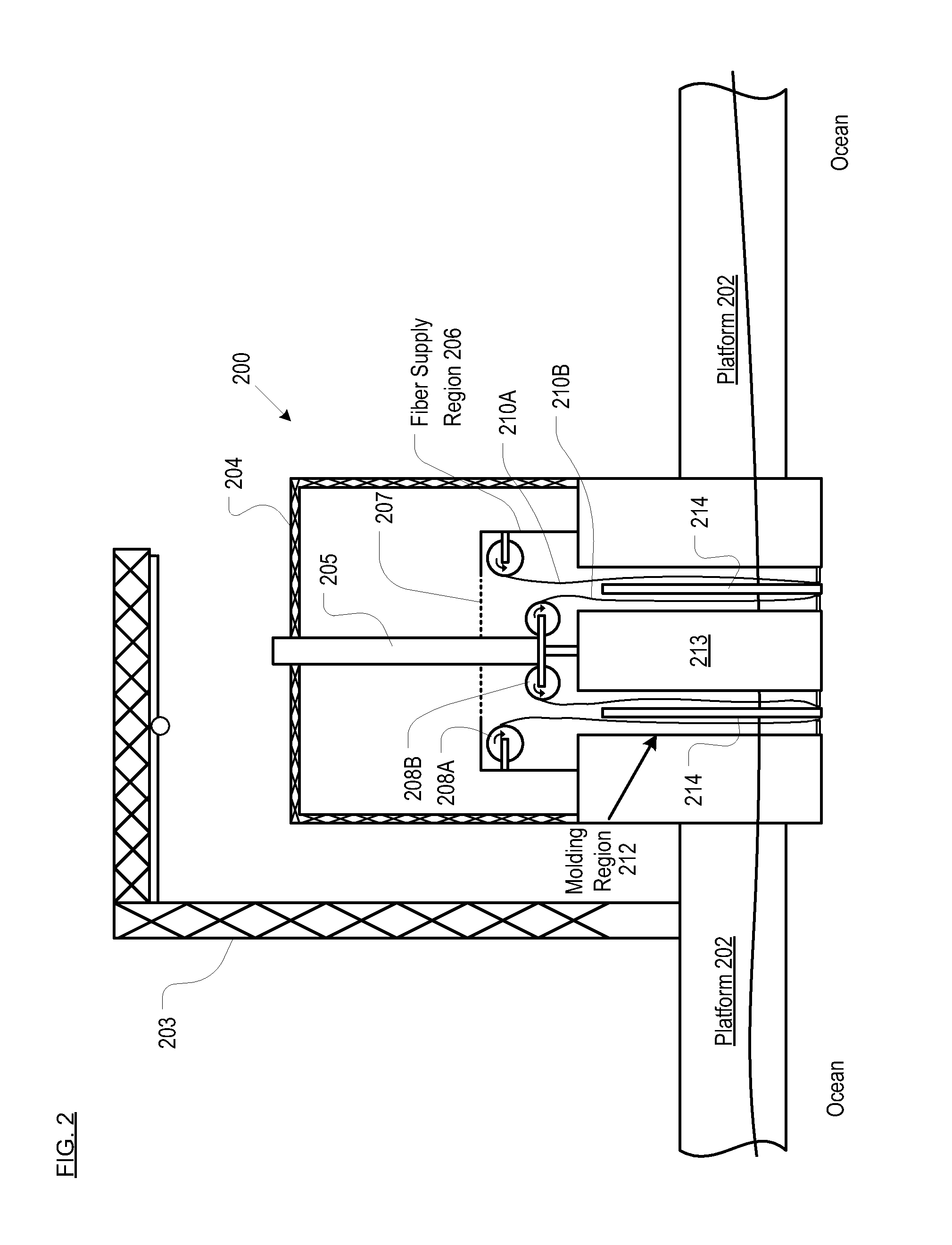
[0023]To facilitate the positioning of fabric within the molding region, a vacuum is drawn “behind” the inner soft tool and the outer soft tool (i.e., in the region between the soft tool and the nearest hard surface). The vacuum causes the inner soft tool to move toward the hard inner surface and the outer soft tool to move toward the hard outer surface. Fabric from the rolls is then fed into the molding region, along with a core material. The core material forms the core of a “sandwich” pipe wall and the fabric forms the face sheets of that sandwich. Specifically, fabric is disposed between the inner soft tool and the core, and fabric is also disposed between the outer soft tool and the core. In some embodiments, a resin distribution material (to assist in spreading the resin throughout the fabric) is pulled into the molding region along with the fabric.
[0024]After the fabric and core are in place in the molding region, the vacuum established behind the soft tools is released. An inner and outer vacuum seal are activated at the bottom of the molding region to seal the soft tools to that portion of the workpiece that has already been formed during a previous molding operation (i.e., a previous shot). A vacuum is developed on the “other” side of the soft tools (where the still-dry fabric is disposed) to withdraw air from the fabric in the molding region, which minimizes the void content of the resulting laminate. To avoid having to create a gas-tight seal between the fiber supply region and the molding region (over the dry, porous fabric, where creating such a seal would be particularly difficult or perhaps even impossible), the fiber supply region, as well as the molding region, are in fluidic communication with one another and are both placed under vacuum.


 Login to View More