Optical fiber sensor
- Summary
- Abstract
- Description
- Claims
- Application Information
AI Technical Summary
Benefits of technology
Problems solved by technology
Method used
Image



Examples
embodiment 1
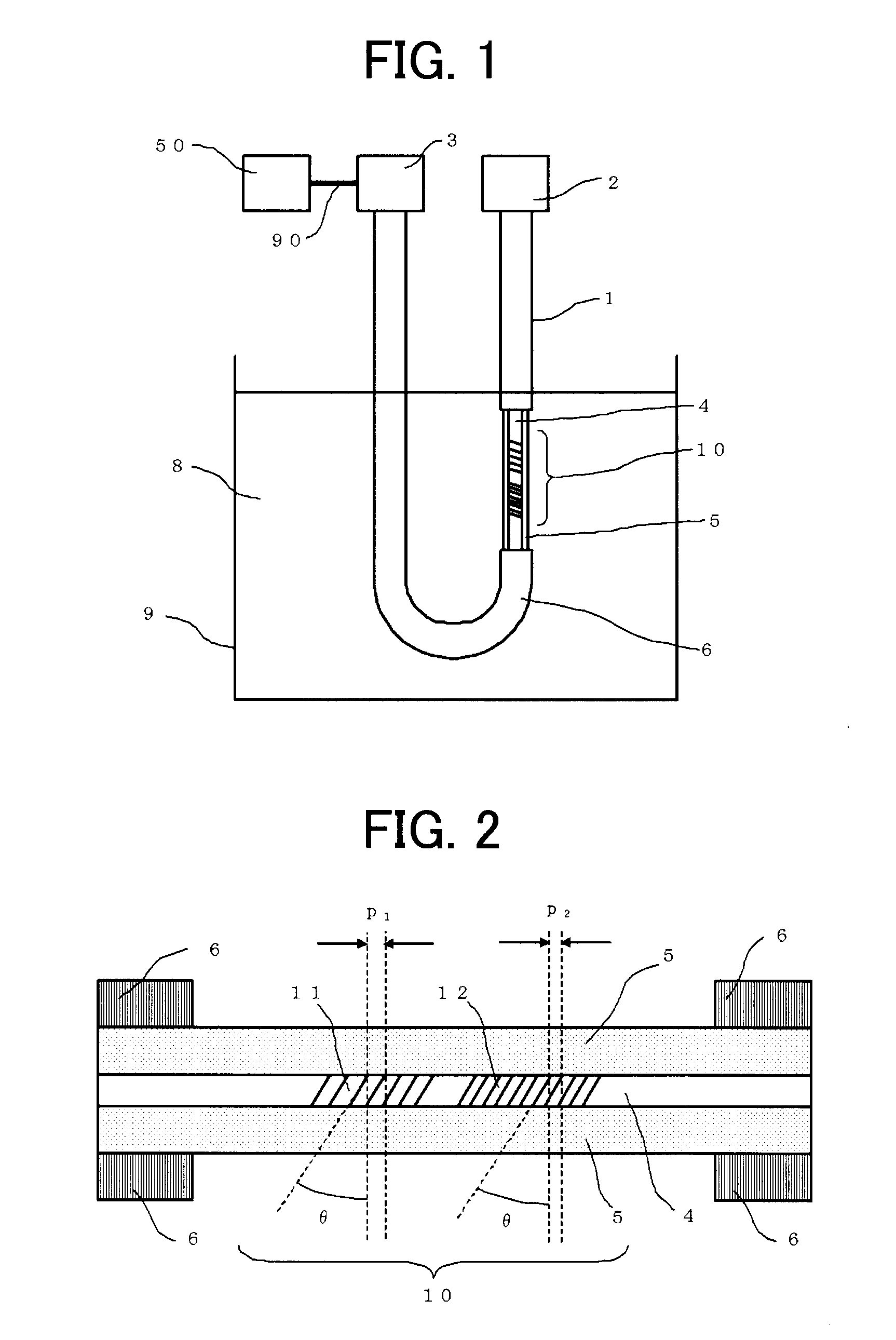
[0054]FIG. 1 is a schematic diagram explaining an optical fiber sensor according to Embodiment 1 implementing the present invention. In FIG. 1, a light source 2 is arranged at one end portion of an optical fiber 1, and a light receiving unit 3 is arranged at the other end portion. The optical fiber 1 is provided with a core 4 through which light mainly from the light source 2 propagates, a cladding 5 covering the core 4 so that light is confined in the core 4, and a fiber jacket 6 which covers and protects the cladding 5. A part of the fiber jacket 6 is removed so that the cladding 5 directly contacts a liquid target 8 to be measured, and short-period gratings 10 are formed on the core 4 corresponding to the portion from which the fiber jacket 6 is removed. The optical fiber sensor is configured with the optical fiber 1, the light source 2, the light receiving unit 3, and a refractive-index calculation unit 50 connected to the light receiving unit 3 through a signal line 90. The opt...
embodiment 2
[0083]The effect of the provision of the short-period gratings 10 having the periods different from each other has been explained in Embodiment 1. In this embodiment, an optical fiber sensor is explained that has a plurality of the short-period gratings 10 whose periods as well as tilt angles are different from each other.
[0084]First, a dependency of the refractive index of the target 8 against the tilt angle of the short-period grating 10 is explained. By changing the period of the short-period grating 10 as explained in Embodiment 1, the wavelength range where the transmission loss appears under cladding propagation mode can be shifted; however, the measurable range of refractive-index of the target 8 to be measured does not vary. In contrast, by changing the tilt angle of the short-period grating 10, it is possible to vary the measurable range of refractive-index of the target 8 to be measured, as well as to shift the wavelength range where the cladding-propagation-mode transmiss...
embodiment 3
[0110]In the short-period grating 10 of the optical fiber sensor according to this embodiment, a region in which the refractive index is different from that of the core 4 is not planarly formed, but is curvedly provided. Hereinafter, such a short-period grating 10 is referred to as short-period grating 10 tilted with a continuously varying angle.
[0111]First, an explanation will be made for the optical fiber 1 represented in Embodiments 1, in which the tilt angle of the short-period grating 10 is uniform, that is, the region in which the refractive index is different from that of the core 4 is formed planarly.
[0112]The short-period grating 10 having a constant tilt angle is formed, for example, using periodical linear beams 30, having the wavelength of 266 nm, of the fourth harmonic wave from an Nd-YAG laser having the output power of 200 mW, by irradiating a multi-mode quartz optical fiber 1 whose fiber jacket 6 has been removed, with the linear beams 30 tilted by a predetermined an...
PUM
 Login to View More
 Abstract
Description
Claims
Application Information
 Login to View More
 - R&D
- Intellectual Property
- Life Sciences
- Materials
- Tech Scout
- Unparalleled Data Quality
- Higher Quality Content
- 60% Fewer Hallucinations
Browse by: Latest US Patents, China's latest patents, Technical Efficacy Thesaurus, Application Domain, Technology Topic, Popular Technical Reports.
© 2025 PatSnap. All rights reserved.Legal|Privacy policy|Modern Slavery Act Transparency Statement|Sitemap|About US| Contact US: help@patsnap.com