

Centrifugation Method
a centrifugation method and centrifugation technology, applied in the direction of amphoteric ion exchangers, chemical/physical processes, water/sewage treatment by ion exchange, etc., can solve the problems of contaminated lower layer substances, method lack of flexibility, difficult to avoid contamination of precipitates into supernatants, etc., to achieve easy prevention of contamination and easy prevention of precipitates
- Summary
- Abstract
- Description
- Claims
- Application Information
AI Technical Summary
Benefits of technology
Problems solved by technology
Method used
Image

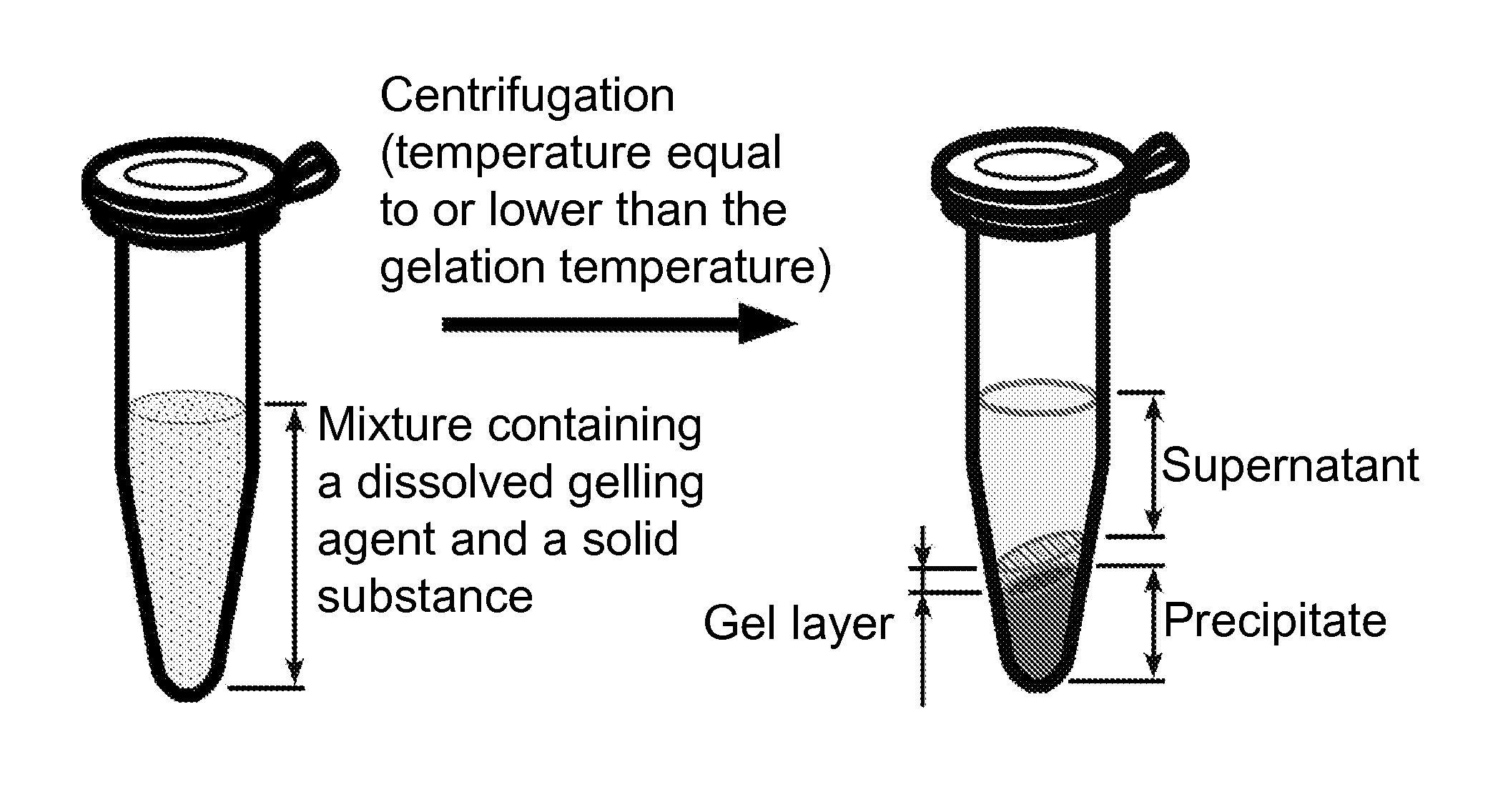

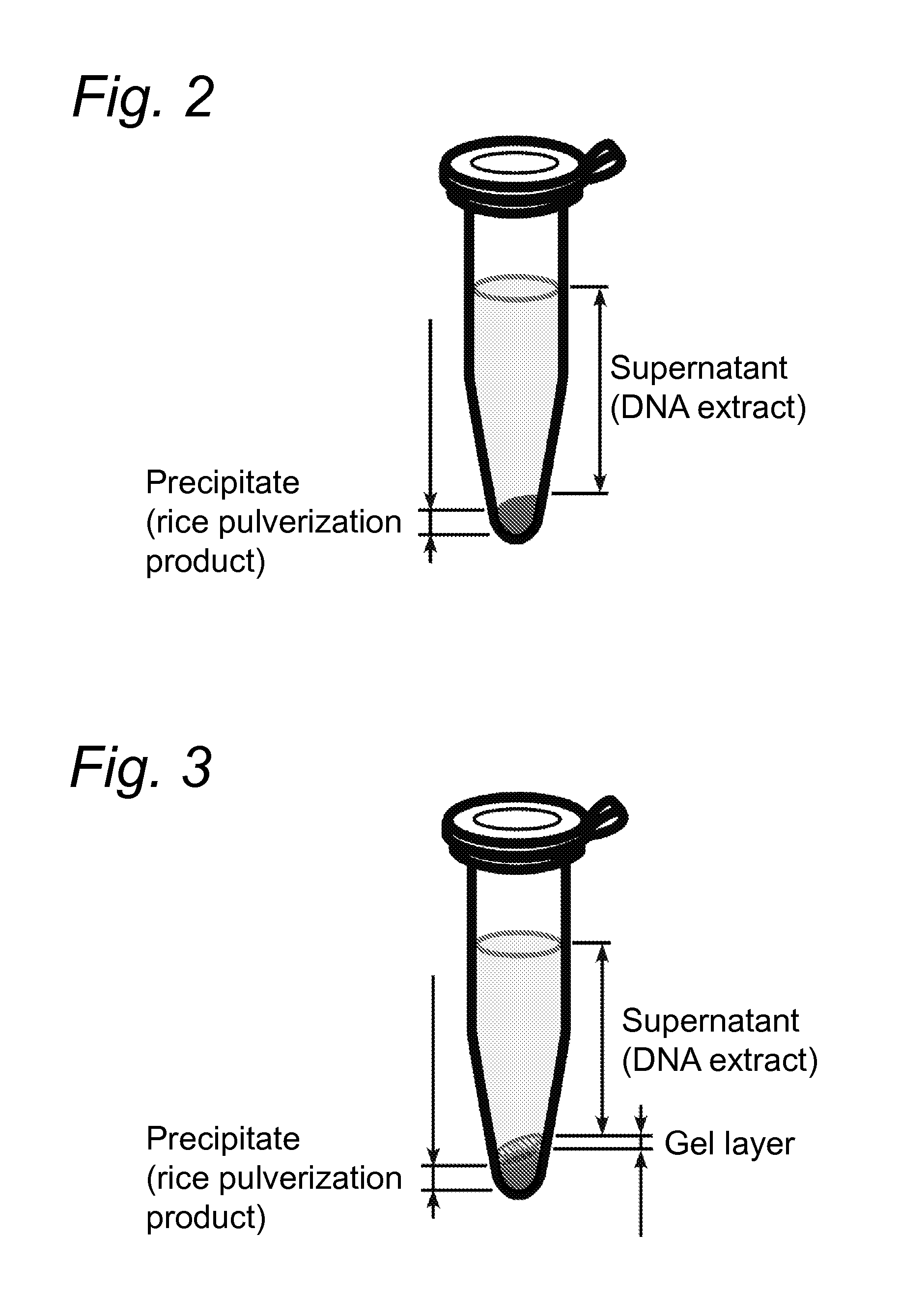
Examples
example 1
[0056]The centrifugation method which uses a gelling agent was tested by applying it to centrifugation in extracting DNA from rice. In this connection, as the respective reagents to be used in the extraction of DNA from rice, those attached to a rice DNA extraction kit [(polished rice 20 grain scale) (for PCR Kit for rice discrimination). manufactured by TAKARA BIO INC.] were used.
[0057]Four suspensions were prepared by adding 4.5 mg, 9 mg, 15 mg or 22.5 mg of SeaKem (registered trademark) GTG Agarose (manufactured by Lonza) to 500 μl of Lysis Buffer A and suspending therein. The thus prepared 4 suspensions were transferred onto a boiling water bath, thereby completely dissolving the agarose. Next, Lysis Buffer B heated in advance on a boiling water bath was added to respective suspensions in 200 μl portions and mixed therewith, and these were kept on the boiling water bath as agarose solutions until their use in the following test.
[0058]Five tubes were prepared by putting 20 grains...
example 2
[0062]The precipitation separation method which uses a gelling agent was tested by applying it to centrifugation in extracting DNA from a plant by a benzyl chloride method. In this connection, as the respective reagents to be used in the benzyl chloride method, those which are attached to the Plant DNA Isolation Reagent (manufactured by TAKARA BIO INC.) were used.
[0063]Four suspensions were prepared by putting 1 ml of sterile water into each of 1.5 ml capacity microtubes and adding 4.5 mg, 9 mg, 15 mg or 22.5 mg of Seakem (registered trademark) GTG Agarose (manufactured by Lonza) thereto and suspending therein. The thus prepared 4 suspensions were transferred onto a boiling water bath, thereby completely dissolving the agarose. These were kept on the boiling water bath as agarose solutions until their use in the following test.
[0064]Spinach was cut into pieces of 3 mm square or less and put into five 1.5 ml capacity microtubes in 50 mg portions, frozen at −20° C. and then thawed at ...
example 3
[0068]The precipitation separation method which uses a gelling agent was tested by applying it to centrifugation of a reagent for extracting DNA from a formalin-fixed paraffin-embedded tissue section.
[0069]Agarose LO3 “TaKaRa” (manufactured by TAKARA BIO INC.) was added to and suspend in DEXPAT (registered trademark, manufactured by TAKARA BIO INC.) which is a mixture of a PCR inhibitor adsorbent resin from a formalin-fixed paraffin-embedded tissue section and a special surfactant solution to be used in the extraction of DNA, to a final concentration of 0.1%, 0.2%, 0.3% or 0.4%.
[0070]A 500 μl portion of each of the 4 suspensions was transferred into a separate 1.5 ml capacity microtube. In addition, 500 μl of agarose-un-added DEXPAT (registered trademark) put into a 1.5 ml capacity microtube was also prepared as a control.
[0071]Each of these 5 suspensions was heated at 100° C. for 10 minutes using a heat block and then centrifugation was carried out at 4° C. and at 17,000 G for 10 m...
PUM
| Property | Measurement | Unit |
|---|---|---|
| Volume | aaaaa | aaaaa |
| Volume | aaaaa | aaaaa |
| Volume | aaaaa | aaaaa |
Abstract
Description
Claims
Application Information
 Login to View More