

Stacked herbicide tolerance event 8291.45.36.2, related transgenic soybean lines, and detection thereof
a technology of herbicide tolerance and event, applied in the field of stacking herbicide tolerance event, can solve the problems of poor selectivity in dicot crops like soybean or cotton, and the limited use of 2,4-d in grass crops, and achieve the effect of conserving the usefulness of herbicide-tolerant technologies and great flexibility and convenience in weed control options
- Summary
- Abstract
- Description
- Claims
- Application Information
AI Technical Summary
Benefits of technology
Problems solved by technology
Method used
Image

Examples
example 1
Transformation and Selection of the 2mEPSPS and AAD-12 Soybean Event 8291.45.36.2
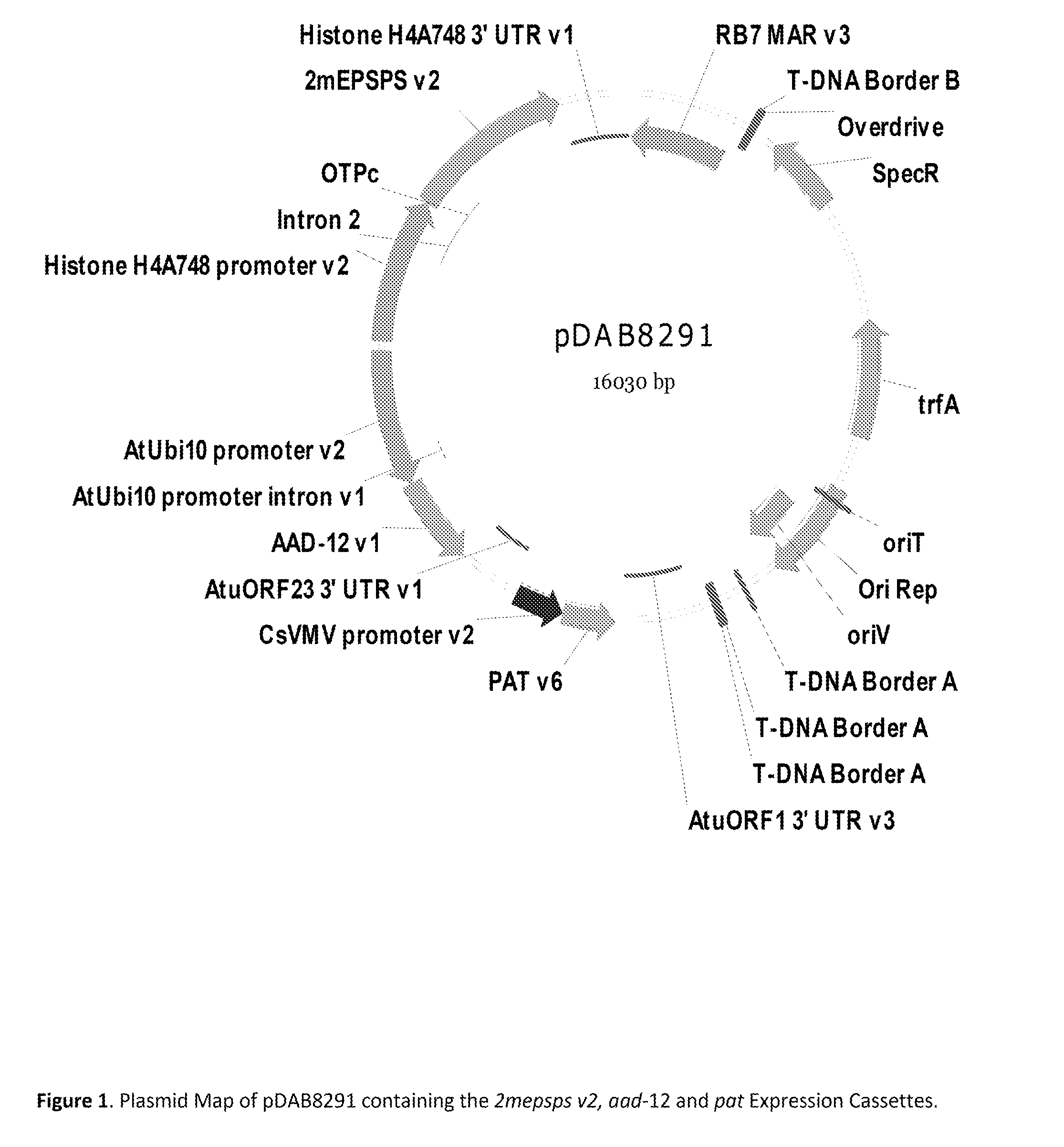
[0183]Transgenic soybean (Glycine max) containing the Soybean Event 8291.45.36.2 was generated through Agrobacterium-mediated transformation of soybean cotyledonary node explants. The disarmed Agrobacterium strain EHA101 (Hood et al., 2006) carrying the binary vector pDAB8291 (FIG. 1) containing the selectable marker, pat, and the genes of interest, aad-12 and 2mepsps v2, within the T-strand DNA region, was used to initiate transformation.
[0184]Agrobacterium-mediated transformation was carried out using a modified procedure of Zeng et al. (2004). Briefly, soybean seeds (cv Maverick) were germinated on basal media and cotyledonary nodes were isolated and infected with Agrobacterium. Shoot initiation, shoot elongation, and rooting media were supplemented with cefotaxime, timentin and vancomycin for removal of Agrobacterium. Glufosinate selection was employed to inhibit the growth of non-transformed shoots...
example 2
Characterization of AAD-12, 2mEPSPS and PAT Protein in Soybean Event 8291.45.36.2
[0187]The biochemical properties of the recombinant AAD-12, 2mEPSPS and PAT protein derived from the transgenic soybean event pDAB8291.45.36.2 were characterized. Quantitative enzyme-linked immunosorbent assay (ELISA) was used to characterize the biochemical properties of the protein and confirm expression of AAD-12, PAT and 2mEPSPS protein.
example 2.1
Expression of the AAD-12 Protein in Plant Tissues
[0188]Levels of AAD-12 protein were determined in soybean event pDAB8291.45.36.2. The soluble, extractable AAD-12 protein was measured using a quantitative enzyme-linked immunosorbent assay (ELISA) method from soybean leaf tissue.
[0189]Samples of soybean tissues were isolated from the test plants and prepared for expression analysis. The AAD-12 protein was extracted from soybean plant tissues with a phosphate buffered saline solution containing the detergent Tween-20 (PBST) containing 0.5% Bovine Serum Albumin (BSA). The plant tissue was centrifuged; the aqueous supernatant was collected, diluted with appropriate buffer as necessary, and analyzed using an AAD-12 ELISA kit in a sandwich format. The kit was used following the manufacturer's suggested protocol.
[0190]Detection analysis was performed to investigate the expression stability and heritability both vertically (between generations) and horizontally (between lineages of the same...
PUM
| Property | Measurement | Unit |
|---|---|---|
| Fraction | aaaaa | aaaaa |
| Temperature | aaaaa | aaaaa |
| Temperature | aaaaa | aaaaa |
Abstract
Description
Claims
Application Information
 Login to View More