Many of
the Internet applications are hosted in the data center servers (such as
cloud computing application,
search engine, etc.) and are data-intensive and require large degree of interactions among the servers in the data center.
In the intra-data center network, the traffics among these servers are usually dynamic in nature and often busty.
Therefore the intra-data center networks are facing challenging demand such as high channel bandwidth, flexible bandwidth configuration, low latency, high network
throughput.
Also, current data centers rely on electronic
router to perform these
interconnection functions, this consumes large amount of power and generates large volume of heat, which in turn requires more power for cooling.
However, currently the optical technology in the intra-data center application is only for point-to-point links, which utilizes only the
advantage of large bandwidth.
Such network lacks flexibility.
And it does not offer the capability to share the bandwidth as the traffic pattern changes.
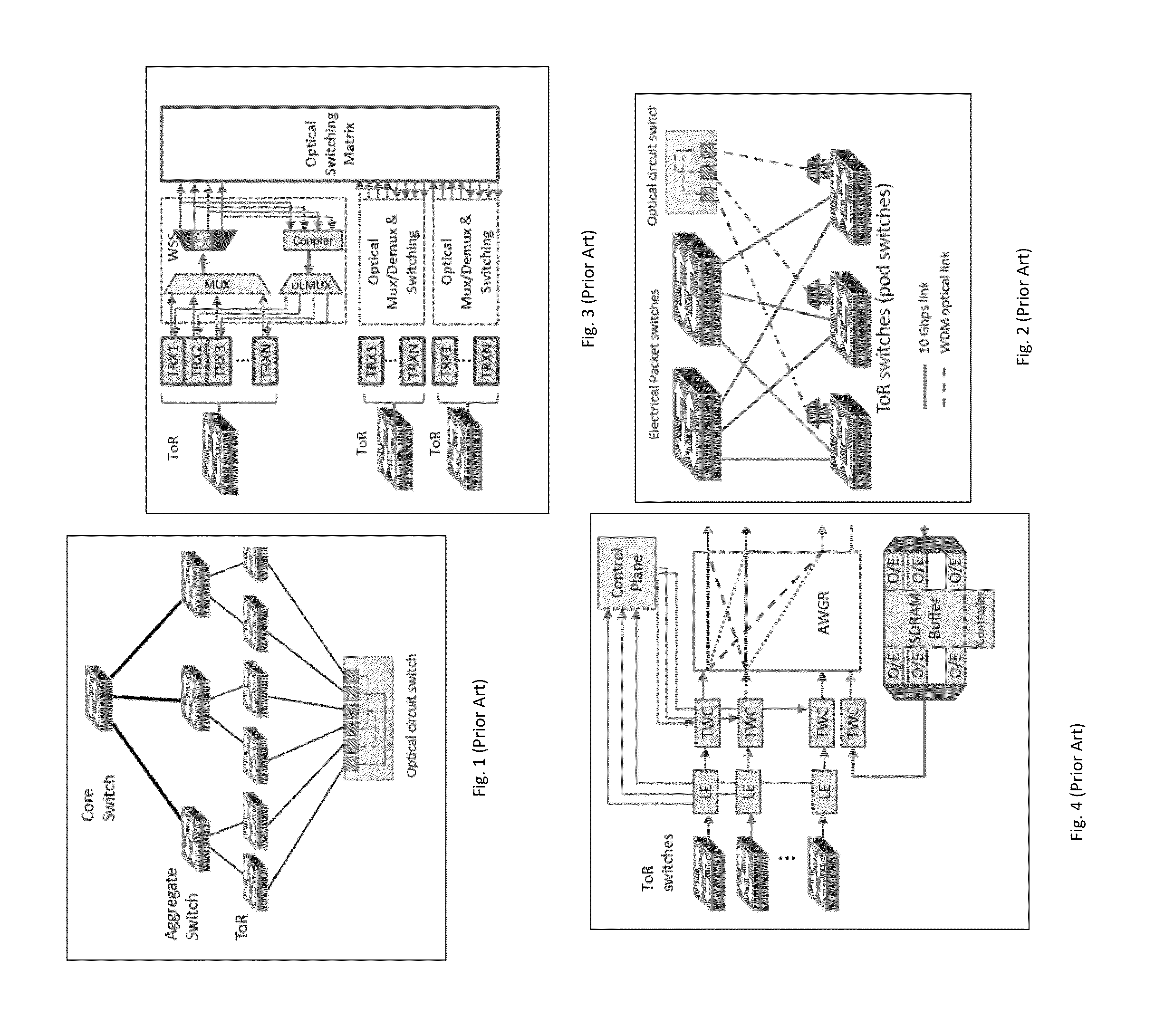
Since the traffics within a rack is relatively smaller and the servers are physically located closer (thus easier to interconnect), the focus of the intra-data center network is on how to efficiently switch among the ToRs, since the ToR, the aggregate switch and the core switch in this architecture have high
power consumption and cause latency in the traffic.
This architecture requires a large sale core optical circuit switch, which is costly and present a large
single point-of-failure.
It also does not offer
bandwidth sharing capability (unless it is done through electrical switch).
This architecture also has the disadvantages of requiring large scale optical circuit switch and not able to share optical bandwidth.
The addition of WSS also increases the hardware cost.
However this remains at lab prototype level and not yet feasible in commercial deployment.
This OEO (optical-electrical-optical) scheme is power hungry and causes latency.
Also, it uses TWC for
wavelength tuning, which is quite costly.
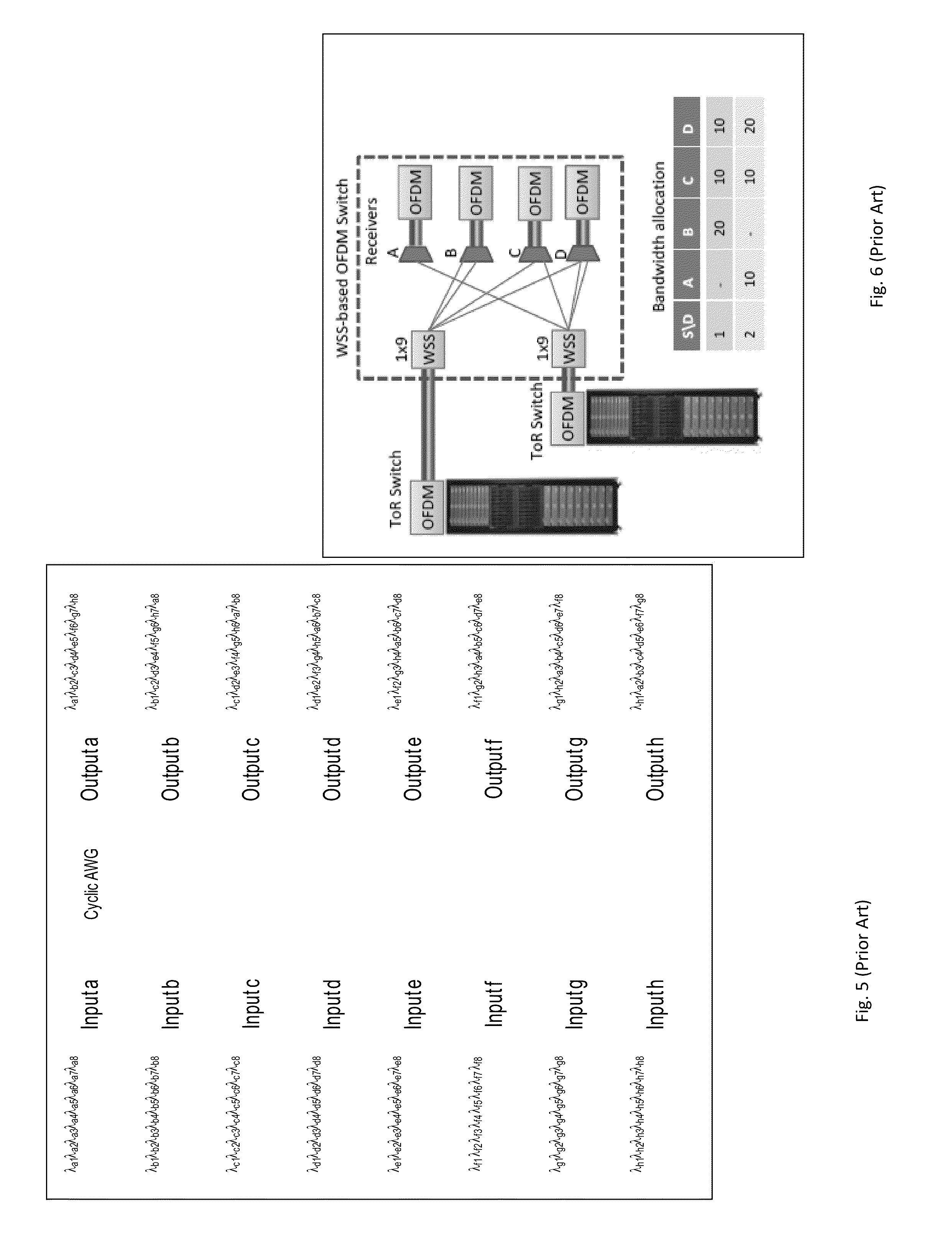
The disadvantages include the requirement of large quantities of TWCs, tunable lasers and CAWGs, which is very costly.
This architecture also requires multiple CAWGs and multiple arrays of
wavelength converters, which is very costly.
Besides that, it require arrays of wavelength switches and different optical
delay lines for time buffer, which adds the hardware cost even further.
Also, this architecture does not provide sharing of bandwidth between ToRs.
The disadvantages of this architecture include: (1) It requires a flexible grid WSS for each ToR, which is not commonly available, has limited
granularity, has limited port count (commercial prototypes are up to 1×9, therefore cannot support the data center network which has typically 100s or 1000s of ToRs), and costly.
(2) It requires guard bands between
subcarrier bands for different output ports, which leads to less efficient spectrum utilization.


 Login to View More
  Login to View More