Check patentability & draft patents in minutes with Patsnap Eureka AI!

Method for detecting hydroxylmethylation modification in nucleic acid and use thereof

a technology of hydroxylmethylation modification and nucleic acid, which is applied in the field of gene engineering, can solve the problems of inability to effectively discriminate between 5mc and 5hmc, lack of effective enzyme or chemical methods to specifically identify it and detect its distribution in the genome, and so as to improve the coverage of the whole genome and reduce the cost. , the effect of reducing the size of sequencing data

Active Publication Date: 2015-01-29
BGI TECH SOLUTIONS
View PDF2 Cites 6 Cited by
  • Summary
  • Abstract
  • Description
  • Claims
  • Application Information

AI Technical Summary

Benefits of technology

The present invention provides a method for detecting hydroxymethylation modification in nucleic acid by glycosylating the nucleic acid and using specific restriction endonucleases to produce biotin-labeled fragments that can be captured and detected. The method can be used with different types of nucleic acid and can be applied to detect hydroxymethylation modification in DNA, RNA, or a combination of both. The method can be used in various organisms and can be used for research and diagnostic purposes.

Problems solved by technology

Though 5hmC modified base has found long before, there is no effective enzyme or chemical methods to specifically identify it and to detect its distribution in the genome.
Meanwhile, bisulfite sequencing analysis, which is regarded as a golden standard for DNA methylation analysis, still cannot effectively discriminate between 5mC and 5hmC.
However, these methods, which are able to detect 5hmC's existence and expression level in a cell or a tissue, still cannot locate 5hmC's genome-wide distributions.
By far, the main strategy for detecting genome-wide distribution patterns of 5hmC comprises the steps of enrichment, capturing and sequencing, for example, hMeDIP, anti-CMS and JBP-pull down, such methods comprising the enrichment-capturing step still cannot obtain the distribution of 5hmC at a single-base resolution level, meanwhile, such antibody / protein-dependent methods are also restricted because of non-specific capture or capture bias.

Method used

the structure of the environmentally friendly knitted fabric provided by the present invention; figure 2 Flow chart of the yarn wrapping machine for environmentally friendly knitted fabrics and storage devices; image 3 Is the parameter map of the yarn covering machine
View more

Image

Smart Image Click on the blue labels to locate them in the text.
Viewing Examples
Smart Image
  • Method for detecting hydroxylmethylation modification in nucleic acid and use thereof
  • Method for detecting hydroxylmethylation modification in nucleic acid and use thereof
  • Method for detecting hydroxylmethylation modification in nucleic acid and use thereof

Examples

Experimental program
Comparison scheme
Effect test

example 1

Glycosylation Modification of Genomic DNA

[0099]Material: h9 Cell Line

[0100]For both glycosylation treatment group and first control group, 1 μg of h9 cell line genomic DNA was used, a reaction system containing the following components in Table 4 was added in a 1.5 ml centrifuge tube.

TABLE 4Glycosylation treatmentComponentgroupFirst control grouph9 genomic DNA1μg1μg25 × UDP-Glucose4μl4μl10 × NEB buffer410μl10μlT4-BGT30units30 units (inactivated)RNase-free waterup to 100 μlup to 100 μl

[0101]The reaction system was well mixed, centrifuged, and then incubated in a water bath at 37° C. for 16 hours, after the reaction, DNA was precipitated with ethanol and the ethanol precipitate was dissolve in 30 μl EB buffer.

example 2

Restriction Endonuclease Digestion with MspI

[0102]DNA yielded from the glycosylation treatment group and the first control group was digested with restriction endonuclease MspI.

[0103]A reaction system containing the following components in Table 5 was added in a 1.5 ml centrifuge tube.

TABLE 5Glycosylation treatmentComponentgroupFirst control groupPurified DNA30μl30μl10 × NEB buffer410μl10μlMspI500units500unitsRNase-free waterup to 50 μlup to 50 μl

[0104]The reaction system was incubated in a water bath at 37° C. for 16-19 hours, the enzyme in the product was inactivated by heating at 80° C. for 20 minutes.

example 3

Restriction Endonuclease Digestion with HpaII

[0105]An additional 1 μg of h9 cell line genomic DNA was directly digested with enzyme HpaII. A reaction system containing the following components in Table 6 was added in a 1.5 ml centrifuge tube.

TABLE 6ComponentHpaII digestion grouph9 genomic DNA1μg10 × NEB buffer410μlHpaII500unitsRNase-free waterup to 50 μl

[0106]The reaction system was incubated in a water bath at 37° C. for 16-19 hours, the enzyme in the product was inactivated by heating at 80° C. for 20 minutes.

the structure of the environmentally friendly knitted fabric provided by the present invention; figure 2 Flow chart of the yarn wrapping machine for environmentally friendly knitted fabrics and storage devices; image 3 Is the parameter map of the yarn covering machine
Login to View More

PUM

PropertyMeasurementUnit
Fractionaaaaaaaaaa
Lengthaaaaaaaaaa
Login to View More

Abstract

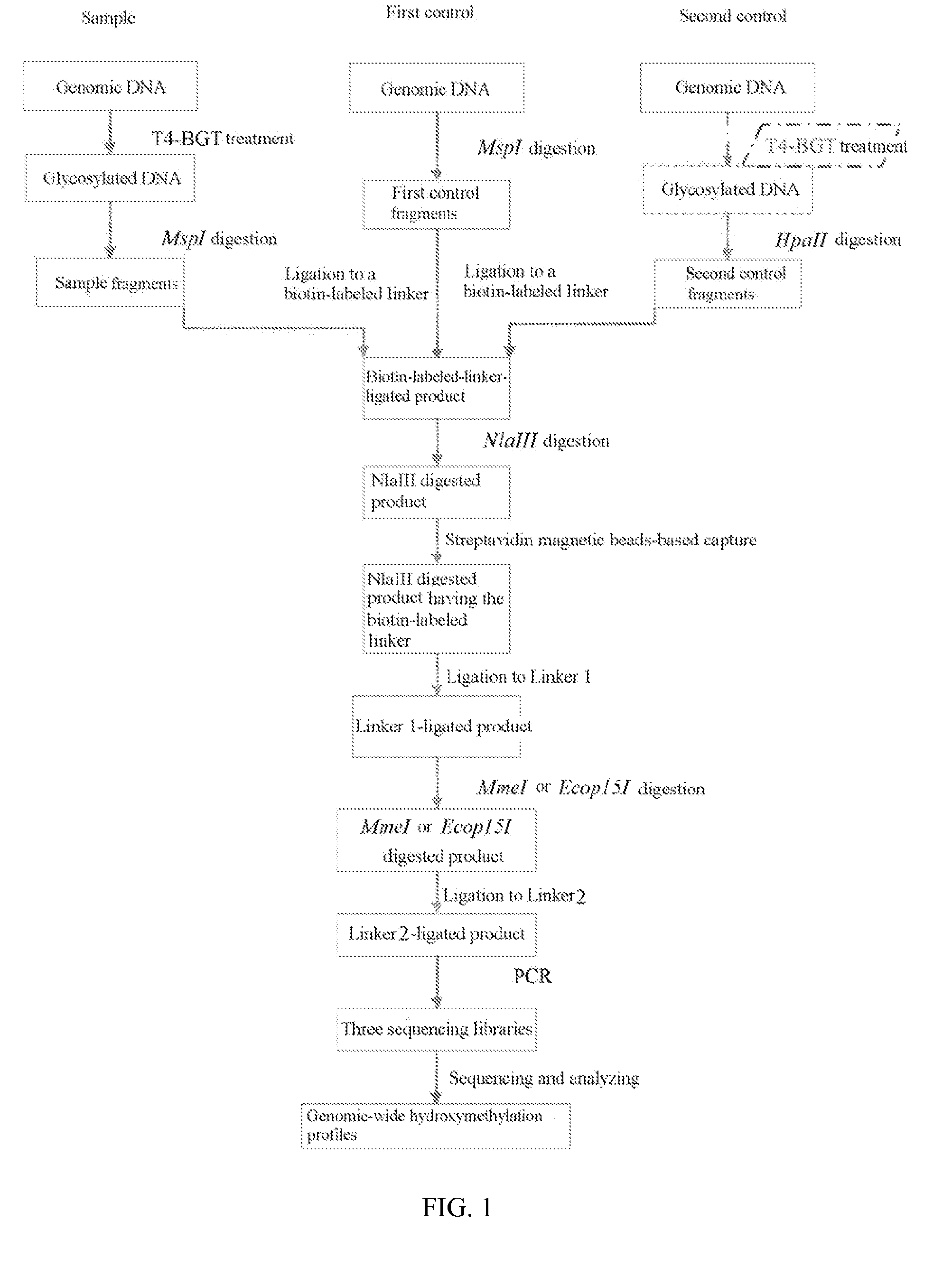
A method for detecting hydroxymethylation modification in nucleic acid comprises: glycosylating the nucleic acid, digesting with MspI, ligating the digested fragments to a biotin-labeled linker at both ends thereof, digesting with NlaIII; capturing the digested fragments using streptavidin magnetic beads to produce fragments having the biotin-labeled linker at one end and a CATG 4-base sticky end at the other end, wherein these fragments reveal modification information of their adjacent CCGG sites; ligating the CATG sticky end to a linker containing a recognition site of MmeI or Ecop15I, digesting with corresponding restriction endonuclease to produce short sequence fragments that can reveal modification information of their adjacent CCGG sites; and performing a tag number comparison to obtain information about methylation and hydroxymethylation modification relative levels. A use of the method is also provided.

Description

FIELD OF THE INVENTION[0001]The present invention relates to the field of genetic engineering, and particularly to a method for detecting hydroxymethylation modification in nucleic acid and use thereof.BACKGROUND OF THE INVENTION[0002]5-hydroxymethylcytosine (5hmC) was first reported in cytosines of bacteriophage in 1952, and this kind of modification was also found in mammalian cells recently, for instance, neurons and embryonic stem cells of mouse. Over the last few years, a lot of researches have been done in revealing the possible role 5hmC plays in genome organization and stem cell differentiation, and TET protease family has been proved to be involved in oxidizing 5mC to 5hmC.[0003]Though 5hmC modified base has found long before, there is no effective enzyme or chemical methods to specifically identify it and to detect its distribution in the genome. Methylation-dependent restriction endonucleases MspJI family or McrBC cannot distinguish 5mC from 5hmC, in addition, methylation...

Claims

the structure of the environmentally friendly knitted fabric provided by the present invention; figure 2 Flow chart of the yarn wrapping machine for environmentally friendly knitted fabrics and storage devices; image 3 Is the parameter map of the yarn covering machine
Login to View More

Application Information

Patent Timeline
no application Login to View More
IPC IPC(8): C12Q1/68
CPCC12Q2600/154C12Q1/6874C12Q1/683C12Q2521/501C12Q2521/531C12Q2525/197C12Q2537/164C12Q2563/131C12Q2521/331
Inventor GAO, FEIWANG, JUNWENZHANG, XIUQINGYANG, HUANMING
Owner BGI TECH SOLUTIONS
Features
  • R&D
  • Intellectual Property
  • Life Sciences
  • Materials
  • Tech Scout
Why Patsnap Eureka
  • Unparalleled Data Quality
  • Higher Quality Content
  • 60% Fewer Hallucinations
Social media
Patsnap Eureka Blog
Learn More