
Acylguanidines for treating osteoarthritis
a technology of acylguanidine and osteoarthritis, which is applied in the direction of amide active ingredients, drug compositions, immunological disorders, etc., can solve the problems of irreversible damage to connective tissue, increased occurrence of arthrotic changes in supporting joints, and inability to fully explain the occurrence or possible intervention, etc., to achieve good stability in synovial fluid, high selectivity for cathepsin, and few side effects
- Summary
- Abstract
- Description
- Claims
- Application Information
AI Technical Summary
Benefits of technology
Problems solved by technology
Method used
Image

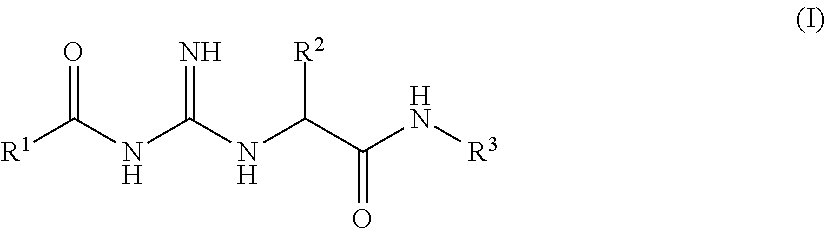
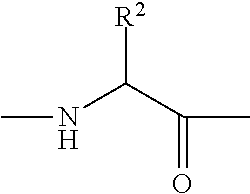
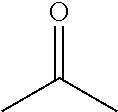
Examples
example 2
Preparation of (R)-3-(2,4-dichlorophenyl)-2-{N′-[2-(3,4-dimethoxyphenyl)acetyl]guanidino}-N-[2-(3,4-dimethoxyphenyl)ethyl]propionamide trifluoroacetate (compound No. 1)
[0221]
[0222]197.4 μl of 4-methylmorpholine were added to the solution of 500 mg (1.5 mmol) of (R)-2-tert-butoxycarbonylamino-3-(2,4-dichlorophenyl)propionic acid in 10 ml of tetrahydrofuran under nitrogen, and the mixture was cooled to −50° C. After addition of 194.6 μl (1.5 mmol) of isobutyl chloroformate, the reaction solution was stirred at −50° C. for 15 min, 248.7 (1.5 mmol) of 2-(3,4-dimethoxyphenyl)ethylamine were then added, the mixture was subsequently stirred at −40° C. for a further 30 min and at room temperature for two hours. The reaction mixture was then evaporated in vacuo, the residue was taken up in 10 ml of 5% sodium hydrogencarbonate solution, and the aqueous mixture was extracted three times with 10 ml of ethyl acetate each time. Drying of the combined organic phases over sodium sulfate and strippi...
example 3
Preparation of (R)-2-{N′-[2-(3,4-dimethoxyphenyl)acetyl]-guanidino}-N-(4-methoxybenzyl)-3-phenylpropionamide trifluoroacetate
a) tert-Butyl[1-[2-(3,4-dimethoxyphenyl)acetylamino]-1-pyrazol-1-ylmeth-(Z)-ylidene]carbamate
[0228]
[0229]1.17 g (29.38 mmol; 60% suspension in paraffin oil) of sodium hydride are added to the solution of 2.42 g (8.4 mmol) of 2-(3,4-dimethoxyphenyl)-N-(iminopyrazol-1-ylmethyl)acetamide (1c)) in 50 ml of tetrahydrofuran and 2 ml of dimethylformamide with ice-cooling and under a nitrogen atmosphere, and the mixture is stirred for 20 min. After addition of 11 g (50.36 mmol) of di-tert-butyl dicarbonate, the reaction mixture is stirred at room temperature for 48 hours, then evaporated to dryness, the residue is taken up in 10 ml of 5% sodium hydrogencarbonate solution, and the aqueous mixture is extracted three times with 10 ml of ethyl acetate each time. After the combined organic extracts have been dried over sodium sulfate and the solvent has been stripped off, ...
example 4
(R)-3-Cyclohexyl-2-{N′-[2-(3,4-dimethoxyphenyl)acetyl]-guanidino}-N-(1-ethylpropyl)propionamide
a) BOC-guanidine
[0232]
[0233]BOC-guanidine was synthesised in accordance with Ando et al., Tetrahedron (2010), 66(32), 6224-6237: 22.93 g (0.24 mol) of guanidinium chloride are added to the solution of 19.2 g (0.48 mol) of sodium hydroxide pellets in 50 ml of water at 0° C. The solution is left to stir for 10 min., a solution of 13.1 g (60 mmol) of di-tert-butyl dicarbonate in 150 ml of acetone is then added in one portion at 0° C., and the reaction mixture is then left to stir at room temperature for 15 hours. The acetone is subsequently stripped off in vacuo, and the aqueous mixture is extracted twice with 50 ml of ethyl acetate. The combined organic phases are washed with 50 ml of saturated sodium chloride solution and dried over sodium sulfate. After the solvent has been stripped off, the residue is recrystallised from ethyl acetate / n-heptane, giving 8.7 g (91%) of BOC-guanidine as whit...
PUM
| Property | Measurement | Unit |
|---|---|---|
| Ratio | aaaaa | aaaaa |
Abstract
Description
Claims
Application Information
 Login to View More