This helps you quickly interpret patents by identifying the three key elements:
Problems solved by technology
Method used
Benefits of technology
Benefits of technology
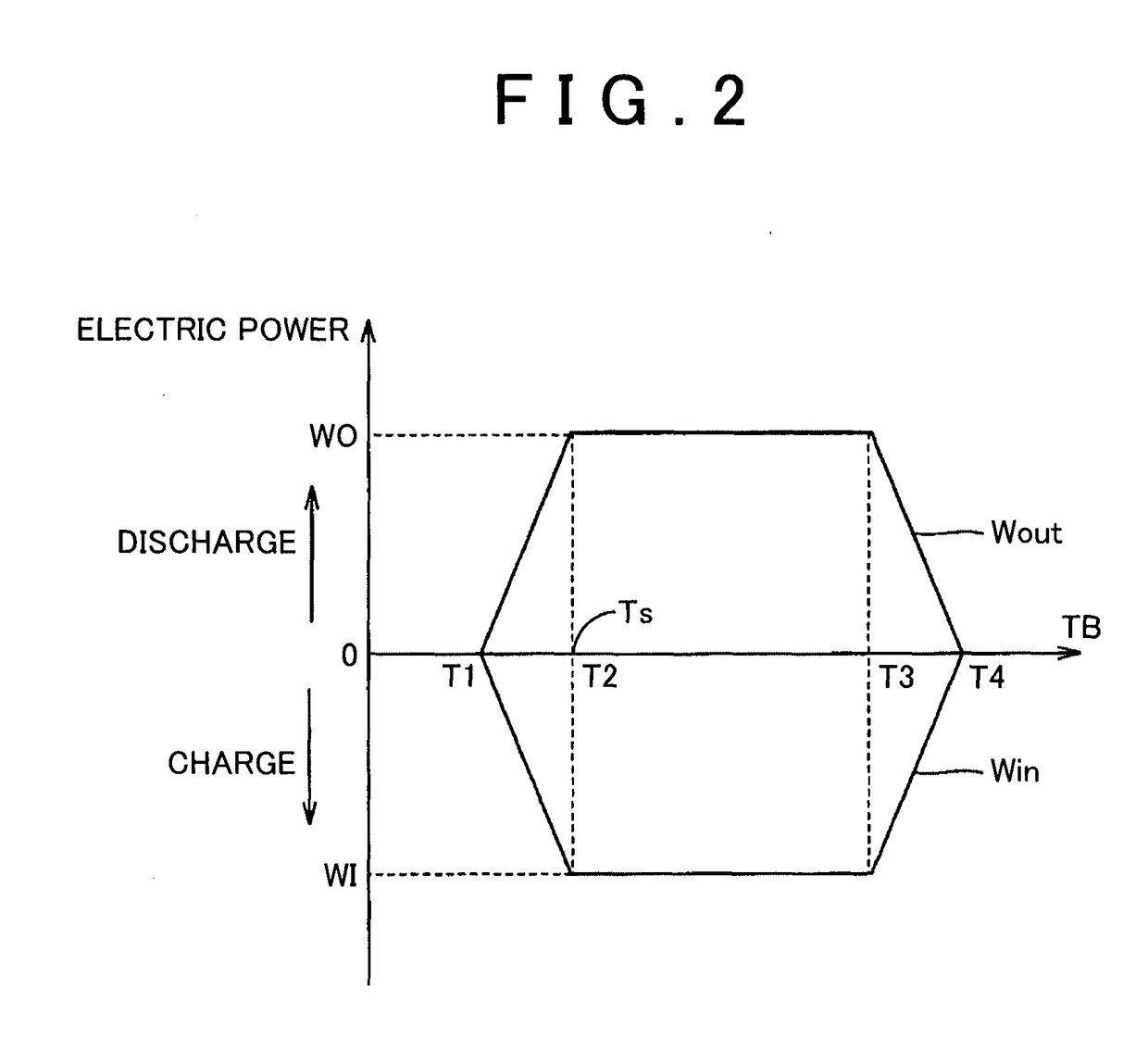
The patent text describes a system for improving the charging and discharging efficiency of a battery in a low-temperature condition, such as in winter or cold regions. The system uses a threshold value to determine when the battery should be warmed up to a higher temperature for optimal performance. By doing so, the system reduces restrictions on the discharge power, allowing for better motoring control and filter regeneration control. Additionally, the system ensures a margin for the threshold value to secure a margin of safety and reliability in the battery control.
Problems solved by technology
Therefore, when the battery is in a low-temperature condition in winter or in cold regions, for example, joule loss due to the internal resistance increases.
As a result, regeneration control of the filter may not be sufficiently performed.
Method used
the structure of the environmentally friendly knitted fabric provided by the present invention; figure 2 Flow chart of the yarn wrapping machine for environmentally friendly knitted fabrics and storage devices; image 3 Is the parameter map of the yarn covering machine
View more
Image
Smart Image Click on the blue labels to locate them in the text.
Viewing Examples
Smart Image
Click on the blue label to locate the original text in one second.
Reading with bidirectional positioning of images and text.
Smart Image
Examples
Experimental program
Comparison scheme
Effect test
first embodiment
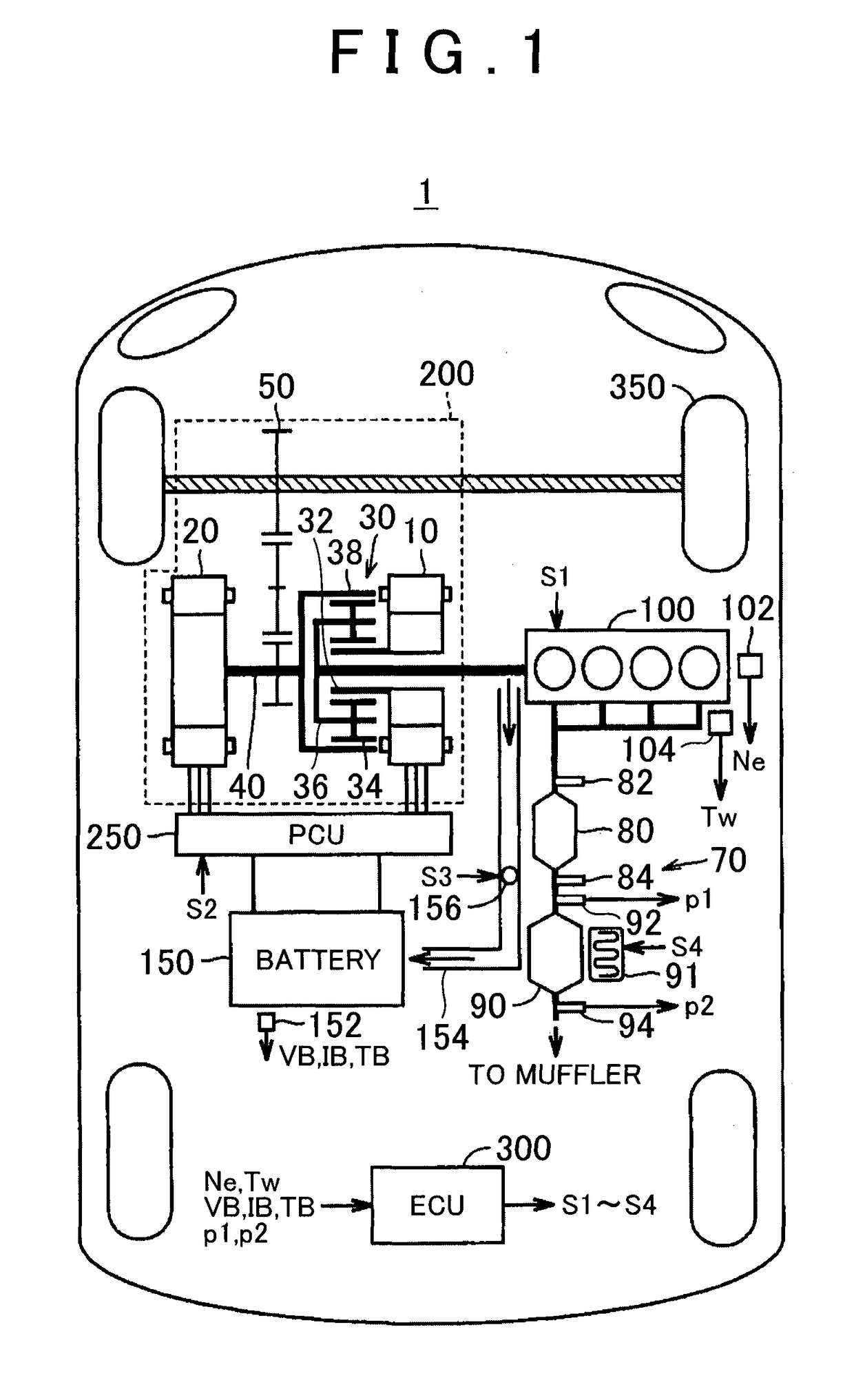
[0038]FIG. 1 is a block diagram schematically showing the configuration of a vehicle according to the invention. Referring to FIG. 1, the vehicle 1 is a hybrid vehicle. The vehicle 1 includes an engine 100, a battery 150, a transmission 200, a PCU (Power Control Unit) 250, an ECU (Electronic Control Unit) 300, and drive wheels 350.
[0039]The engine 100 (internal combustion engine) generates driving force for moving the vehicle 1, according to a control signal 51 from the ECU 300. In this embodiment, a gasoline engine is employed as the engine 100. However, the fuel of the engine 100 is not limited to gasoline, but may be light oil (diesel fuel), biofuel (such as ethanol), or gas fuel (such as propane gas), for example.
[0040]A crankposition sensor 102 is provided at a position opposed to a crankshaft (not shown) of the engine 100. The crankposition sensor 102 detects the rotational speed Ne of the engine 100 (which will also be called “engine speed”), and outputs the detection resul...
second embodiment
[0106]Thus, when the reference value Ts is set to a value different from the temperature T2, too, the battery can be warmed up until the GPF regeneration control becomes able to be carried out. Since a margin for the temperature T2 can be secured by warming up the battery to a temperature level higher than the temperature T2, the charge power or discharge power is less likely to be restricted even when the battery temperature TB is lowered during execution of the GPF regeneration control.
[0107]The temperature T2 is specified so as to protect the battery by restricting the charge power and the discharge power, and is a fixed value that is determined according to the specifications of the battery. On the other hand, the reference value Ts is specified so as to secure the charge power or discharge power needed for execution of the GPF regeneration control. Therefore, the reference value Ts can be changed according to a method of executing the GPF regeneration control (which (one) of t...
third embodiment
[0109]FIG. 9 is a timing chart useful for explaining the battery warm-up control according to the While the reference value Ts may be larger than the temperature T2 or smaller than the temperature T2, depending on the manner of setting the reference value Ts, the case where the reference value Ts is set to be smaller than the temperature T2 will be described in FIG. 9. Referring to FIG. 9, control before time t3 is substantially the same as control before time t3 in the timing chart shown in FIG. 3, and therefore, will not be repeatedly described.
[0110]At time t3a, the battery temperature TB exceeds the reference value Ts. This indicates that the battery 150 is warmed up to a battery temperature TB at which the GPF regeneration control can be performed. However, since the battery temperature TB is lower than the temperature T2, the charge power and discharge power of the battery 150 are restricted. Therefore, in this embodiment, the battery warm-up control is continued so that the ...
the structure of the environmentally friendly knitted fabric provided by the present invention; figure 2 Flow chart of the yarn wrapping machine for environmentally friendly knitted fabrics and storage devices; image 3 Is the parameter map of the yarn covering machine
Login to View More
PUM
Login to View More
Abstract
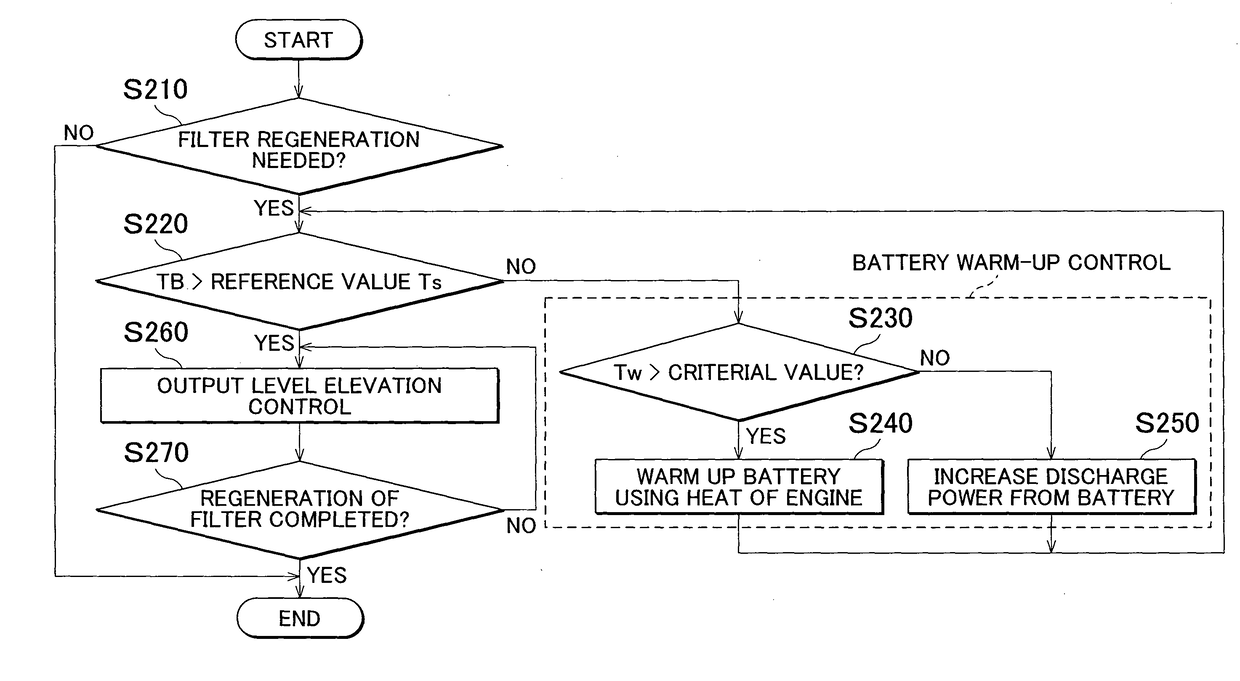
A hybrid vehicle includes an internal combustion engine, a filter, an electrical storage device, a rotating electric machine, and a controller. The filter is configured to trap particulate matter in exhaust gas of the internal combustion engine. The rotating electric machine is configured to generate electric power using power from the internal combustion engine so as to charge the electrical storage device, and drive the internal combustion engine using electric power from the electrical storage device. The controller is configured to control the internal combustion engine and the rotating electric machine, so as to warm up the electrical storage device when regeneration control needs to be performed and when the temperature of the electrical storage device is lower than a reference value. The regeneration control is control for raising the temperature of the filter to a predetermined temperature so as to burn the particulate matter. The controller may be configured to execute the regeneration control when the temperature of the electrical storage device exceeds the reference value.
Description
CROSS-REFERENCE TO RELATED APPLICATIONS[0001]This application is a national phase application of International Application No. PCT / IB2015 / 000323, filed Mar. 13, 2015, and claims the priority of Japanese Application No. 2014-054864, filed Mar. 18, 2014, the content of both of which is incorporated herein by reference.BACKGROUND OF THE INVENTION[0002]1. Field of the Invention[0003]The invention relates to a hybrid vehicle and a method of controlling the hybrid vehicle. In particular, the invention relates to a hybrid vehicle including a filter for trapping particulate matter in exhaust gas of an internal combustion engine, and a method of controlling the hybrid vehicle.[0004]2. Description of Related Art[0005]Exhaust gas emitted from an engine contains particulate matter (which will also be referred to as “PM”). It is preferable not to emit the PM into the atmosphere since the PM may exert an influence on the environment, or the like. Therefore, a filter for trapping the PM may be ins...
Claims
the structure of the environmentally friendly knitted fabric provided by the present invention; figure 2 Flow chart of the yarn wrapping machine for environmentally friendly knitted fabrics and storage devices; image 3 Is the parameter map of the yarn covering machine
Login to View More
Application Information
Patent Timeline
Application Date:The date an application was filed.
Publication Date:The date a patent or application was officially published.
First Publication Date:The earliest publication date of a patent with the same application number.
Issue Date:Publication date of the patent grant document.
PCT Entry Date:The Entry date of PCT National Phase.
Estimated Expiry Date:The statutory expiry date of a patent right according to the Patent Law, and it is the longest term of protection that the patent right can achieve without the termination of the patent right due to other reasons(Term extension factor has been taken into account ).
Invalid Date:Actual expiry date is based on effective date or publication date of legal transaction data of invalid patent.


 Login to View More
  Login to View More