
Mass spectrometer
a mass spectrometer and mass spectrometer technology, applied in the field of mass spectrometers, can solve the problems of insufficient needle insertion into the hole in the holder, inability to completely prevent contamination, and falling off the holder, so as to reduce workload and waste measurement time
- Summary
- Abstract
- Description
- Claims
- Application Information
AI Technical Summary
Benefits of technology
Problems solved by technology
Method used
Image


Examples
Embodiment Construction
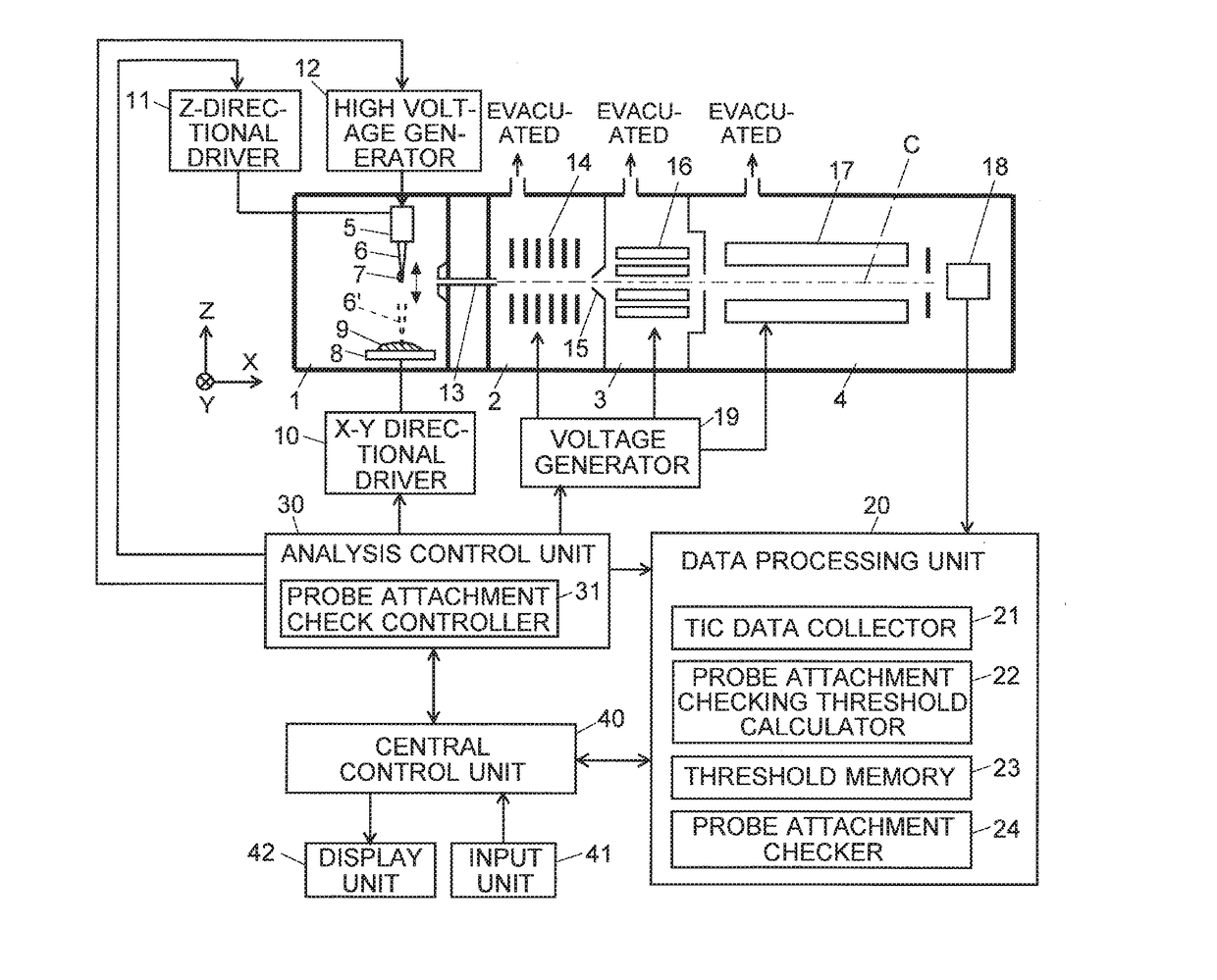
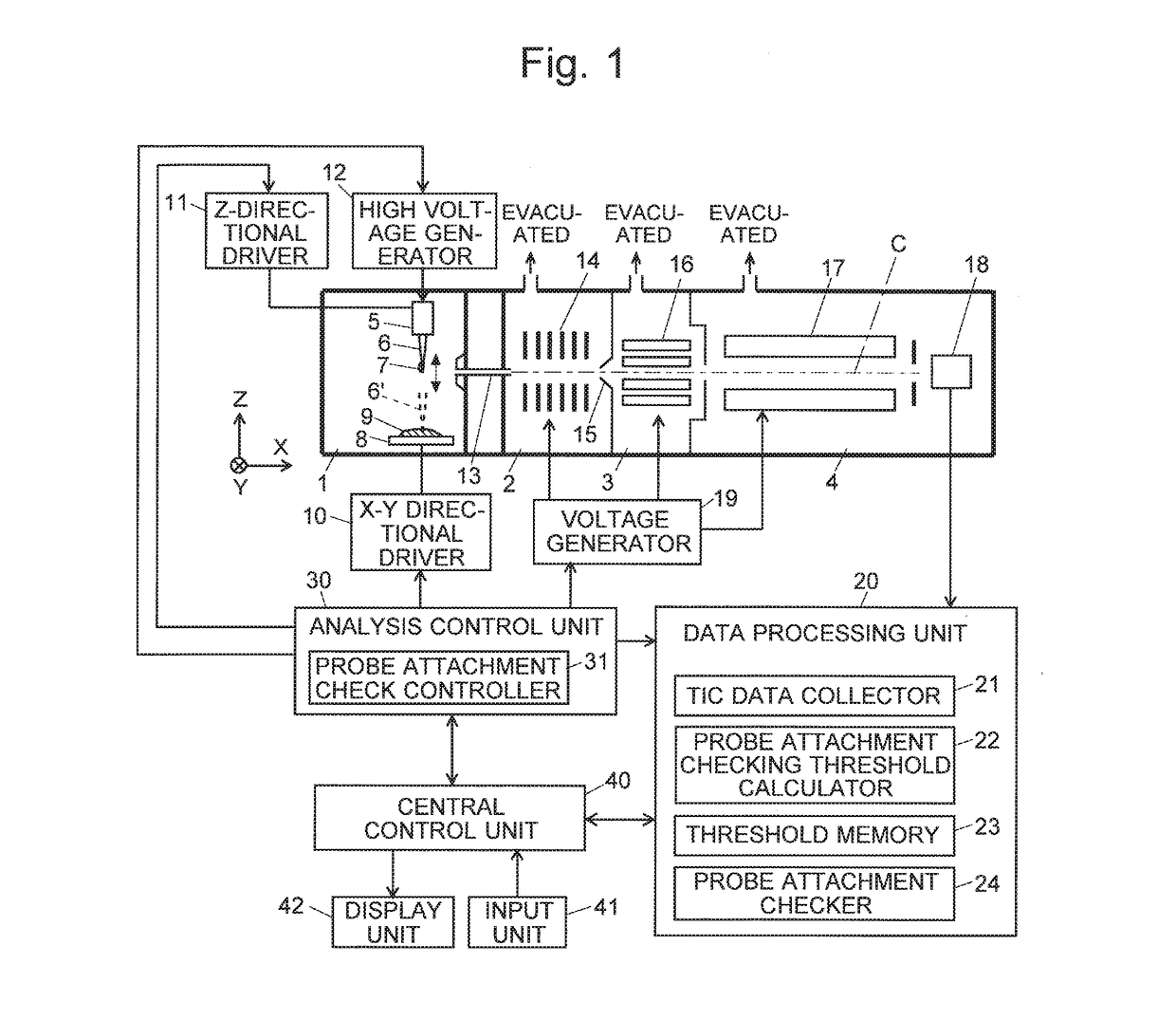
[0034]One embodiment of the mass spectrometer according to the present invention is described with reference to the attached drawings. FIG. 1 is a schematic configuration diagram of a mass spectrometer using a PESI ion source according to the present embodiment.
[0035]The mass spectrometer of the present embodiment has the configuration of a differential pumping system including an ionization chamber 1 for ionizing components in a sample under atmospheric pressure and an analysis chamber 4 for performing the mass separation and detection of ions under a high degree of vacuum, between which a plurality of (in the present example, two) intermediate vacuum chambers 2 and 3 are provided having their degrees of vacuum increased in a stepwise manner. Although not shown in FIG. 1, normally, the first intermediate vacuum chamber 2 is evacuated with a rotary pump, while the second intermediate vacuum chamber 3 and the analysis chamber 4 are evacuated with a turbo molecular pump in addition to...
PUM
 Login to View More
 Abstract
Description
Claims
Application Information
 Login to View More