Check patentability & draft patents in minutes with Patsnap Eureka AI!

Method of producing an optical sensor at wafer-level and optical sensor

a technology of optical sensors and wafers, applied in the direction of photometry, instruments, electrical apparatus, etc., can solve the problems of optical sensors that are prone to error, source of error, and light that does not originate from ambient surroundings, so as to reduce limitations and risks, reduce cost, and add flexibility

Active Publication Date: 2018-08-09
AMS AG
View PDF1 Cites 6 Cited by
  • Summary
  • Abstract
  • Description
  • Claims
  • Application Information

AI Technical Summary

Benefits of technology

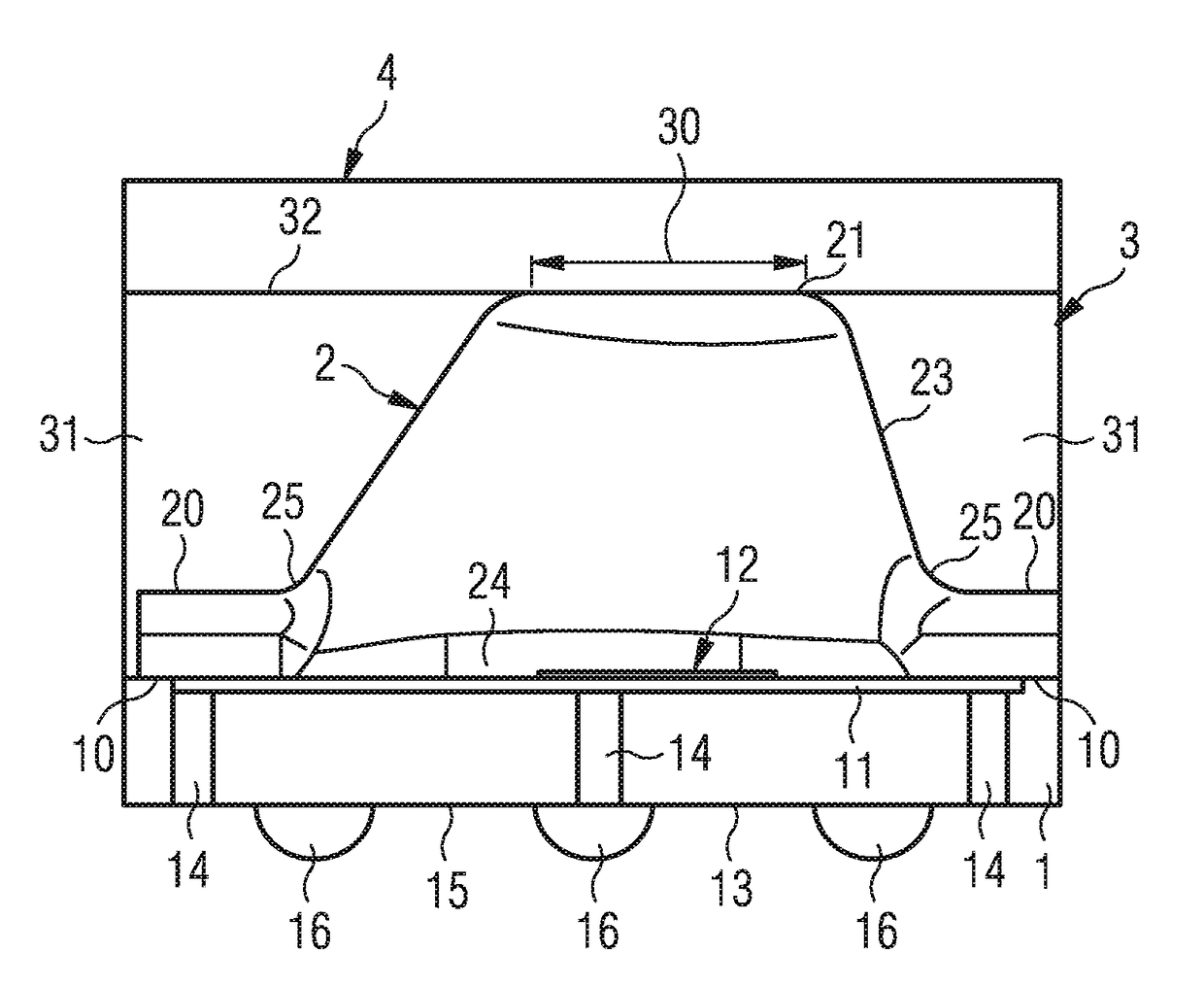
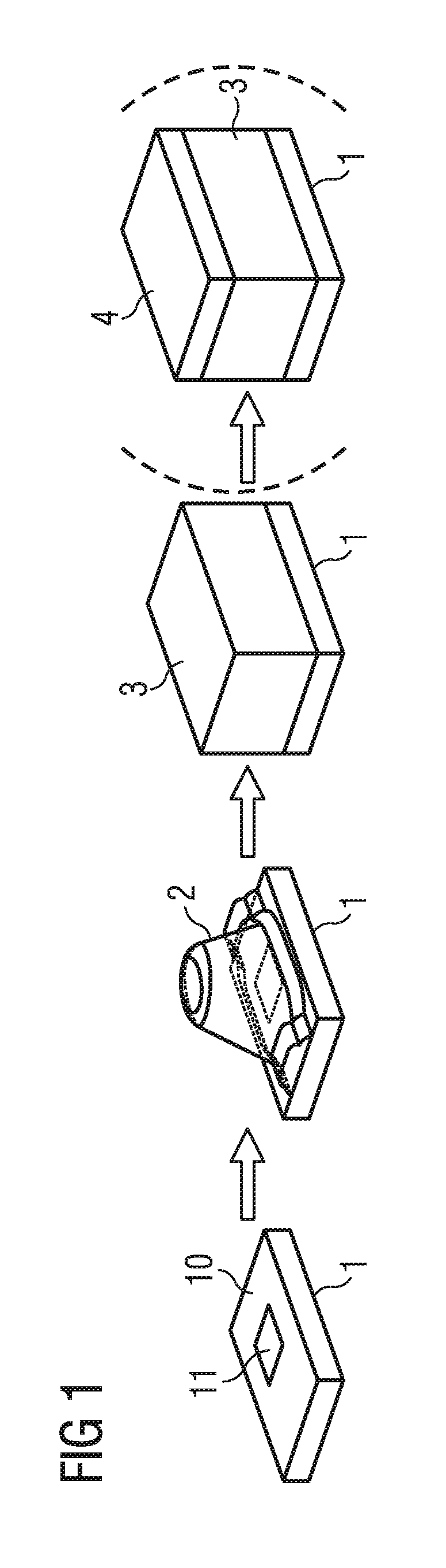
The patent describes a method to create optical sensors using a wafer-level molding process. This process involves using different molds with different properties to create the sensor and its protective package. This method allows for the production of smaller and more compact sensors with better protection and easier handling. Additionally, it allows for the integration of additional layers, such as a diffuser, in a single molding process. Overall, this method is more efficient and cost-effective than traditional methods of producing optical sensors.

Problems solved by technology

At the same time, the range of angles or field of view should not be too wide as many optical sensors are prone to error when light incidents the sensor surface at large angles.
A further source of error constitutes light that does not originate from ambient surroundings but rather comes from within the device itself, e.g. from stray light from a screen display, backlight in a mobile phone or from light emitted by neighboring active sensors.
Current open cavity package technologies, however, are either complex and therefore costly, or else cannot be used for most wafer-level applications because the requirements on aspect ratio and pin dimensions can be critical (or both).

Method used

the structure of the environmentally friendly knitted fabric provided by the present invention; figure 2 Flow chart of the yarn wrapping machine for environmentally friendly knitted fabrics and storage devices; image 3 Is the parameter map of the yarn covering machine
View more

Image

Smart Image Click on the blue labels to locate them in the text.
Viewing Examples
Smart Image
  • Method of producing an optical sensor at wafer-level and optical sensor
  • Method of producing an optical sensor at wafer-level and optical sensor
  • Method of producing an optical sensor at wafer-level and optical sensor

Examples

Experimental program
Comparison scheme
Effect test

embodiment d

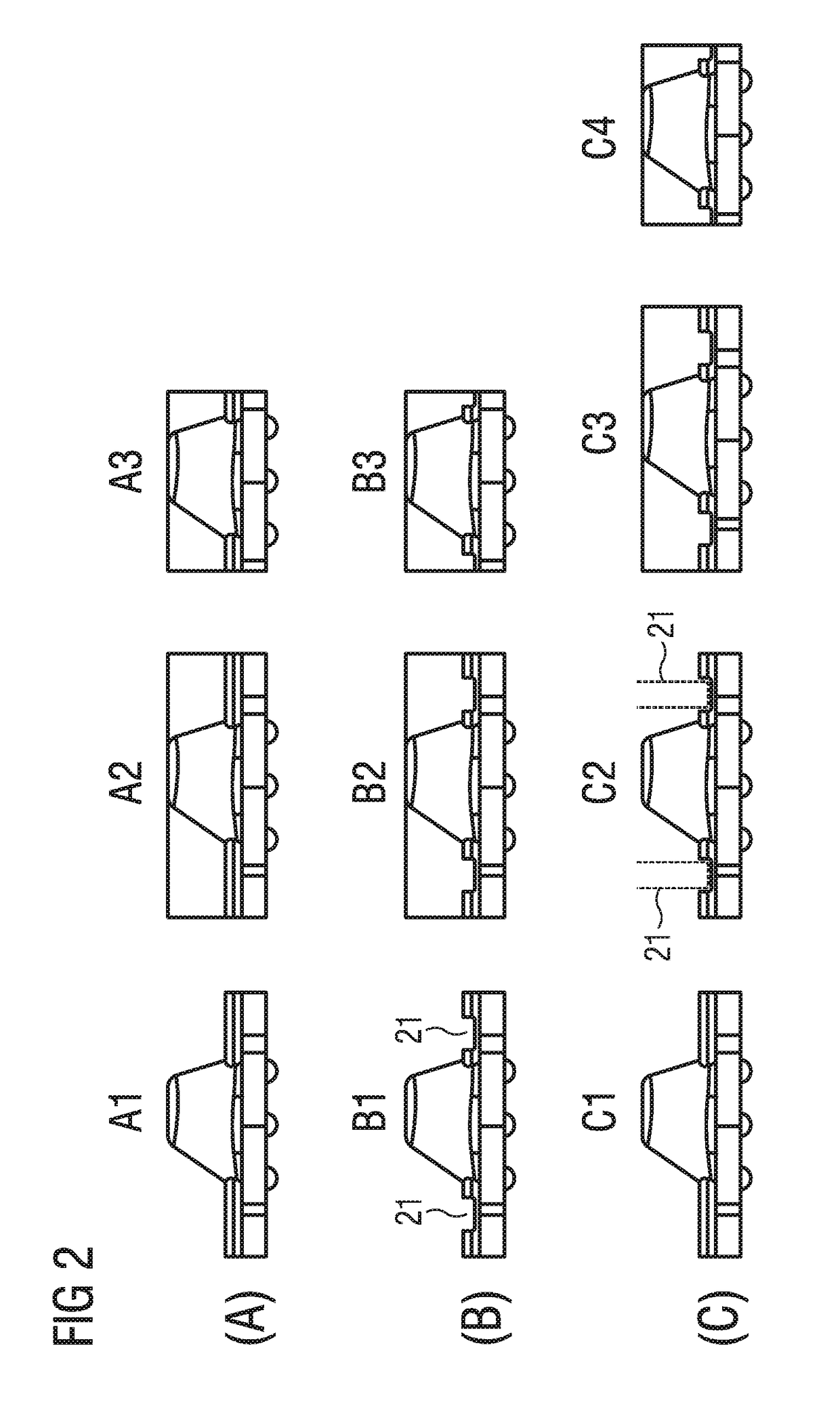
[0070 only differs from embodiment C in that the sawing step D2 completely cuts into the runners and further even partly penetrates into the substrate of the wafer. Thus, sawing may involve the runners 20 and, additionally, partial sawing of the saw street. Steps D1, D3, and D4 correspond to steps C1, C3, and C4, respectively.

[0071]Embodiment E involves runner removal by means of masking and etching. Steps E1, E5, and E6 correspond to steps C1, C3, and C4, respectively. However, in step E a mask layer 23 is applied over the transparent mold structure 2. The mask layer 23 at least partially covers the transparent mold structure 2. Most part of the runners 20, however, is not covered by the mask layer 23 and can be exposed to an etching substance.

[0072]In step E3 the runners 20 are removed by means of isotropic or anisotropic etching while the transparent mold structure 2 is protected from etchant by the masking layer 23 having a material which resists etching. Next, the mask layer 23...

the structure of the environmentally friendly knitted fabric provided by the present invention; figure 2 Flow chart of the yarn wrapping machine for environmentally friendly knitted fabrics and storage devices; image 3 Is the parameter map of the yarn covering machine
Login to View More

PUM

No PUM Login to View More

Abstract

A method of producing an optical sensor at wafer-level, comprising the steps of providing a wafer having a main top surface and a main back surface and arrange at or near the top surface of the wafer at least one first integrated circuit having at least one light sensitive component. Furthermore, providing in the wafer at least one through-substrate via for electrically contacting the top surface and back surface and forming a first mold structure by wafer-level molding a first mold material over the top surface of the wafer, such that the first mold structure at least partly encloses the first integrated circuit. Finally, forming a second mold structure by wafer-level molding a second mold material over the first mold structure, such that the second mold structure at least partly encloses the first mold structure.

Description

BACKGROUND OF THE INVENTION[0001]Optical sensors are electronic detectors that convert light, or a change in light, into an electronic signal. They are used in many industrial and consumer applications. As ambient light sensors (ALS) optical sensors are commonly used to automatically control the brightness of displays depending on the intensity of ambient light, both for user comfort, and for the purpose of conserving battery power in handheld devices.[0002]An optical sensor should robustly respond to light striking a sensor aperture from a wide range of angles. At the same time, the range of angles or field of view should not be too wide as many optical sensors are prone to error when light incidents the sensor surface at large angles. A further source of error constitutes light that does not originate from ambient surroundings but rather comes from within the device itself, e.g. from stray light from a screen display, backlight in a mobile phone or from light emitted by neighborin...

Claims

the structure of the environmentally friendly knitted fabric provided by the present invention; figure 2 Flow chart of the yarn wrapping machine for environmentally friendly knitted fabrics and storage devices; image 3 Is the parameter map of the yarn covering machine
Login to View More

Application Information

Patent Timeline
no application Login to View More
Patent Type & Authority Applications(United States)
IPC IPC(8): H01L31/0203H01L31/02H01L23/00
CPCH01L31/0203H01L31/02005H01L24/13H01L31/02327H01L31/153H01L2224/13025H01L31/173G01J1/0271G01J5/045G01J1/0204
Inventor ETSCHMAIER, HARALDTOSCHKOFF, GREGORBODNER, THOMASSCHRANK, FRANZ
Owner AMS AG
Features
  • R&D
  • Intellectual Property
  • Life Sciences
  • Materials
  • Tech Scout
Why Patsnap Eureka
  • Unparalleled Data Quality
  • Higher Quality Content
  • 60% Fewer Hallucinations
Social media
Patsnap Eureka Blog
Learn More