Unlock instant, AI-driven research and patent intelligence for your innovation.

Nuclear fusion reactor, thermal device, external combustion engine, power generating apparatus, and moving object

a fusion reactor and nuclear technology, applied in nuclear reactors, nuclear engineering, greenhouse gas reduction, etc., can solve the problems of limited size reduction of nuclear reactors, difficult to achieve a positive electric power balance, and inability to say that such fusion reactors will be practical use, etc., to achieve high energy, high penetration power, and efficient thermal energy production

Inactive Publication Date: 2020-06-04
OOYAMA POWER INC
View PDF0 Cites 1 Cited by
  • Summary
  • Abstract
  • Description
  • Claims
  • Application Information

AI Technical Summary

Benefits of technology

The present invention is a nuclear fusion reactor that uses a metallic heating element with a crystalline structure. The metallic heating element has a channeling phenomenon, where an α ion beam is deflected and guided to the nuclei of interstitial heavy hydrogen atoms. The resulting binary nucleus with two heavy hydrogen nuclei has the same momentum as the 2H ion beam and forms an ion beam passing through the same channeling path. The binary nucleus emits a magnetic flux and generates a strong stopping power, causing the binary nucleus to stop without colliding with the 2H nuclei and capture the surrounding electrons and remain within the interstitial space of the crystalline structure of the metallic heating element as pseudo atoms. The heavy hydrogen nuclei in the pseudo atoms have lost part of their energy and are gradually approaching each other, resulting in nuclear fusion. The resulting binary nucleus produces 4He and 6Li, which are accumulated as interstitial atoms in the crystalline structure of the metallic heating element. The 4He and 6Li are then used to generate thermal energy without emitting neutron rays or gamma rays. The technical effects of this invention include efficient production of thermal energy without emitting high-energy neutron rays or gamma rays, and the formation of a stable binary nucleus without causing unstable 8Be nucleus.

Problems solved by technology

Regarding the development of a nuclear fusion reactor, a nuclear fusion reactor of a plasma magnetic confinement type needs much electric power for holding plasma as compared to the amount of heat it generates, and it is quite difficult to achieve a positive electric power balance.
In addition, there are still many difficult problems such as a superconducting magnet for confining ultra-high temperature plasma and a material of an inner wall to be in contact with the plasma, and thus, we still cannot say that such fusion reactor will be practical use.
Regarding nuclear reactors utilizing nuclear fission, since the critical mass of uranium is fixed, the size reduction of nuclear reactors is limited.
Moreover, since the output is controlled through insertion and removal of control rods, falling or malfunction of such control rods may cause a loss of control.
Further, a loss of cooling power due to a stop in the supply of cooling water may also cause a loss of control.
Such loss of control would possibly result in a nuclear core meltdown.
Further, a large amount of radioactive waste, whose disposal method has not yet been established, is generated.

Method used

the structure of the environmentally friendly knitted fabric provided by the present invention; figure 2 Flow chart of the yarn wrapping machine for environmentally friendly knitted fabrics and storage devices; image 3 Is the parameter map of the yarn covering machine
View more

Image

Smart Image Click on the blue labels to locate them in the text.
Viewing Examples
Smart Image
  • Nuclear fusion reactor, thermal device, external combustion engine, power generating apparatus, and moving object
  • Nuclear fusion reactor, thermal device, external combustion engine, power generating apparatus, and moving object
  • Nuclear fusion reactor, thermal device, external combustion engine, power generating apparatus, and moving object

Examples

Experimental program
Comparison scheme
Effect test

working example 1

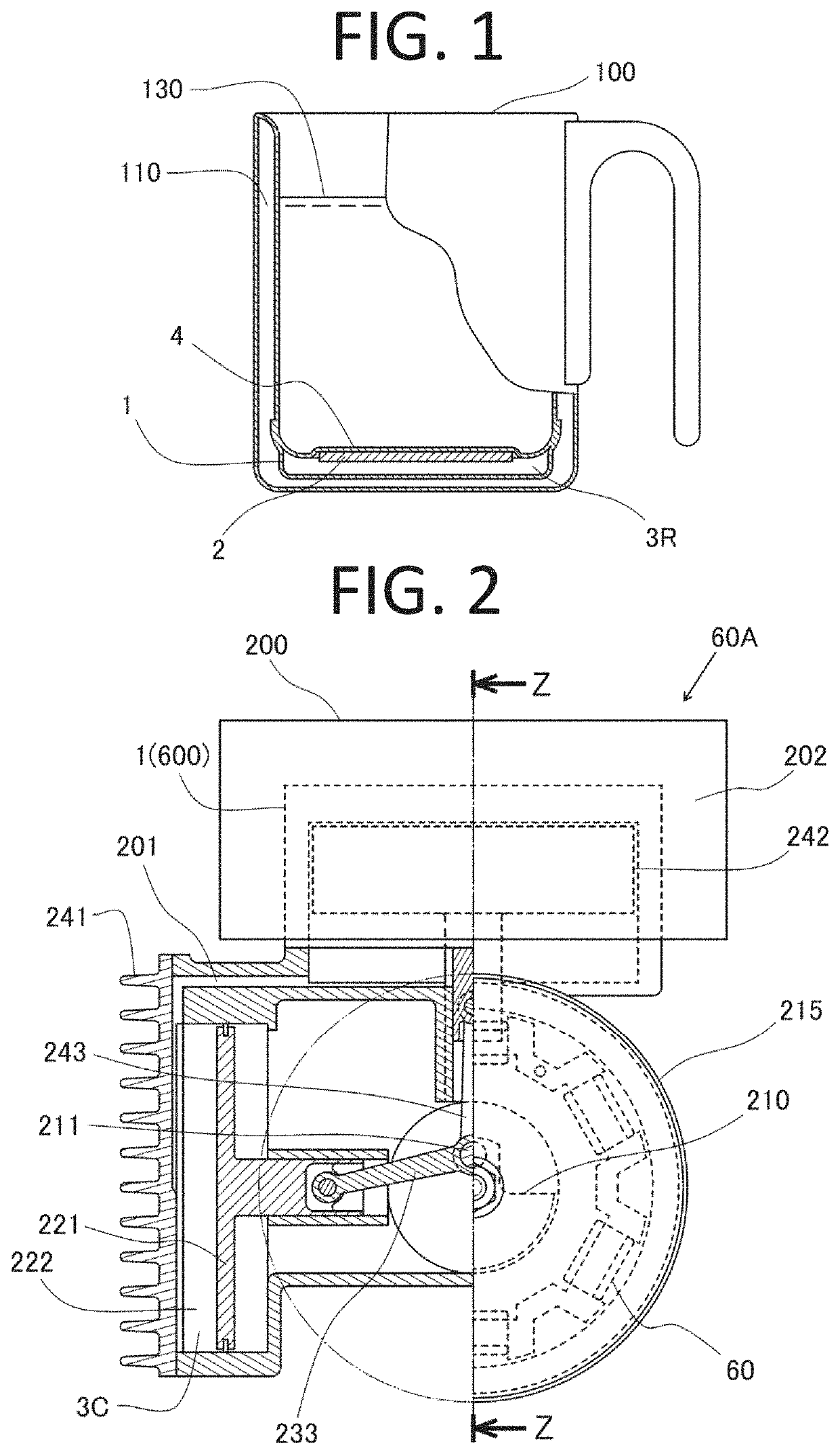
[0111]FIG. 1 a partial cross-sectional view of an example of a thermal device that uses a nuclear fusion reactor according to an embodiment of the present invention as a heat source. A thermo mug 100, being a thermal device, includes a nuclear fusion reactor 1 mounted on a bottom of a heat insulation mug provided with a heat insulation layer 110. In the nuclear fusion reactor 1, a palladium plate 2 serving as a metallic heating element is attached onto an inner surface of a vessel 4 which is a reactor body provided between an inner container and an outer layer of the thermo mug 100. Such configuration allows the heat to be easily transferred to a warm beverage 130 in the thermo mug 100. The palladium plate 2 contains a trace amount of 6Li as a solute on its lower surface side.

[0112]In the thermo mug 100 having the above configuration, by sealing a mixed gas 3R of heavy hydrogen and a trace amount of radon in the nuclear fusion reactor 1 at a pressure lower than the atmospheric press...

working example 2

[0113]FIGS. 2 and 3 are a front view and a side view, respectively, showing an example of an external combustion engine and a power generating apparatus which use a nuclear fusion reactor according to an embodiment of the present invention as a heat source. The cross-sectional portion in FIG. 3 shows a Z-Z cross-section of FIG. 2 and the cross-sectional portion in FIG. 2 shows a Y-Y cross-section of FIG. 3. A power generating apparatus 60A uses a gamma-type Stirling engine 200 as an external combustion engine provided with a nuclear fusion reactor 1. The power generating apparatus 60A can also be considered an example of the “thermal device” from the viewpoint that it uses the nuclear fusion reactor 1 as a heat source.

[0114]In the present working example, the nuclear fusion reactor 1 constitutes a high-temperature chamber of the Stirling engine 200 and has a structure in which the internal volume of the high-temperature chamber is changed by a heat exchange piston 242 moving up and ...

working example 3

[0121]FIGS. 5, 6 and 7 are a front view, a side cross-sectional view and a front cross-sectional view with a partially enlarged view, respectively, of a once-through boiler that includes a plurality of nuclear fusion reactors according to the present invention, the nuclear fusion reactors being arranged in series. FIG. 6 is an enlarged X-X cross-section of FIG. 5, and FIG. 7 is a W-W cross-section of FIG. 6.

[0122]The once-through boiler 400 includes a nuclear fusion reactor 1A in which five nuclear fusion reactors 1a-1e in total are arranged in series. During the operation of the once-through boiler 400, temperatures become higher in the ascending order of the nuclear fusion reactors 1a-1e, and a heavy hydrogen gas 3 of five different pressures is supplied to the respective nuclear fusion reactors 1a-1e. The nuclear fusion reactors 1a-1e have respective gas inlets 31a-31e through which the heavy hydrogen gas 3 of different pressures is supplied and respective gas outlets 33a-33e thr...

the structure of the environmentally friendly knitted fabric provided by the present invention; figure 2 Flow chart of the yarn wrapping machine for environmentally friendly knitted fabrics and storage devices; image 3 Is the parameter map of the yarn covering machine
Login to View More

PUM

No PUM Login to View More

Abstract

An object of the present invention is to achieve a simple and safe nuclear fusion reactor. The nuclear fusion reactor comprises: a vessel serving as a reactor body; a metallic heating element that contains heavy hydrogen contained in the vessel as a solute; a heavy hydrogen gas contained in the vessel, the heavy hydrogen gas being in an amount that allows 0.005% to 5% of heavy hydrogen to be contained as a solute in the metallic heating element based on the atomic ratio; and a mechanism for irradiating the metallic heating element with an ion beam. Such configuration causes, in the metallic crystal of the metallic heating element, a channeling phenomenon which guides ion beams to interstitial atom nuclei, and an intra-metal nuclear fusion probability increasing phenomenon which is explained based on the binary nucleus model. As a result, a “mild nuclear fusion” that does not emit gamma rays and neutron rays occurs, and the nuclear energy can be efficiently converted into heat due to the intra-metal nuclear fusion chain reaction.

Description

TECHNICAL FIELD[0001]The present invention relates to a nuclear fusion reactor, and in particular, to a nuclear fusion reactor utilizing a channeling phenomenon and a nuclear fusion probability increasing phenomenon caused by the crystalline structure of metal, as well as relating to techniques using such nuclear fusion reactor.BACKGROUND ART[0002]Nuclear fusion reactors which have conventionally been proposed include a Tokamak-type reactor employing a plasma magnetic confinement method. A nuclear reactor utilizing nuclear fission uses water as a coolant and such nuclear reactor is used as a heat source for a steam turbine primarily in power generation. If a fission reactor of a higher temperature can be achieved in the future, the use of a combined cycle is expected; in the combined cycle, a less reactive gas, such as helium, is used as a coolant to operate a gas turbine in a closed circuit and the exhaust heat is used to operate a steam turbine. The steam turbine and the gas turbi...

Claims

the structure of the environmentally friendly knitted fabric provided by the present invention; figure 2 Flow chart of the yarn wrapping machine for environmentally friendly knitted fabrics and storage devices; image 3 Is the parameter map of the yarn covering machine
Login to View More

Application Information

Patent Timeline
no application Login to View More
IPC IPC(8): G21B1/15G21B1/00G21B1/11
CPCG21B1/11G21B1/00G21B1/15G21B3/00Y02E30/10G21B3/006
Inventor OOYAMA, KAZUO
Owner OOYAMA POWER INC