Unlock instant, AI-driven research and patent intelligence for your innovation.

Foreign object detection in a wireless power transfer system

a wireless power transfer and foreign object technology, applied in the direction of electrical equipment, circuit arrangements, etc., can solve the problems of increasing the weight, potential cost and size of the device, affecting the operation of the device, so as to reduce the cost, the effect of increasing flexibility and less than optimum performan

Active Publication Date: 2020-07-02
KONINKLJIJKE PHILIPS NV
View PDF0 Cites 6 Cited by
  • Summary
  • Abstract
  • Description
  • Claims
  • Application Information

AI Technical Summary

Benefits of technology

The patent aims to improve the detection of foreign objects in a wireless power transfer system. It introduces a method for detecting objects during a power transfer phase by using a repeating time frame and a test coil to generate an electromagnetic test signal. The system also includes an adapter to optimize power transfer and an improved foreign object detector. The technical effects of this invention are increased flexibility, reduced cost, reduced complexity, improved object detection, fewer false detections and missed detections, backwards compatibility, and improved performance.

Problems solved by technology

However, this tends to be impractical and requires the user to physically insert connectors or otherwise establish a physical electrical contact.
Although, the use of internal batteries may avoid the need for a wired connection to a power supply during use, this only provides a partial solution as the batteries will need recharging (or replacing).
The use of batteries may also add substantially to the weight and potentially cost and size of the devices.
A potential problem with wireless power transfer is that power may unintentionally be transferred to e.g. metallic objects that happen to be in the vicinity of the power transmitter.
The heat increase may be very significant and may be highly disadvantageous.
When the power transmitter detects a significant difference between the power sent by the transmitter and the power received by the receiver, an unwanted foreign object may potentially be present, and the power transfer may be reduced or aborted for safety reasons.
In practice, it tends to be difficult to achieve sufficient detection accuracy using the methods described in the Qi specification.
This difficulty is exacerbated by a number of uncertainties about the specific current operating conditions.
For example, a particular problem is the potential presence of friendly metals (i.e. metal parts of the device that embodies the power receiver or the power transmitter) as the magnetic and electrical properties of these may be unknown (and vary between different devices) and therefore may be difficult to compensate for.
Further, undesirable heating may result from even relatively small amounts of power being dissipated in a metallic foreign object.
Therefore, it is necessary to detect even a small power discrepancy between the transmitted and received power, and this may be particularly difficult when the power levels of the power transfer increase.
However, it may still not provide sufficient accuracy and e.g. may also suffer from the influence of friendly metal.
However, for such a small signal, the signal / noise ratio is typically poor, resulting in reduced accuracy of the measurement.
The requirement for a small measurement signal may result in other disadvantageous effects.
Another issue is that foreign object detection is typically a very sensitive test where it is desired that relatively small changes caused by the presence of a foreign object is detected in an environment with possibly a large variation of the operating conditions and scenarios for which the test is being performed.
Accordingly, current algorithms tend to be suboptimal and may in some scenarios and examples provide less than optimum performance.
In particular, they may result in the presence of foreign objects not being detected, or in false detections of foreign objects when none are present.

Method used

the structure of the environmentally friendly knitted fabric provided by the present invention; figure 2 Flow chart of the yarn wrapping machine for environmentally friendly knitted fabrics and storage devices; image 3 Is the parameter map of the yarn covering machine
View more

Image

Smart Image Click on the blue labels to locate them in the text.
Viewing Examples
Smart Image
  • Foreign object detection in a wireless power transfer system
  • Foreign object detection in a wireless power transfer system
  • Foreign object detection in a wireless power transfer system

Examples

Experimental program
Comparison scheme
Effect test

Embodiment Construction

[0077]The following description focuses on embodiments of the invention applicable to a wireless power transfer system utilizing a power transfer approach such as known from the Qi specification. However, it will be appreciated that the invention is not limited to this application but may be applied to many other wireless power transfer systems.

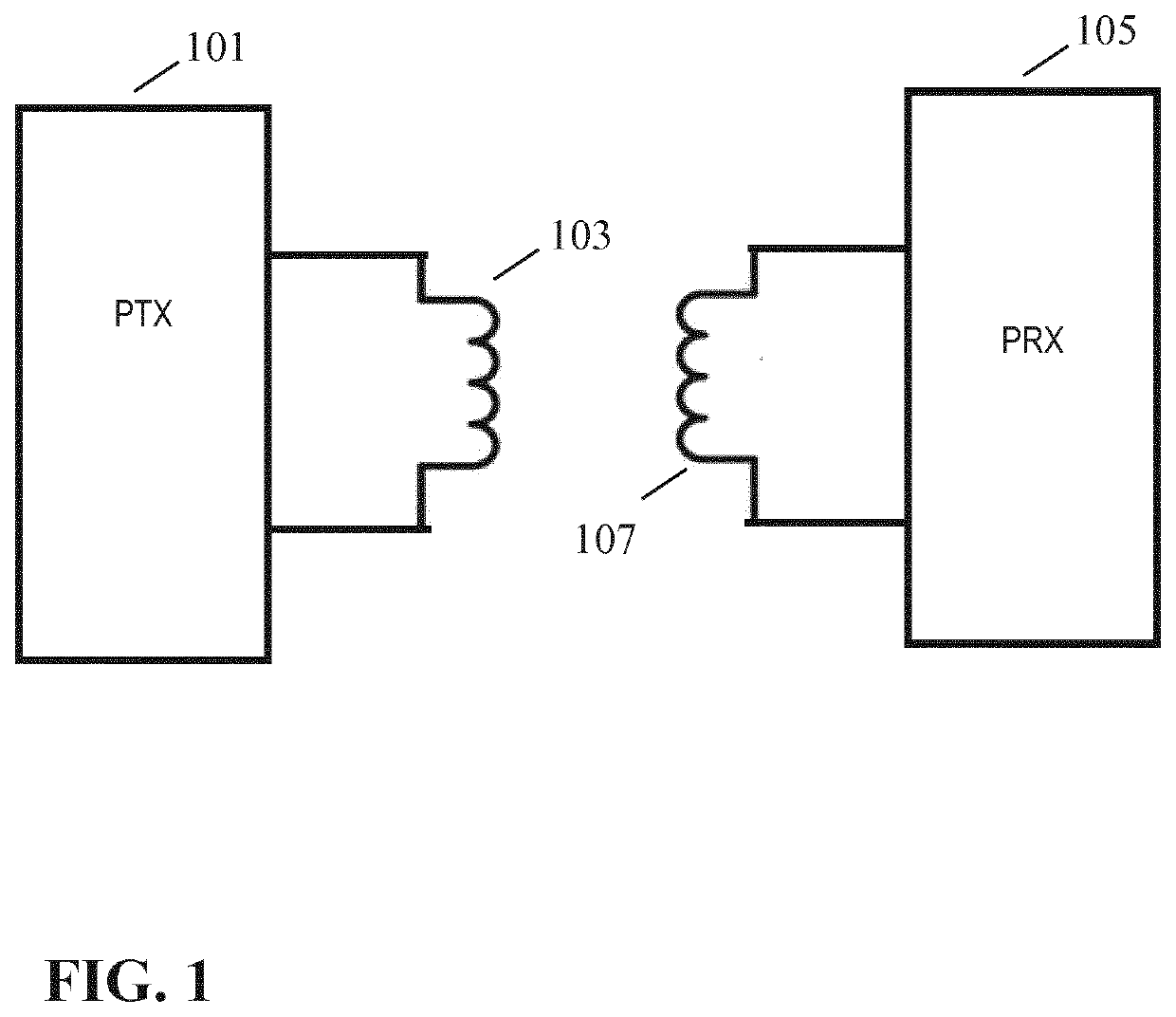
[0078]FIG. 1 illustrates an example of a power transfer system in accordance with some embodiments of the invention. The power transfer system comprises a power transmitter 101 which includes (or is coupled to) a transmitter coil / inductor 103. The system further comprises a power receiver 105 which includes (or is coupled to) a receiver coil / inductor 107.

[0079]The system provides an electromagnetic power transfer signal which may inductively transfer power from the power transmitter 101 to the power receiver 105. Specifically, the power transmitter 101 generates an electromagnetic signal, which is propagated as a magnetic flux by the transmit...

the structure of the environmentally friendly knitted fabric provided by the present invention; figure 2 Flow chart of the yarn wrapping machine for environmentally friendly knitted fabrics and storage devices; image 3 Is the parameter map of the yarn covering machine
Login to View More

PUM

No PUM Login to View More

Abstract

A power transmitter (101) for a wireless power transfer system comprises a transmitter coil (103) and a driver (201) generates a drive signal for the transmitter coil (103) employing a repeating time frame with a power transfer time interval and a foreign object detection time interval. A test generator (211) generates a test drive signal for a test coil (209) during the foreign object detection time interval. A foreign object detector (207) performs a foreign object detection test based on a measured parameter for the test drive signal. Prior to entering a power transfer phase, an adapter (213) controls the power transmitter (101) to operate in a foreign object detection initialization mode in which a preferred value of a signal parameter for the test drive signal is determined in response to at least a first message received from the power receiver (105). During the foreign object detection time interval the signal parameter of is set to the preferred value.

Description

FIELD OF THE INVENTION[0001]The invention relates to foreign object detection in a wireless power transfer system and in particular, but not exclusively, to foreign object detection for a power transmitter providing inductive power transfer to higher power devices, such as e.g. kitchen appliances.BACKGROUND OF THE INVENTION[0002]Most present-day electrical products require a dedicated electrical contact in order to be powered from an external power supply. However, this tends to be impractical and requires the user to physically insert connectors or otherwise establish a physical electrical contact. Typically, power requirements also differ significantly, and currently most devices are provided with their own dedicated power supply resulting in a typical user having a large number of different power supplies with each power supply being dedicated to a specific device. Although, the use of internal batteries may avoid the need for a wired connection to a power supply during use, this...

Claims

the structure of the environmentally friendly knitted fabric provided by the present invention; figure 2 Flow chart of the yarn wrapping machine for environmentally friendly knitted fabrics and storage devices; image 3 Is the parameter map of the yarn covering machine
Login to View More

Application Information

Patent Timeline
no application Login to View More
IPC IPC(8): H02J50/60H02J50/12
CPCH02J50/12H02J50/60H02J50/80
Inventor VAN WAGENINGEN, ANDRIESETTES, WILHELMUS GERARDUS MARIAVELTMAN, EDDY GERRITSTARING, ANTONIUS ADRIAAN MARIATHEELEN, RICHARD HENRICUS MARIAKABLAU, JOHANNES GERARDUS FREDERICUS
Owner KONINKLJIJKE PHILIPS NV