Check patentability & draft patents in minutes with Patsnap Eureka AI!

Method and apparatus for detecting viruses in biological samples

a biological sample and virus technology, applied in the field of rapid detection of the presence of viruses, can solve the problems of limited training for test operators, slow approval of antigen tests, and time-consuming development of antibodies to capture antigens, and achieves rapid scale-up, low cost, and decentralized testing capacity

Inactive Publication Date: 2022-02-17
BOSTON MOLECULES INC
View PDF0 Cites 0 Cited by
  • Summary
  • Abstract
  • Description
  • Claims
  • Application Information

AI Technical Summary

Benefits of technology

The present invention is a rapid viral test using monoclonal antibodies that can detect the SARS-CoV-2 virus from saliva. The device is designed to be simple and cost-effective, with a sensitivity and specificity of approximately 90%. The test can be used in clinical laboratories, near the point-of-care, or at home. The high affinity monoclonal antibodies capture and detect the virus by binding to viral proteins, and a filter technology implemented using microfluidic technology helps in detecting low copies of viral particles. This technology helps in controlling the pandemic and supporting decentralized testing capacity.

Problems solved by technology

They are relatively simple to perform, with results easy to interpret and therefore require limited training for test operators.
Antigen tests have been slow to approval by any authorities for SARS-CoV-2 due to multiple reasons.
Developing antibodies to capture an antigen is usually time consuming, and requires immunizing animals followed by monoclonal screening.

Method used

the structure of the environmentally friendly knitted fabric provided by the present invention; figure 2 Flow chart of the yarn wrapping machine for environmentally friendly knitted fabrics and storage devices; image 3 Is the parameter map of the yarn covering machine
View more

Image

Smart Image Click on the blue labels to locate them in the text.
Viewing Examples
Smart Image
  • Method and apparatus for detecting viruses in biological samples
  • Method and apparatus for detecting viruses in biological samples
  • Method and apparatus for detecting viruses in biological samples

Examples

Experimental program
Comparison scheme
Effect test

Embodiment Construction

I. Virus Test Description.

[0023]The disclosed process for virus detection can be used use for both paraprofessional diagnostic applications and potentially as an in-home screening test.

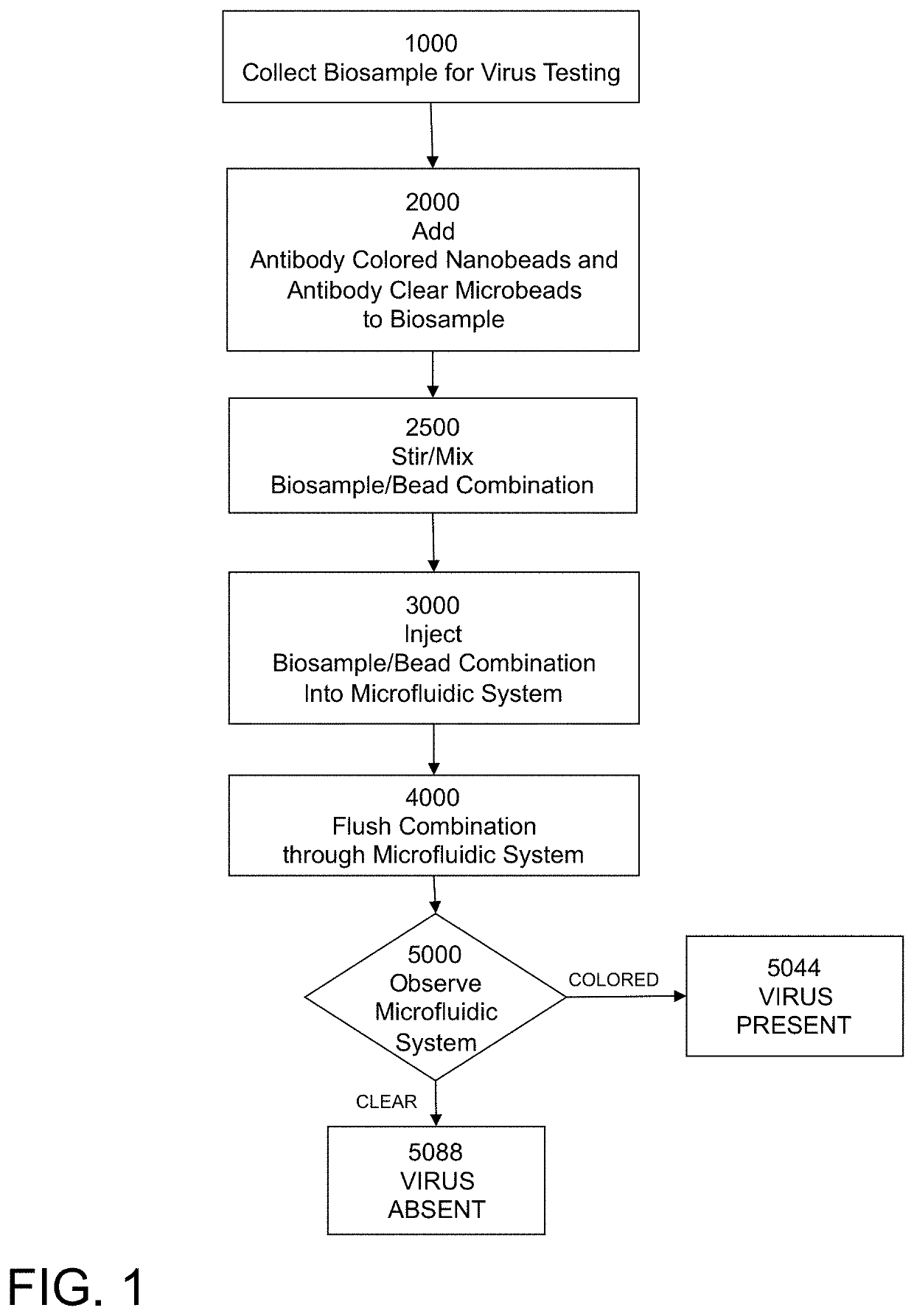
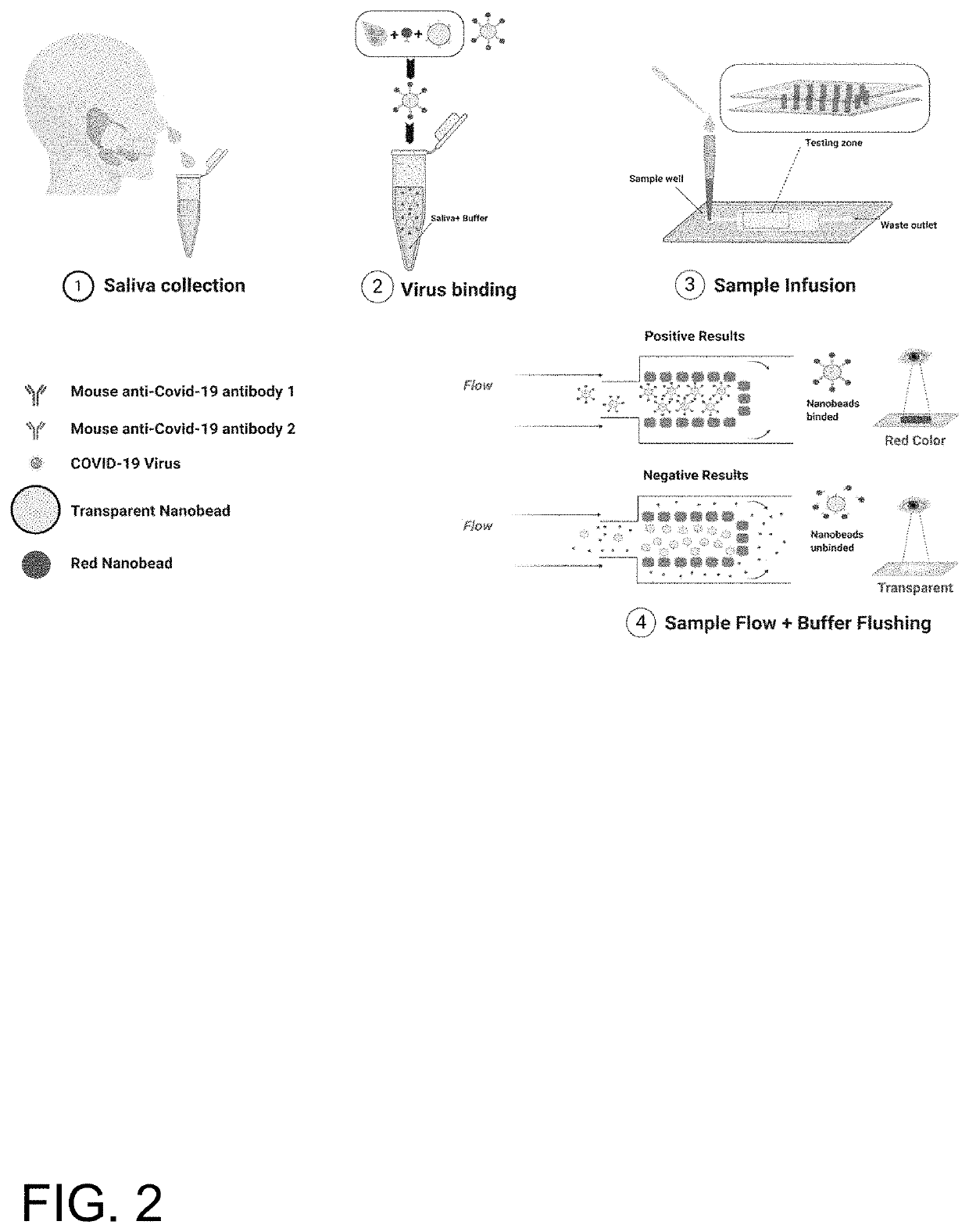
[0024]A flow chart and working mechanism of the method we have developed using a microfluidics diagnostic chip is briefly described below and illustrated in FIGS. 1 and 2. FIG. 1 presents a flow chart diagram of the steps in the process, while FIG. 2 presents illustrations of each step of the process.

[0025]Referring to FIG. 1, in the first step 1000, a biological sample (the biosample) to be tested for the presence of a predetermined virus (such as SARS-CoV-2) is collected into a sterile tube that also contains a buffer fluid. In one preferred embodiment, the biological sample can be a sample of the patient's saliva, collected by self-service.

[0026]Buffers for biological sample selection are commonly used in the art. In some embodiments of the invention, a phosphate-buffered saline (PBS) buffer with 1...

the structure of the environmentally friendly knitted fabric provided by the present invention; figure 2 Flow chart of the yarn wrapping machine for environmentally friendly knitted fabrics and storage devices; image 3 Is the parameter map of the yarn covering machine
Login to View More

PUM

No PUM Login to View More

Abstract

The present invention relates to a process for detecting a virus that include the steps of: taking a biosample (e.g. saliva) suspected of containing a virus, mixing it with a solution comprising nanoparticles having easily detectable properties (e.g. a color) and also comprising contrasting microparticles (e.g. clear or white), each having attached chemical compounds (e.g. antibodies) that selectively bind to the virus to be detected (e.g. SARS-CoV-2). When suitably mixed together, virus present in the biosample may bind to the nanoparticles and to the microparticles, connecting the two. When the mixture is then passed through a microfluidic assembly with dimensions that trap the microparticles but pass unbound nanoparticles, the detection of the presence of nanoparticles bound to the microparticles at the microfluidic filter indicates the presence of the virus to be detected. The process may include a concentration step to accelerate binding the virus to the nano- and micro-particles.

Description

CROSS-REFERENCE TO RELATED APPLICATIONS[0001]This application claims priority to U.S. Provisional Application No. 63 / 064911 filed on Aug. 12, 2020.FIELD OF THE INVENTION[0002]The present invention relates to tests for rapid detection of the presence of viral material in a biological sample.BACKGROUND OF THE INVENTION[0003]Rapid viral tests are qualitative or semi-quantitative in-vitro diagnostics (IVDs), used singly or in a small series, which typically involve non-automated procedures and have been designed to give a fast result. For the Severe Acute Respiratory Syndrome Coronavirus 2 (SARS-CoV-2), the virus responsible for the pandemic of Coronavirus Disease of 2019 (COVID-19), rapid tests such as antigen tests may take less than 15 minutes to produce a result, while other molecular tests may take as long as four hours, or even longer if samples need to be transported to a distant testing laboratory. By contrast, rapid viral tests may be used in clinical laboratories, near the poi...

Claims

the structure of the environmentally friendly knitted fabric provided by the present invention; figure 2 Flow chart of the yarn wrapping machine for environmentally friendly knitted fabrics and storage devices; image 3 Is the parameter map of the yarn covering machine
Login to View More

Application Information

Patent Timeline
no application Login to View More
IPC IPC(8): G01N33/569G01N33/543G01N33/563B01L3/00
CPCG01N33/56983G01N33/54326B01L2300/0681G01N33/563B01L3/5027G01N33/54346G01N33/54313
Inventor LAO, TAOTAOXU, JIANG
Owner BOSTON MOLECULES INC
Features
  • R&D
  • Intellectual Property
  • Life Sciences
  • Materials
  • Tech Scout
Why Patsnap Eureka
  • Unparalleled Data Quality
  • Higher Quality Content
  • 60% Fewer Hallucinations
Social media
Patsnap Eureka Blog
Learn More