
Lumped-element transmission line in multi-layered substrate
a transmission line and multi-layered technology, applied in the direction of high frequency circuit adaptation, one-port network, inductance, etc., can solve the problems of large circuit area, large physical length of the required transmission line, and insufficient so as to improve the frequency response of the lumped-element transmission line, wide frequency bandwidth, and reduce the circuit area of the transmission line
- Summary
- Abstract
- Description
- Claims
- Application Information
AI Technical Summary
Benefits of technology
Problems solved by technology
Method used
Image

Examples
first embodiment
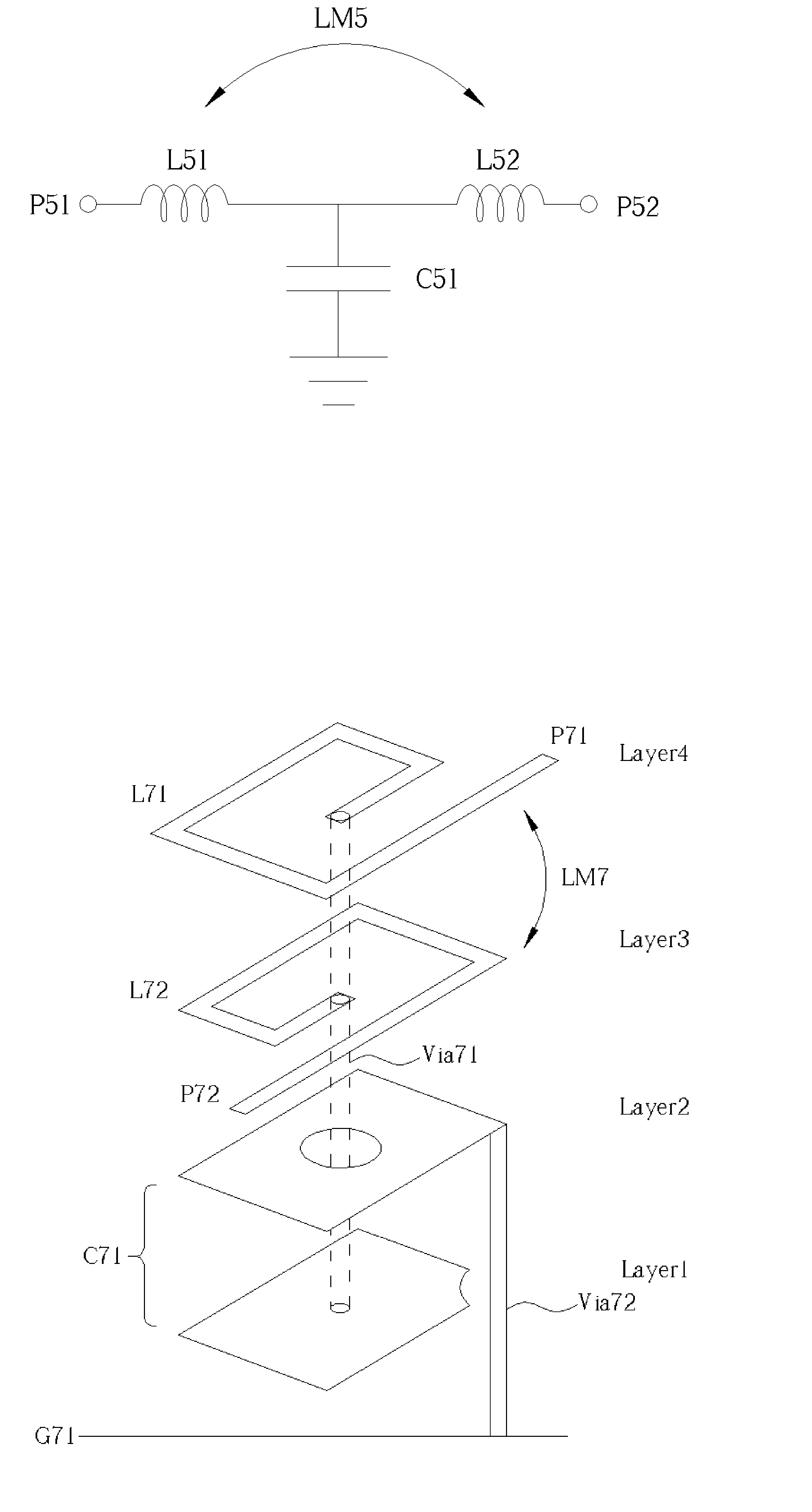
[0024]The primary reason for adopting lumped-element transmission lines is to reduce circuit area. The utilization of mutual inductance in the present invention helps to widen the applicable frequency range of the lumped-element transmission line. It is known that the mutual inductance relates to the relative distance and geometrical relations between two inductors. Therefore, it is very applicable to implement the present invention in a 3-dimensional structure such as a multi-layered substrate. Please refer to FIG. 7. FIG. 7 shows the present invention transmission line realized in a multi-layered substrate (layers 1–4) with a bottom ground plane G71. FIG. 7 illustrates inductors L71 and L72, a capacitor C71, and vias Via71 and Via72 penetrating the substrate and connecting different layers. The inductors L71 and L72 are realized with rectangular conductive spirals on layer 4 and layer 3 respectively. The inductor L72 is electrically connected to the inductor L71 in series through ...
second embodiment
[0025]FIG. 9 shows the present invention transmission line realized in a multi-layered substrate with both a top ground plane G92 and a bottom ground plane G91. FIG. 9 illustrates inductors L91 and L92, a capacitor C91, and vias Via91, Via92, and Via93 penetrating the substrate and connecting different layers. The inductors L91 and L92 are realized by conductive circular spirals on layer 4 and layer 3 respectively. The inductor L92 is electrically connected to the inductor L91 in series through the via Via91 penetrating the substrate. The capacitor C91 comprises two sub capacitors C911 and C912 shunt-connected to each other, such that each of them can be made smaller. The capacitor C911 comprises two plates formed on layer 1 and layer 2 of the multi-layered substrate, in which the plate formed on layer 2 is connected to the ground plane G91 through the via Via92 and the plate formed on layer 1 is connected to the via Via91. The capacitor C912 comprises two plates formed on a layer 5...
third embodiment
[0026]Shown in FIG. 11 and FIG. 12 are alternative realizations of the equivalent-circuit model in FIG. 5. Please refer to FIG. 11. FIG. 11 shows the present invention transmission line realized in a multi-layered substrate with a bottom ground plane G111. FIG. 11 illustrates inductors L111 and L112, a capacitor C111, and vias Via111 and Via112 penetrating the substrate and connecting different layers. The inductors L111 and L112 are realized by octagonal spirals on layer 2, and the inductor L112 is electrically connected to the inductor L111 in series at an end. The inductor L111 connects to a port P111 formed in layer 3 through the via Via111. The capacitor C111 is formed between a plate on layer 1 and the ground plane G111. The plate formed on layer 1 is connected to the via Via 112, which also connects to the end of the inductor L112 at which the inductor L112 is electrically connected to the inductor L111. Note that the orientations of inductors L111 and L112 are the same, thou...
PUM
| Property | Measurement | Unit |
|---|---|---|
| mutual inductance | aaaaa | aaaaa |
| shape | aaaaa | aaaaa |
| frequency | aaaaa | aaaaa |
Abstract
Description
Claims
Application Information
 Login to View More