Compositions and methods for identifying agents which regulate chromosomal stability, gene activation and aging
a technology of chromosomal stability and chromosomal activation, applied in the field of compositions and methods for identifying agents which regulate chromosomal stability, gene activation and aging, can solve problems such as general uncertainty and achieve the effect of facilitating the production of immunologically specific antibodies
- Summary
- Abstract
- Description
- Claims
- Application Information
AI Technical Summary
Benefits of technology
Problems solved by technology
Method used
Image

Examples
example i
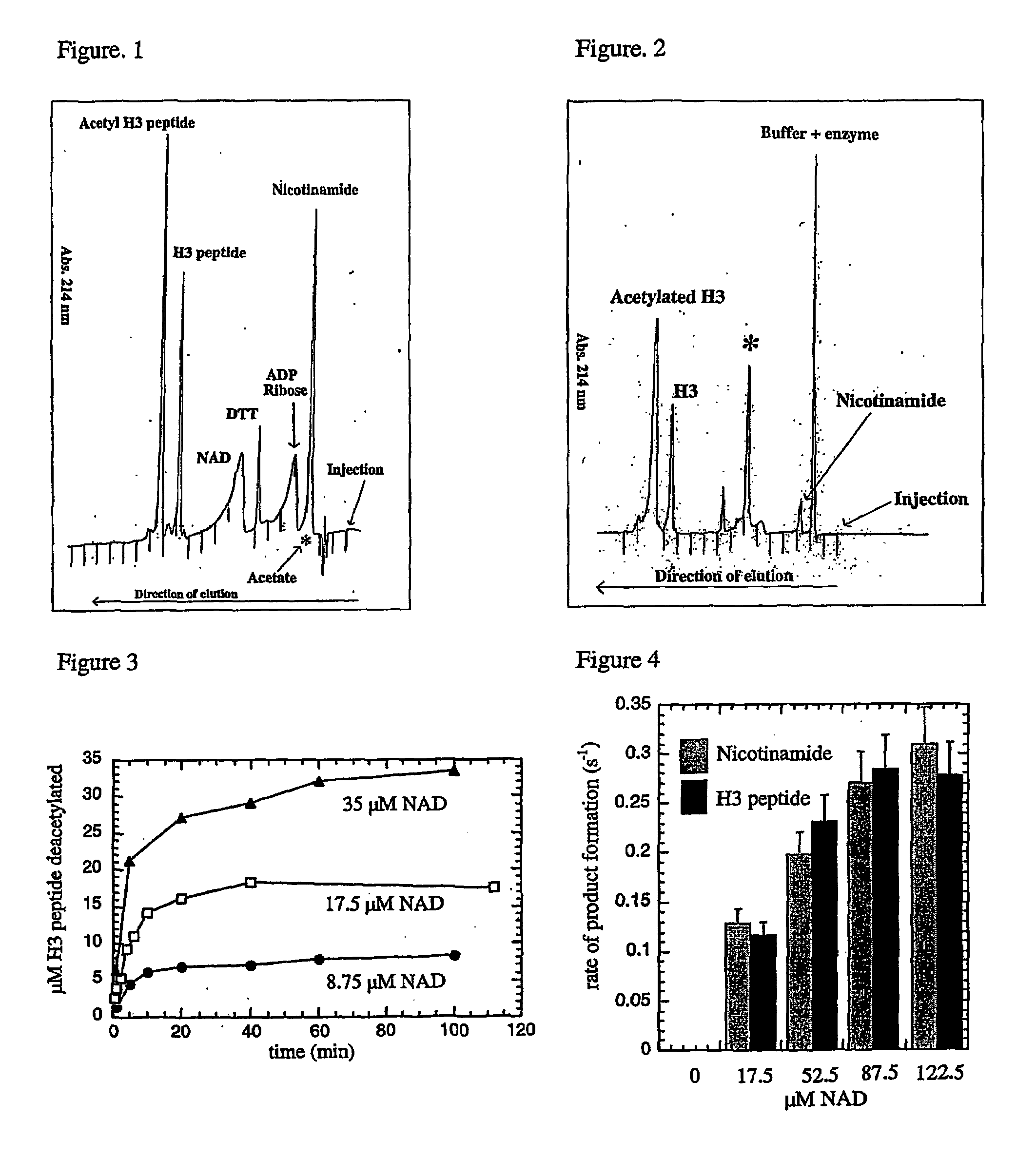
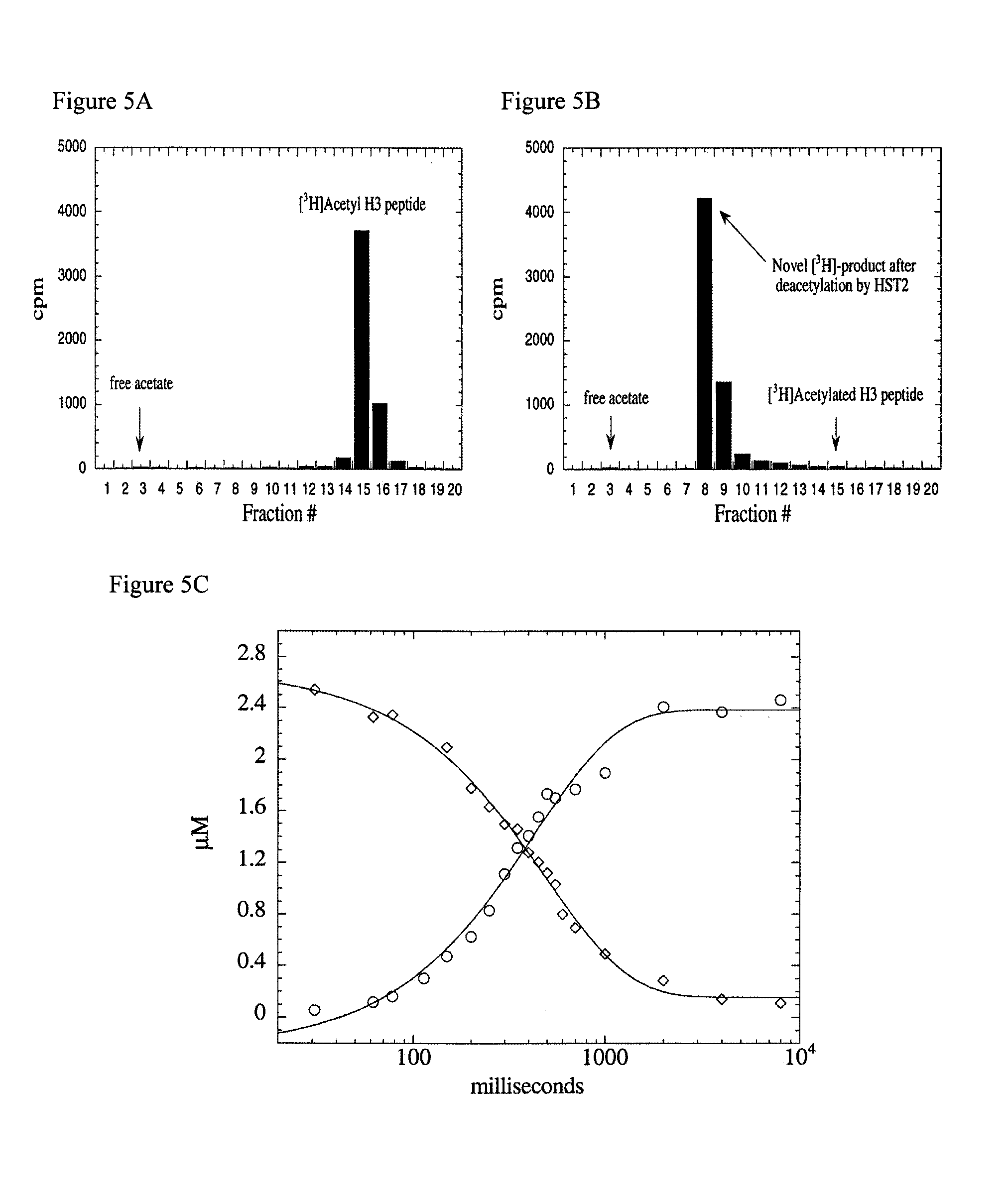
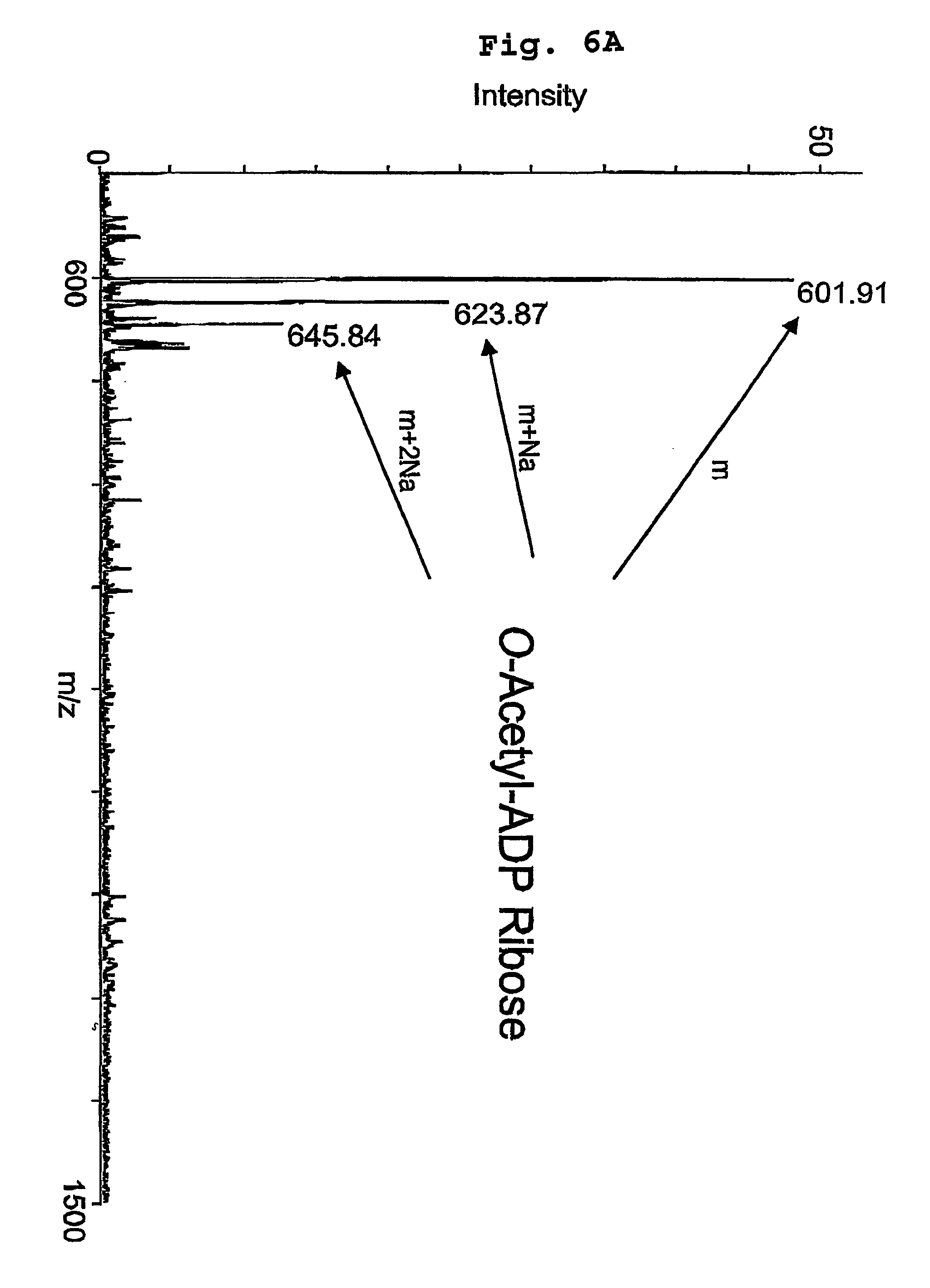
[0047]Due to the high yield and activity of recombinant enzyme, the yeast SIR2 homolog HST2 was utilized as the prototypical SIR2 member for the extensive study described here. Where noted, yeast SIR2 and the Escherichia coli homolog, CobB, were employed to demonstrate the conservation in catalytic function among the family. Although the requirement for NAD+ has been demonstrated, surprisingly, the true identity and stoichiometry of the products has not been investigated. The extent of coupling between NAD+ consumption and histone deacetylation was examined initially using the monoacetylated histone H3 peptide ARTKQTARKSTGG(AcK)APRKQL (corresponding to the first 20 amino-terminal residues in histone H3), subsequently referred to as AcLys-14 H3 peptide. To unambiguously identify the authentic products of the NAD-dependent deacetylation reaction, HST2 catalyzed products were resolved and quantified by reverse phase HPLC, and verified by mass spectrometry. First, standards of substrate...
example ii
[0056]To provide evidence for the existence of human cellular proteins / enzymes that are capable of binding and catalyzing the conversion or decomposition of O-acetyl-ADP ribose, human HeLa cell extracts were generated and the ability of proteins within the extract to catalyze the decomposition of O-acetyl-ADP ribose was assessed. Radio-labeled O-acetyl-ADP ribose was generated and purified as described above, and was added to the HeLa cell extract. As a control, O-acetyl-ADP ribose was added to a buffer control. At time points up to 3 hrs, the samples were analyzed for the amount of O-acetyl-ADP ribose remaining (by HPLC as described above). The results, shown in FIGS. 8A and 8B clearly demonstrate the ability of the human cell extract to convert O-acetyl-ADP ribose to a distinct, but as yet unidentified species. These findings suggest that O-acetyl-ADP ribose could be acting as a second messenger, where additional proteins / enzymes are capable of terminating the signal through the e...
example iii
[0059]The data presented in the previous examples indicates that O-acetyl ADP ribose is a novel molecule demonstrating unique cellular function(s) that may be linked to SIR2's gene silencing or other physiological effects. It appears that O-acetyl-ADP ribose has an important signaling role in which other enzymes / proteins utilize O-acetyl-ADP ribose to elicit the proper cellular response. Such targets might include ATP-dependent chromatin remodeling enzymes, histone / protein acetyltransferases or poly(ADP-ribosyl)transferases. Also, the observation that caloric restriction leading to increased life-span appears to be linked through an NAD+ and SIR2-dependent pathway, raises the possibility that O-acetyl-ADP ribose may play a role in this phenomenon.
[0060]To explore the function of SIR2-like enzymes and of O-acetyl-ADP ribose, microinjection analyses in living cells were performed which have provided evidence for phenotypic effects caused by SIR2- or O-acetyl-ADP ribose. The evidence p...
PUM
| Property | Measurement | Unit |
|---|---|---|
| pH | aaaaa | aaaaa |
| pH | aaaaa | aaaaa |
| height | aaaaa | aaaaa |
Abstract
Description
Claims
Application Information
 Login to View More