Low cost symbol error correction coding and decoding

a low-cost, error-correction technology, applied in the direction of redundancy data error correction, coding, code conversion, etc., can solve the problems of increasing the potential for soft errors, increasing the complexity of problems, increasing the cost of error correction code design and implementation, etc., to enhance computer storage integrity, reliability and serviceability, and simplify coder and decoder design and implementation. , the effect of low cos

US7487425B1Inactive Publication Date: 2009-02-03IBM CORP
4 Cites 16 Cited by

Patent Information

Authority / Receiving Office
US · United States
Patent Type
Patents(United States)
Current Assignee / Owner
Publication Date
2009-02-03
Estimated Expiration
Not applicable · inactive patent

Smart Images

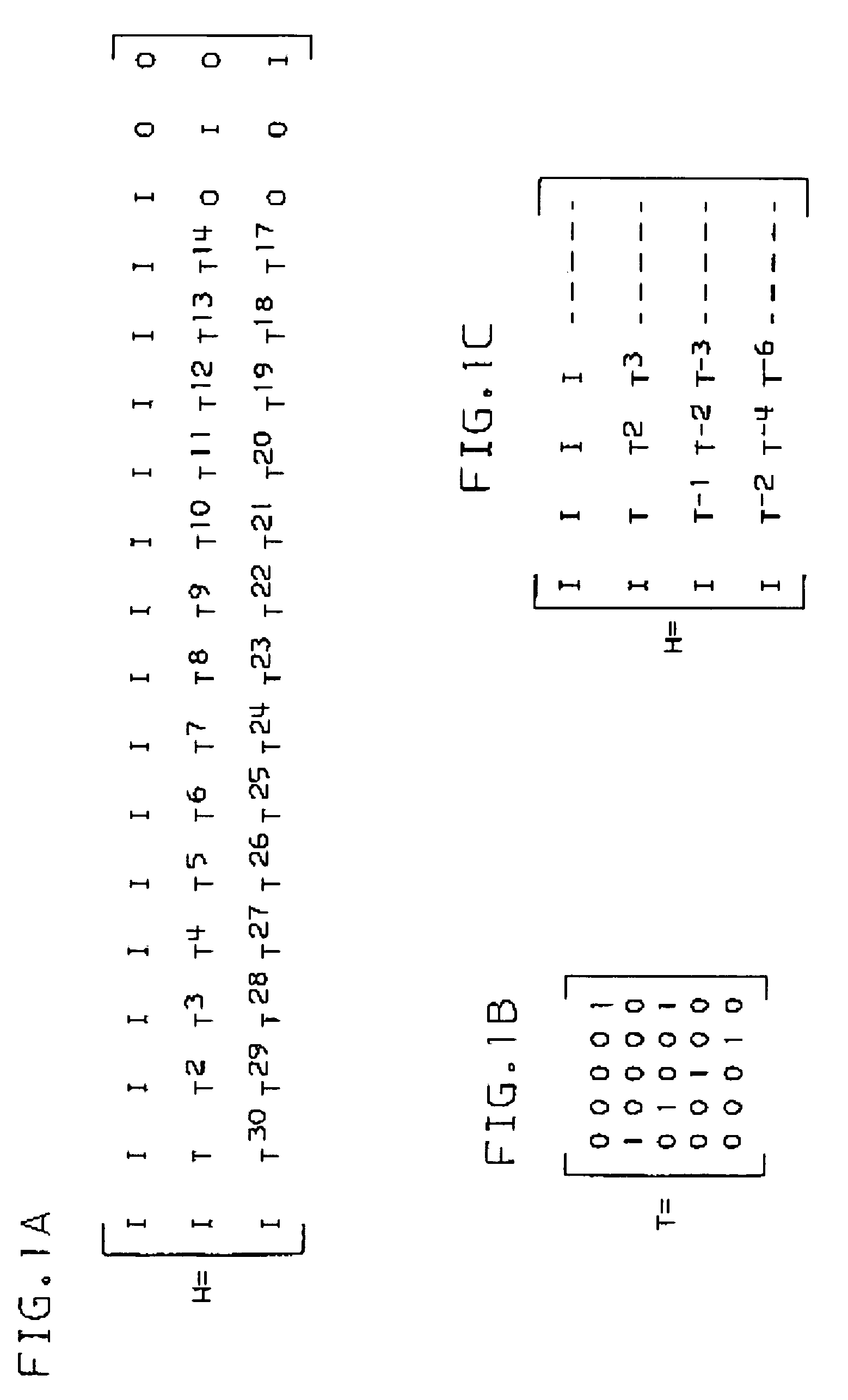
  • Figure 1
    Figure 1
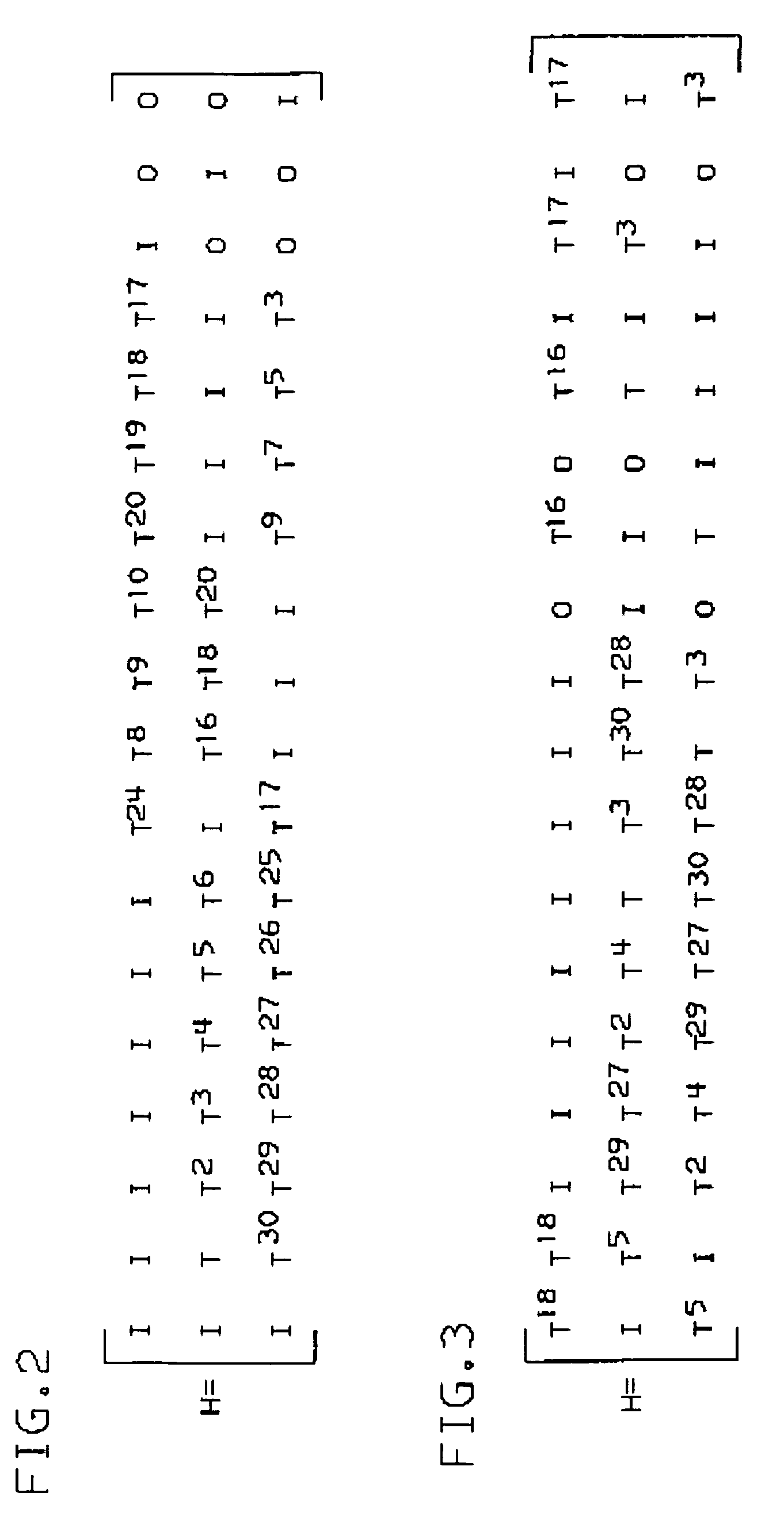
  • Figure 2
    Figure 2
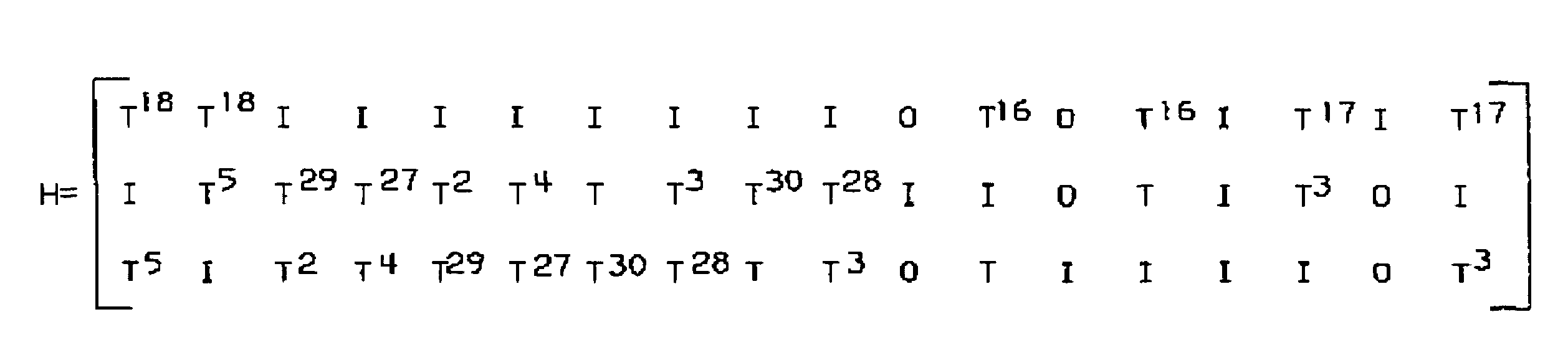
  • Figure 3
    Figure 3
Patent Text Reader

Abstract

Byte or symbol organized linear block codes are optimized in terms of reducing the number of ones in their parity check matrices by means of symbol column transformations carried out by multiplication by non-singular matrices. Each optimized symbol column preferably, and probably necessarily, includes a submatrix which is the identity matrix which contributes to low weight check matrices and also to simplified decoding procedures and apparatus. Since circuit cost and layout area are proportional to the number of Exclusive-OR gates which is determined by the number of ones in the check matrix, it is seen that the reduction procedures carried out in accordance with the present invention solve significant problems that are particularly applicable in the utilization of byte organized semiconductor memory systems. Reduced weight coding systems are also generated in accordance with weight reducing procedures used in conjunction with modified Reed Solomon codes. The decoding and encoding methods and apparatus are extendable to the inclusion of any number of check symbols.
Need to check novelty before this filing date? Find Prior Art

Description

[0001] This is a continuation of application(s) Ser. No. 07 / 318,983 filed on Mar. 6, 1989, now abandoned.BACKGROUND OF THE INVENTION

[0002] The present invention is generally directed to the encoding and decoding of binary data so as to employ error correction coding (ECC) methods for symbol error correction and detection. Apparatus for decoding such codes is also provided and implemented in a fashion which exploits code structure to provide encoders and decoders which minimize circuit cost, particularly with respect to the number of Exclusive-OR gates needed. More particularly, an embodiment employing three check symbols is presented.

[0003] The utilization of error correction and detection codes in electronic data processing and transmission systems is becoming more and more important for several reasons. In particular, increased problem complexity and security concerns require ever increasing levels of reliability in data transmission. Furthermore, the increased use of high density, v...

Examples

Embodiment Construction

[0039]The description which follows first considers the situation in which the number of check symbols in the code, M, is equal to 3. However, in the latter part of the present description, attention is directed to the general case in which M is greater than 3.

[0040]In one embodiment, the present invention is directed to a class of binary codes which have been found to be useful because of their error correction properties and because of their ease of decoding. However, the present invention improves upon these codes with respect to both encoding and decoding, particularly when measured against circuit cost as determined by the number of Exclusive-OR gates employed. The present invention is specifically directed to code construction based upon codes having a parity check matrix organized in the form of a plurality of symbol columns. Each of the symbol columns preferably includes submatrices which are powers of a given companion matrix, T, which is the matrix associated with a primit...