Solid polymer electrolyte membrane, method for manufacturing the same, and fuel cell using the solid polymer electrolyte membrane
a technology of electrolyte membrane and solid polymer, which is applied in the direction of non-aqueous electrolyte cells, sustainable manufacturing/processing, cell components, etc., can solve the problems of insufficient energy generation efficiency of solid polymer fuel cells that use electrolyte membranes formed of perfluorocarbonsulfonic acids, inability to stably maintain energy generation efficiency of fuel cells, and poor long-term stability of fuel cells. achieve the effect of stable energy generation performan
- Summary
- Abstract
- Description
- Claims
- Application Information
AI Technical Summary
Benefits of technology
Problems solved by technology
Method used
Image

Examples
example 1
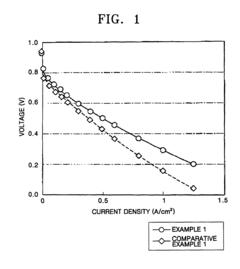
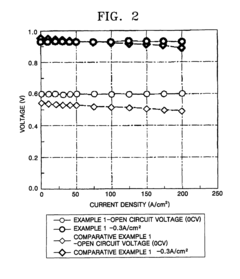
[0069]10 wt % of poly-2,2′-(m-phenylene)-5,5′-bibenzimidazole (weight average molecular weight of 150,000 on a polystyrene basis) as a polybenzimidazole was dissolved in N,N-dimethylacetamide. One equivalent of 2-isocyanatoethylmethacrylate (Carlenz MOI®, Showha Electric, Japan) with respect to the nitrogen-containing heterocyclic active hydrogen of the polybenzimidazole was added to the solution.
[0070]The resulting solution was spread on a glass plate using a doctor blade and then heated at 150° C. to remove the solvent from the solution and induce the reaction illustrated in Reaction Scheme 1. The result was a polymer compound film in which the substituent with a C-C double bond was bonded to the heterocyclic nitrogen atom of the polybenzimidazole.
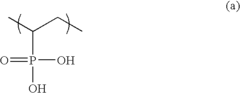
[0071]Then, the polymer compound film was directly immersed in vinylphosphonic acid (Tokyo Chemicals Inc.) at 70° C. after 1,000 ppm of organic peroxide, 2,5-dimethyl-2,5-bis(t-butylperoxy) hexane (Perhexer 25B®, Nippon Oil & Fat), was a...
example 2
[0075]A polymer compound film was fabricated in the same manner as in Example 1 except that glycidylmethacrylate (Tokyo Chemicals Inc.) was used instead of 2-isocyanatoethylmethacrylate to induce the reaction illustrated in Reaction Scheme 2.
[0076]Vinylphosphonic acid was added to the polymer compound film in the same manner as in Example 1, to prepare the solid polymer electrolyte membrane of Example 2 with a concentration of 450 mol % of vinylphosphonic acid.
[0077]A fuel cell was fabricated using the solid polymer electrolyte membrane, and the emergy generation characteristics of the fuel cell were measured in the same manner as in Example 1.
PUM
| Property | Measurement | Unit |
|---|---|---|
| humidity | aaaaa | aaaaa |
| temperature | aaaaa | aaaaa |
| temperature | aaaaa | aaaaa |
Abstract
Description
Claims
Application Information
 Login to View More