Unlock instant, AI-driven research and patent intelligence for your innovation.

Non-PVC flooring made of thermo plastic elastomer and method for producing the same

a technology of thermoplastic elastomer and non-pvc flooring, which is applied in the direction of synthetic resin layered products, other domestic articles, manufacturing tools, etc., can solve the problems of inability to use, poor installation, and inability to meet the needs of practical use, and achieves no adhesion of polyolefin resins, surface treatment agents and other components, and good adhesion

Inactive Publication Date: 2011-05-03
LG CHEM LTD
View PDF12 Cites 2 Cited by
  • Summary
  • Abstract
  • Description
  • Claims
  • Application Information

AI Technical Summary

Benefits of technology

This approach allows for the production of non-PVC flooring using conventional calendering equipment, eliminating environmental pollution issues and improving adhesion and heat resistance, while simplifying the production process and reducing costs by avoiding additional treatment steps.

Problems solved by technology

However, since non-PVC floorings suffer from many problems, such as difficult production, poor installation and high price, they are not yet suitable for practical use.
However, polyolefin resins, including polypropylene and polyethylene, have no adhesion to inks, surface treatment agents and other components due to the absence of polar components in the resins.
Accordingly, production of polyolefin floorings essentially involves various complicated processes, such as corona treatment and primer treatment, for sufficient adhesion to inks and surface treatment agents.
Further, viscosity characteristics of polyolefin resins are drastically deteriorated during melting above specific temperatures, and thus polyolefin resins cannot be substantially molded into sheets by calendering.
Accordingly, the use of an extruder, e.g., a T-die, is inevitable, leading to a serious deterioration in productivity.
Although processing of polypropylene and ethylene-propylene rubbers has been recently performed by calendering, the problem of poor adhesion to inks and surface treatment agents still remains unsolved.

Method used

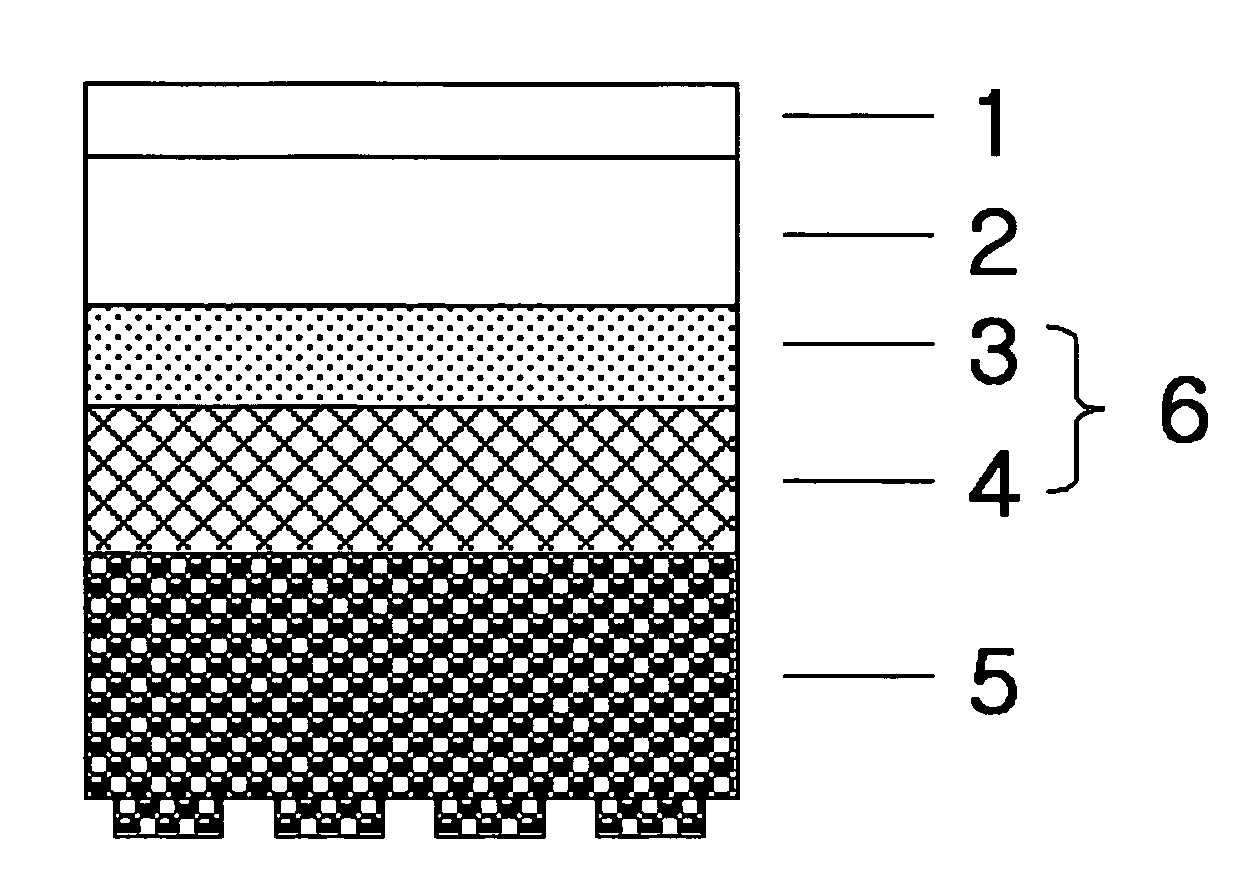
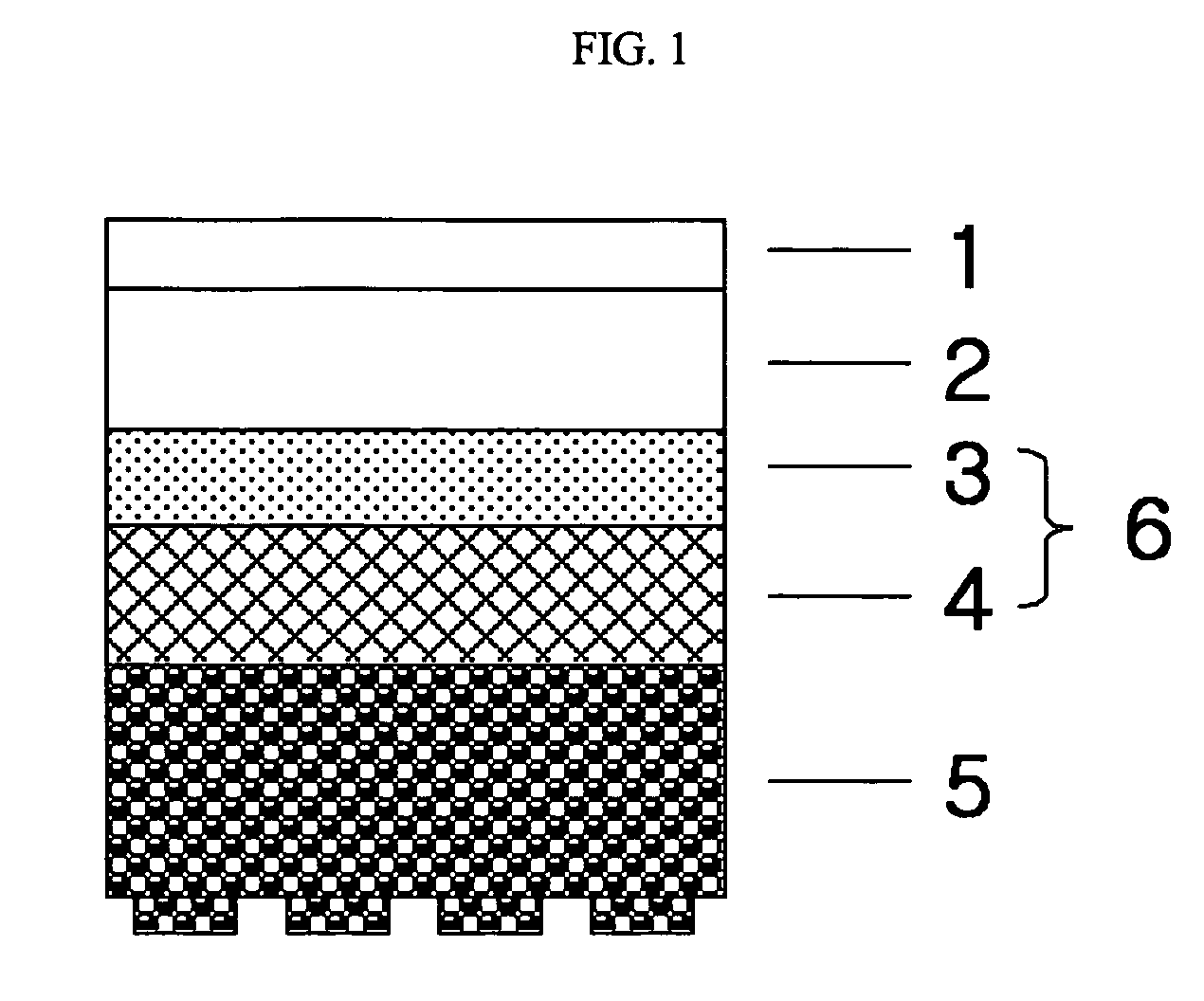
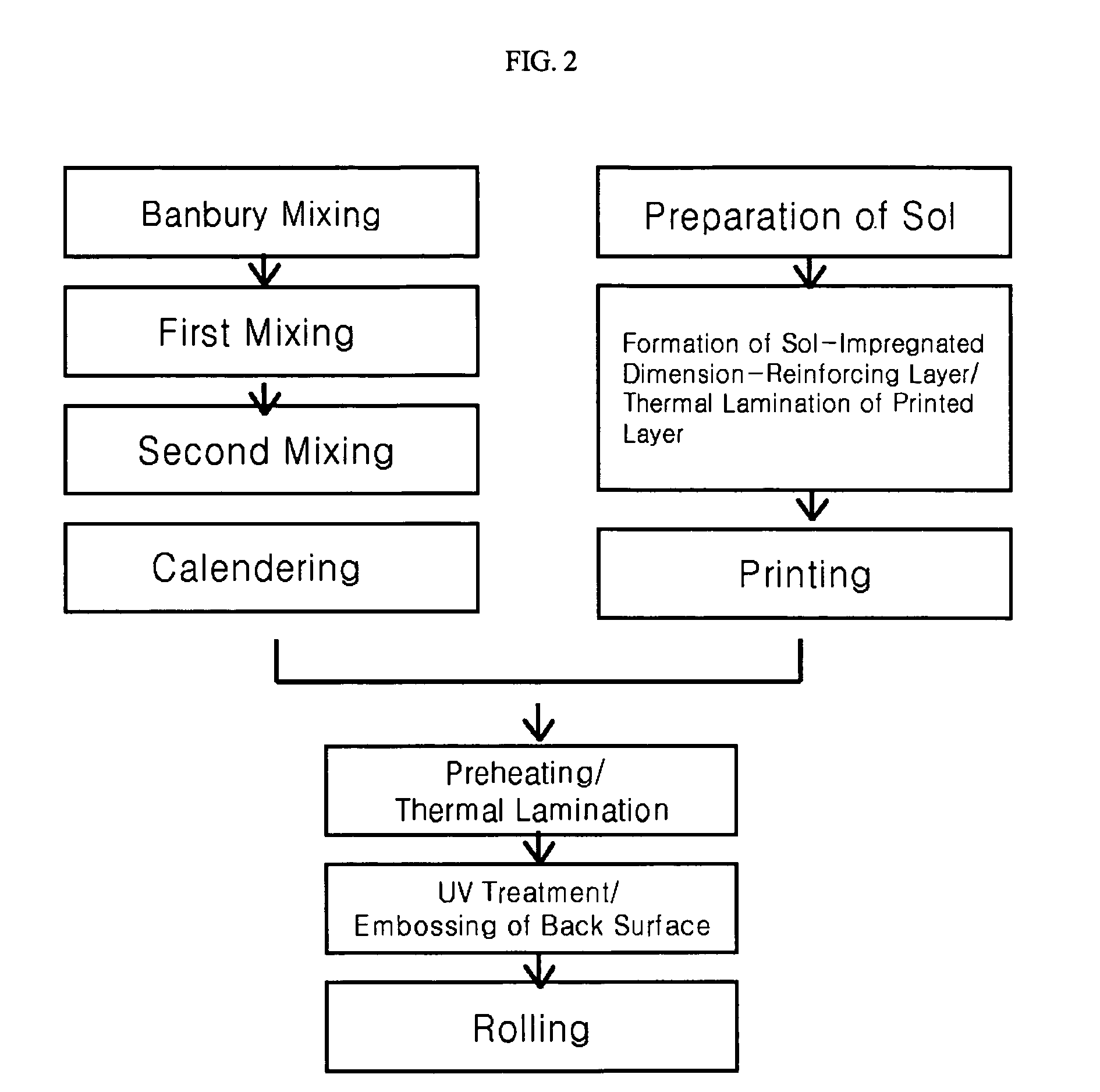
the structure of the environmentally friendly knitted fabric provided by the present invention; figure 2 Flow chart of the yarn wrapping machine for environmentally friendly knitted fabrics and storage devices; image 3 Is the parameter map of the yarn covering machine
View more

Image

Smart Image Click on the blue labels to locate them in the text.
Viewing Examples
Smart Image
  • Non-PVC flooring made of thermo plastic elastomer and method for producing the same
  • Non-PVC flooring made of thermo plastic elastomer and method for producing the same
  • Non-PVC flooring made of thermo plastic elastomer and method for producing the same

Examples

Experimental program
Comparison scheme
Effect test

examples

Constituent layers of a flooring according to the present invention other than a dimension-reinforcing layer were formed by calendering.

1. Formation of Transparent Layer

To form a transparent layer 2, the following raw materials were mixed: 50 parts by weight of a hydrogenated styrene-butadiene copolymer rubber (SS L601, Asahi, Japan) having a polystyrene content of 70 wt % and a melt index (MI) of 10, 70 parts by weight of a first styrene-butadiene block copolymer rubber (LG604, LG Chem., Korea) having a polystyrene content of 40 wt % and a melt index (MI) of 8, 70 parts by weight of a second styrene-butadiene block copolymer rubber (KTR-301, Kumho Petrochemical Co., Ltd. Korea) having a polystyrene content of 41 wt % and a melt index (MI) of 6, 30 parts by weight of polystyrene (25SPE, LG Chem., Korea), 0.7 parts by weight of a UV stabilizer (Hisorb 327, LG Chem., Korea), 0.5 parts by weight of a first antioxidant (Songnox 2450, Songwon Industrial Co., Ltd. Korea), 0.8 parts by wei...

the structure of the environmentally friendly knitted fabric provided by the present invention; figure 2 Flow chart of the yarn wrapping machine for environmentally friendly knitted fabrics and storage devices; image 3 Is the parameter map of the yarn covering machine
Login to View More

PUM

PropertyMeasurementUnit
thicknessaaaaaaaaaa
thicknessaaaaaaaaaa
thicknessaaaaaaaaaa
Login to View More

Abstract

Disclosed herein is a method for producing a transparent or opaque flooring sheet or a flooring using a styrene-butadiene copolymer resin (as a thermoplastic elastomer) by calendering. The flooring causes no problems associated with environmental hormones, and generates no halogen gases or endocrine disruptors, such as dioxin, during incineration. Further, the flooring can be regenerated and reused at any time, and exhibits superior stability upon installation and mounting and excellent elastic restoration after application of stress due to inherent flexibility of rubber.

Description

This application claims the benefit of the filing date of Korean Patent Application No. 10-2004-0094413 filed on Nov. 18, 2004 in the Korean Intellectual Property Office, the disclosure of which is incorporated herein in their entirety by reference.TECHNICAL FIELDThe present invention relates to a method for producing a flooring sheet or a flooring using a hydrogenated styrene-butadiene copolymer thermoplastic elastomer (TPE) by calendering, and more particularly to a flooring causing no problems associated with environmental hormones arising from the use of plasticizers in conventional polyvinyl chloride (PVC) resins and dioxin generated during incineration of PVC resins.BACKGROUND ARTThere have been various attempts to develop non-polyvinyl chloride (non-PVC) floorings. However, since non-PVC floorings suffer from many problems, such as difficult production, poor installation and high price, they are not yet suitable for practical use. In recent years, floorings using polyolefin r...

Claims

the structure of the environmentally friendly knitted fabric provided by the present invention; figure 2 Flow chart of the yarn wrapping machine for environmentally friendly knitted fabrics and storage devices; image 3 Is the parameter map of the yarn covering machine
Login to View More

Application Information

Patent Timeline
no application Login to View More
Patent Type & Authority Patents(United States)
IPC IPC(8): B32B5/00B32B27/08
CPCB29C43/30E04F15/16B32B3/30B32B27/08B32B27/12B32B27/18B32B27/302B32B27/32B32B38/06B32B38/145B32B2260/021B32B2260/046B32B2262/101B32B2274/00B32B2307/412B32B2419/04B32B2471/00B29K2009/06Y10T428/31917Y10T428/31855Y10T428/31924
Inventor PARK, JONG-DAEJUNG, WOO-JINHWANG, BO-SOOKIM, JUN-HYOUNG
Owner LG CHEM LTD