
ORO and ORPRO with bit line trench to suppress transport program disturb
a technology of transport program and bit line trench, which is applied in the field of memory devices, can solve the problems of hot electron generation, disturb the programming of adjacent memory cells, and memory cells may reach adjacent memory cells, so as to prevent and/or mitigate tpd and improve electrical isolation
- Summary
- Abstract
- Description
- Claims
- Application Information
AI Technical Summary
Benefits of technology
Problems solved by technology
Method used
Image

Examples
Embodiment Construction
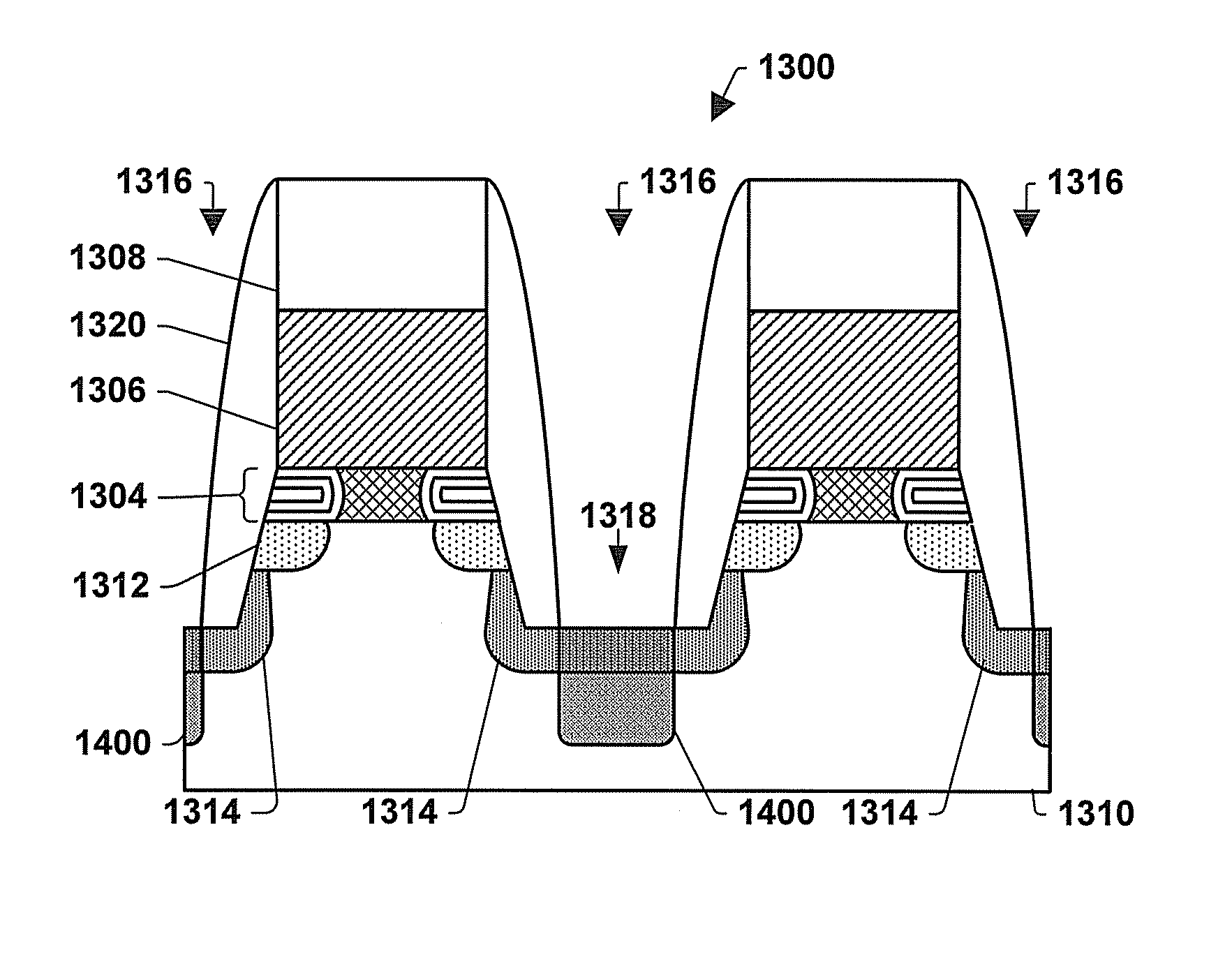
[0032]A memory cell, for example, a single bit memory cell or a dual bit memory cell, is programmed by applying a relatively high voltage to a control gate and connecting a source to ground and a drain to a predetermined potential above the source. During the programming of memory cells, hot electrons in a core cell channel region tunnel through a gate oxide into the floating gate and become trapped in the floating gate since the floating gate is surrounded by an interpoly dielectric and the tunnel oxide. As a result of the trapped electrons, the threshold voltage of the cell increases. This change in the threshold voltage (and thereby the channel conductance) of the cell created by the trapped electrons is what causes the cell to be programmed.
[0033]The hot electrons generated during programming may be so hot that they go under bitline junction. The hot electrons may reach floating gates or storage elements of adjacent memory cells. Moreover, hot holes generated during programming ...
PUM
 Login to View More
 Abstract
Description
Claims
Application Information
 Login to View More