Typically, the heart loses propulsive power because the
cardiac muscle loses capacity to stretch and contract.
Often, the ventricles do not adequately eject or fill with blood between heartbeats and the valves regulating
blood flow become leaky, allowing regurgitation or back-flow of blood.
The impairment of arterial circulation deprives vital organs of
oxygen and nutrients.
Fatigue,
weakness and the inability to carry out daily tasks may result.
As
heart failure progresses, it tends to become increasingly difficult to manage.
Even the compensatory responses it triggers in the body may themselves eventually complicate the
clinical prognosis.
If the
oxygen supply falls short of the growing demand, as it often does, further injury to the heart may result.
A particularly severe form of
heart failure is congestive heart failure (CHF) wherein the weak pumping of the heart leads to build-up of fluids in the lungs and other organs and tissues.
Any of these conduction pathways may potentially be degraded.
The
electrical impulse continues to be conducted to the postero-lateral wall of the left
ventricle causing its activation and
depolarization but, due to an inability to use the native conduction
system, this activation and contraction is delayed.
LBBB thus results in an abnormal activation of the left
ventricle inducing desynchronized
ventricular contraction (i.e. ventricular dyssynchrony) and impairment in cardiac performance.
However, this evaluation and
programming requires an office visit and is therefore a timely and expensive process.
It also restricts the evaluation to a resting state, commonly with the patient in a
supine position.
As such, the
system is not necessarily optimized for activity, for the upright position, for other times of day since there may also be a
circadian rhythm to cardiac function.
Unfortunately, conventional pacemakers and ICDs are not capable of detecting the aforementioned mechanical and electromechanical parameters.
That is, although conventional devices are certainly capable of sensing electrical cardiac signals such as P-
waves, R-
waves, and T-
waves, the devices are not typically capable of sensing actual mechanical contraction of the various chambers of the heart and hence cannot detect the mechanical and electromechanical parameters needed for optimal CRT control.
Although the techniques of Min et al. are quite useful, the various parameters specific to ventricular dyssynchrony noted above are not detected by those techniques.
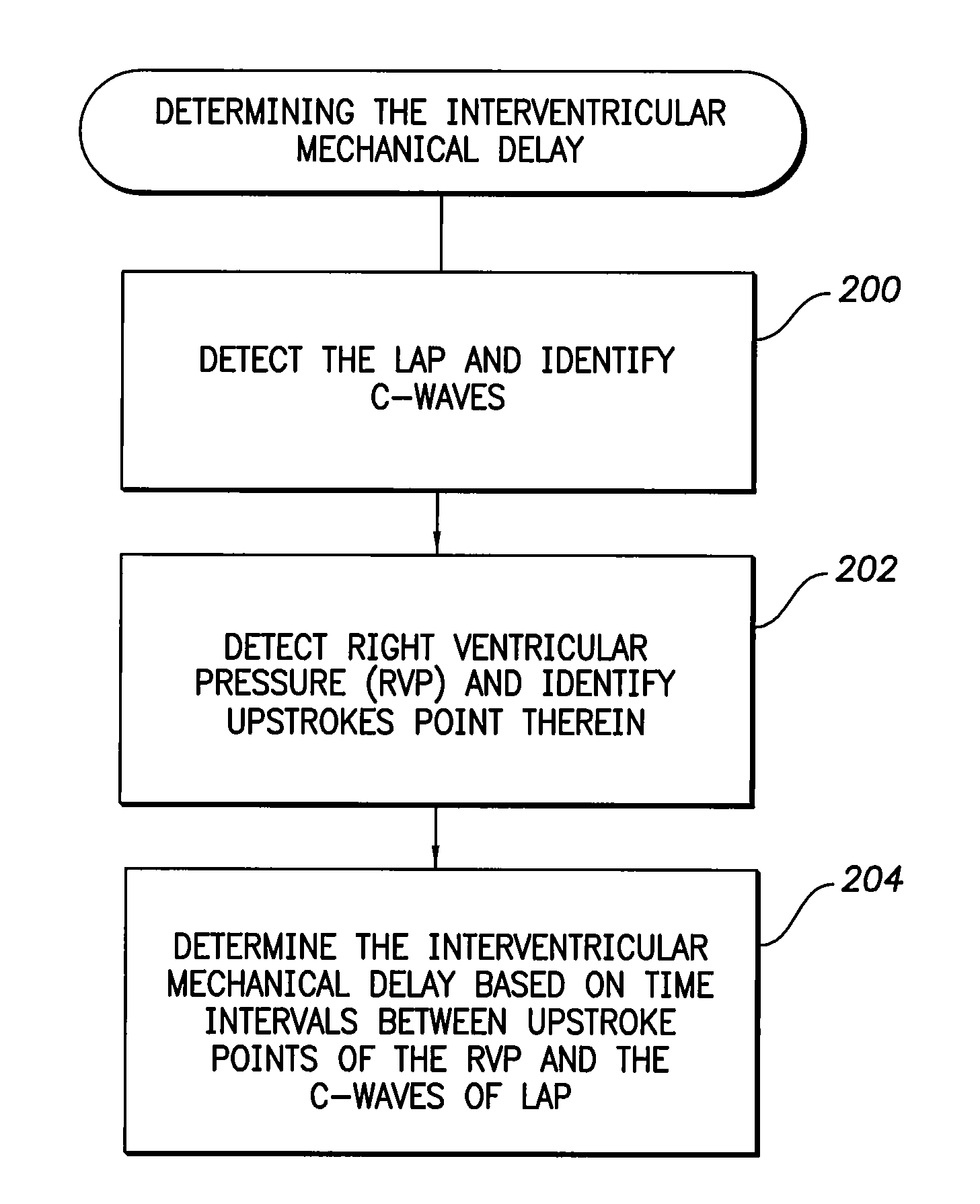
However, reliable detection of LVP is problematic and so it would be desirable to provide alternative techniques for determining the interventricular delay that do not necessarily require an LVP sensor.
Also, Struble et al. does not appear to provide techniques for detecting each of the various other ventricular mechanical and electromechanical parameters listed above by exploiting pressure measurements.
However, Mann et al. does not appear to set forth techniques for measuring the interventricular delay as well as the various other ventricular mechanical and electromechanical intervals listed above that are pertinent to ventricular dyssynchrony.


 Login to View More
  Login to View More