
Stress detection within an integrated circuit having through silicon vias
a stress detection and integrated circuit technology, applied in the direction of electrical/magnetic measuring arrangements, using electrical/magnetic means, liquid/fluent solid measurements, etc., can solve the problems of incorrect circuitry operation, high mechanical strain, and mechanical strain within the wafer layer, so as to improve the efficiency of managing the operating parameters of the integrated circuit, improve the effect of performance and reliable functioning
- Summary
- Abstract
- Description
- Claims
- Application Information
AI Technical Summary
Benefits of technology
Problems solved by technology
Method used
Image

Examples
Embodiment Construction
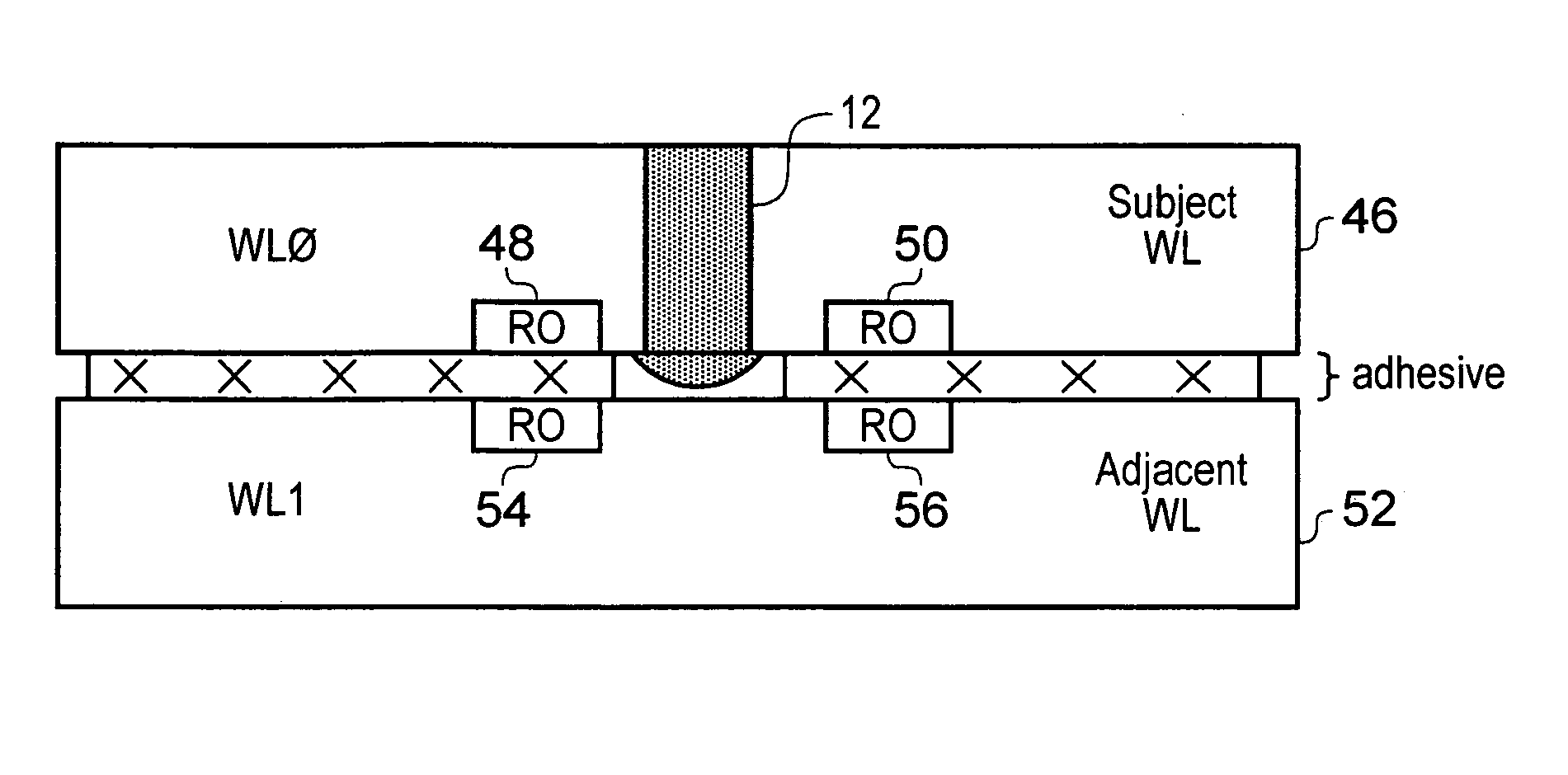
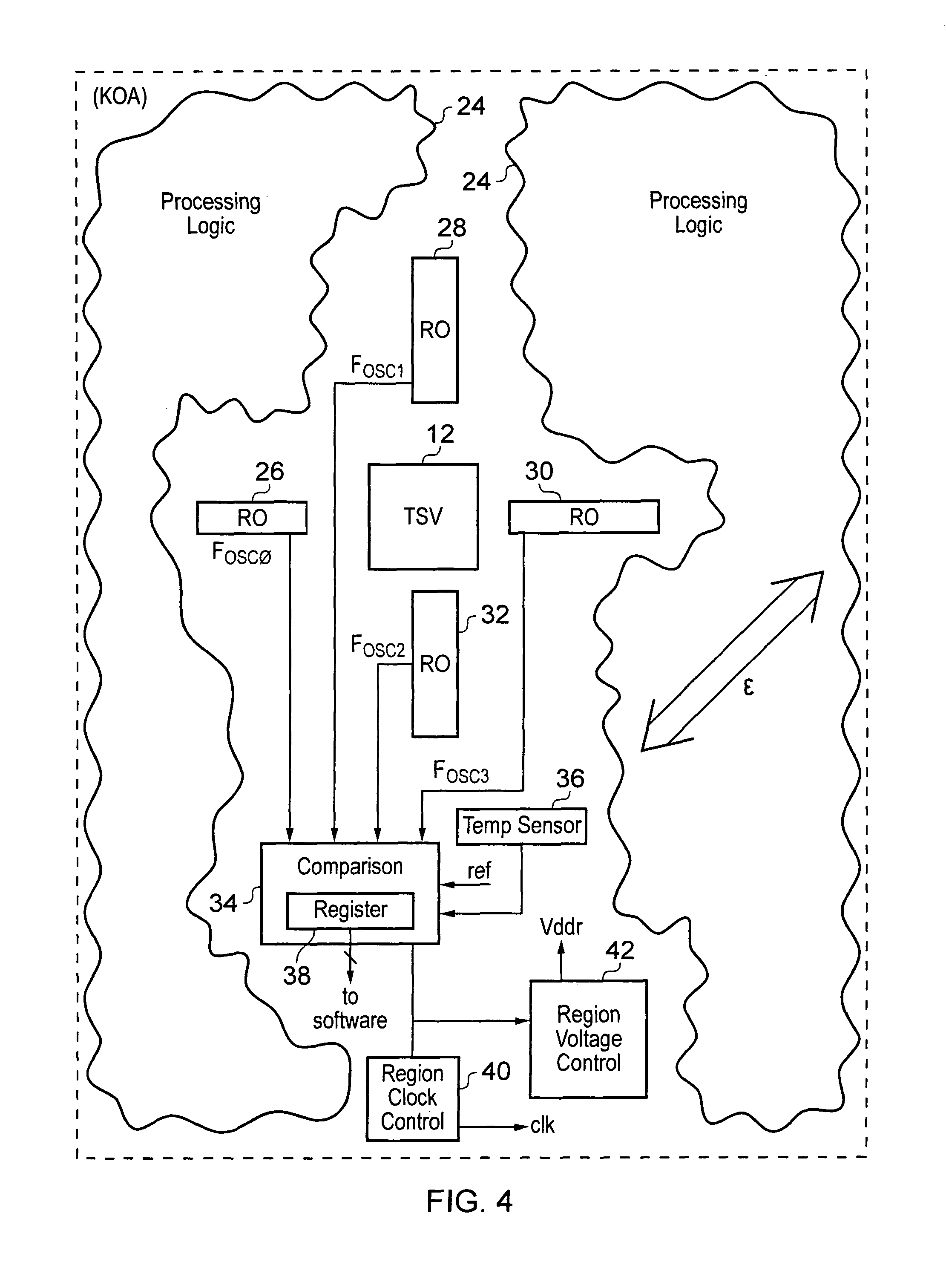
[0044]FIG. 4 schematically illustrates the region within a wafer layer of an integrated circuit surrounding a through silicon via 12. This through silicon via 12 would normally be surrounded by a keep out area KOA in which useful processing circuitry 24 would not be located as it could be subject to malfunction due electrical changes resulting from mechanical strain induced by the presence of the through silicon via 12. In accordance with the present techniques, this area proximal to the through silicon via 12 is utilised for useful processing circuitry 24. Strain sensors comprising four ring oscillators 26, 28, 30, 32, are provided surrounding the through silicon via 12. These ring oscillators 26, 28, 30, 32 are provided in pairs with each pair being disposed on an opposite side of the point at which the through silicon via 12 intersects the plane of the wafer layer. Thus, the ring oscillators 26, 28, 30, 32 can be considered as being provided in the four cardinal directions surrou...
PUM
 Login to View More
 Abstract
Description
Claims
Application Information
 Login to View More