
System for developing patient specific therapies based on dynamic modeling of patient physiology and method thereof
a dynamic modeling and patient technology, applied in the field of chronic disease management, can solve problems such as damage, inability to translate such data into actionable information, and inability to adapt to population-based approaches
- Summary
- Abstract
- Description
- Claims
- Application Information
AI Technical Summary
Benefits of technology
Problems solved by technology
Method used
Image

Examples
process implementation example
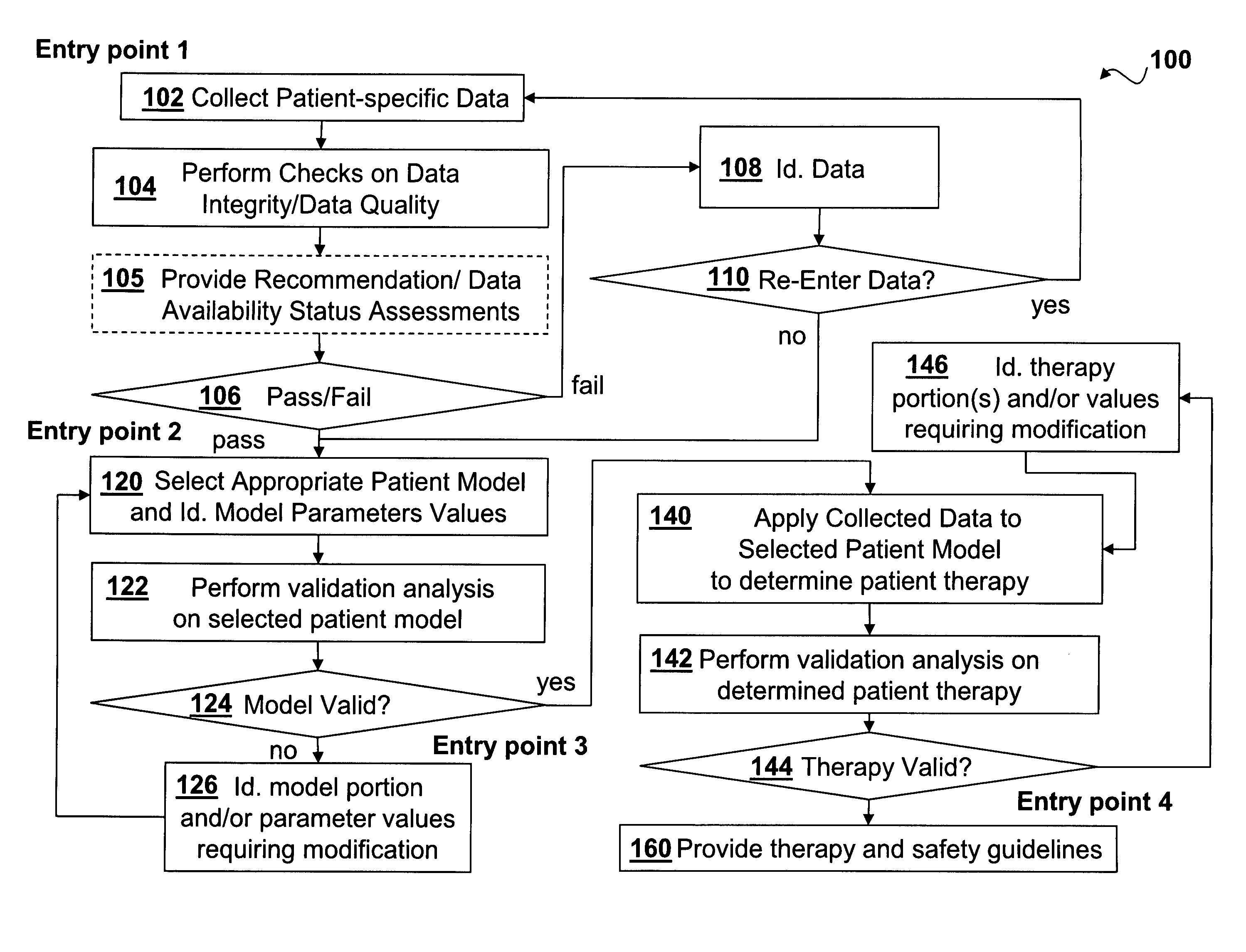
[0094]Referring now to FIG. 4, a flowchart is shown of one illustrative embodiment of a process 100 for developing patient-specific therapies. The process 100 helps to ensure that minimum rules for a therapy are met, selection of a choice(s) is relevant of achieving a therapy goal, and that specific problems to improve therapy of the patient are addressed. The process 100 need not be executed in its entirety at one time, and may instead be accessed at any of a number of entry points as will be described in greater detail hereinafter.
[0095]A first entry point of the process 100 advances to step 102 where patient-specific data is collected according to one more of the data collection protocols accessible via the data collection protocols module 70. It is to be appreciated that the collection protocols in one embodiment may be those specified by governing medical bodies, such as ADA or similar organizations, and in other embodiments, as established by a healthcare professional, such as...
use case examples
SPECIFIC USE CASE EXAMPLES
Example A
[0112]The following is a use-case example of some of the concepts described herein. The steps of this example generally follow the algorithm 100 of FIG. 4, and may be implemented via a conventional wizard, i.e., a computer user interface via which the user is led through a sequence of dialogs to accomplish a task. The wizard is a mixture of information gathering and classification of the diabetic patient with the goal to navigate the healthcare professional toward (i) the end goal of therapy determination, and / or (ii) intermediate outcomes as shown in the flow chart of FIG. 4. The example below will be presented in the framework of steps executed by such a wizard, although it will be understood that the steps of this example may alternatively be implemented via a conventional recipe or set of instructions.
[0113]In this first example, the case history file and current status of the patient is as follows. The subject is a diabetic Type I patient who'...
example b
[0126]In a second use case example, the case history of the subject is as follows. The subject is the same diabetic Type I patient in Example A above and whose last visit to the healthcare professional was 24 days ago. The subject is a 40 year old male, weighing 80 kg (no change since last visit), and is currently using a fast-acting insulin, such as Lispro (no change since last visit). The subject measures blood glucose (bG) on an average 6 times per day (3 times per day as of last visit). Mean Meal amount values for previous visit are 25 g, 85 g, 85 g, and 25 g, and current meal amount values are unknown. The subject's carbohydrate-to-insulin ratio is 8 gm / U (no change), and insulin sensitivity is 40 mg / dL / U (no change). The subject's physical activity is normal (no change). At the subject's previous visit, his HbA1C was 9.5, and it is currently 9.5. Under this fact pattern, the healthcare professional is directed to follow an intensive monitoring data collection protocol for typi...
PUM
 Login to View More
 Abstract
Description
Claims
Application Information
 Login to View More