Unlock instant, AI-driven research and patent intelligence for your innovation.

Block copolymer, method of forming the same, and method of forming pattern

a technology of block copolymer and pattern, which is applied in the field of block copolymer, a method of forming the same, and a pattern method, can solve the problem of difficult to provide a pattern having a period of more than 100 nm from a self-assembly process, and achieve the effect of reducing the process time for forming a pattern by using such a block copolymer, reducing the difficulty of self-assembly

Active Publication Date: 2016-02-09
SAMSUNG DISPLAY CO LTD +2
View PDF53 Cites 0 Cited by
  • Summary
  • Abstract
  • Description
  • Claims
  • Application Information

AI Technical Summary

Benefits of technology

This approach enables the realization of phase-separation with larger periods and reduces the overall process time for pattern formation, facilitating the creation of patterns with improved efficiency.

Problems solved by technology

In a linear block copolymer, phase-separation and self-assembly within a short process time can provide a pattern having a size of several tens of nanometers, however it is difficult to provide a pattern having a period of more than 100 nm from a self-assembly process because the phase-separation time is long.

Method used

the structure of the environmentally friendly knitted fabric provided by the present invention; figure 2 Flow chart of the yarn wrapping machine for environmentally friendly knitted fabrics and storage devices; image 3 Is the parameter map of the yarn covering machine
View more

Image

Smart Image Click on the blue labels to locate them in the text.
Viewing Examples
Smart Image
  • Block copolymer, method of forming the same, and method of forming pattern
  • Block copolymer, method of forming the same, and method of forming pattern
  • Block copolymer, method of forming the same, and method of forming pattern

Examples

Experimental program
Comparison scheme
Effect test

experimental example 1

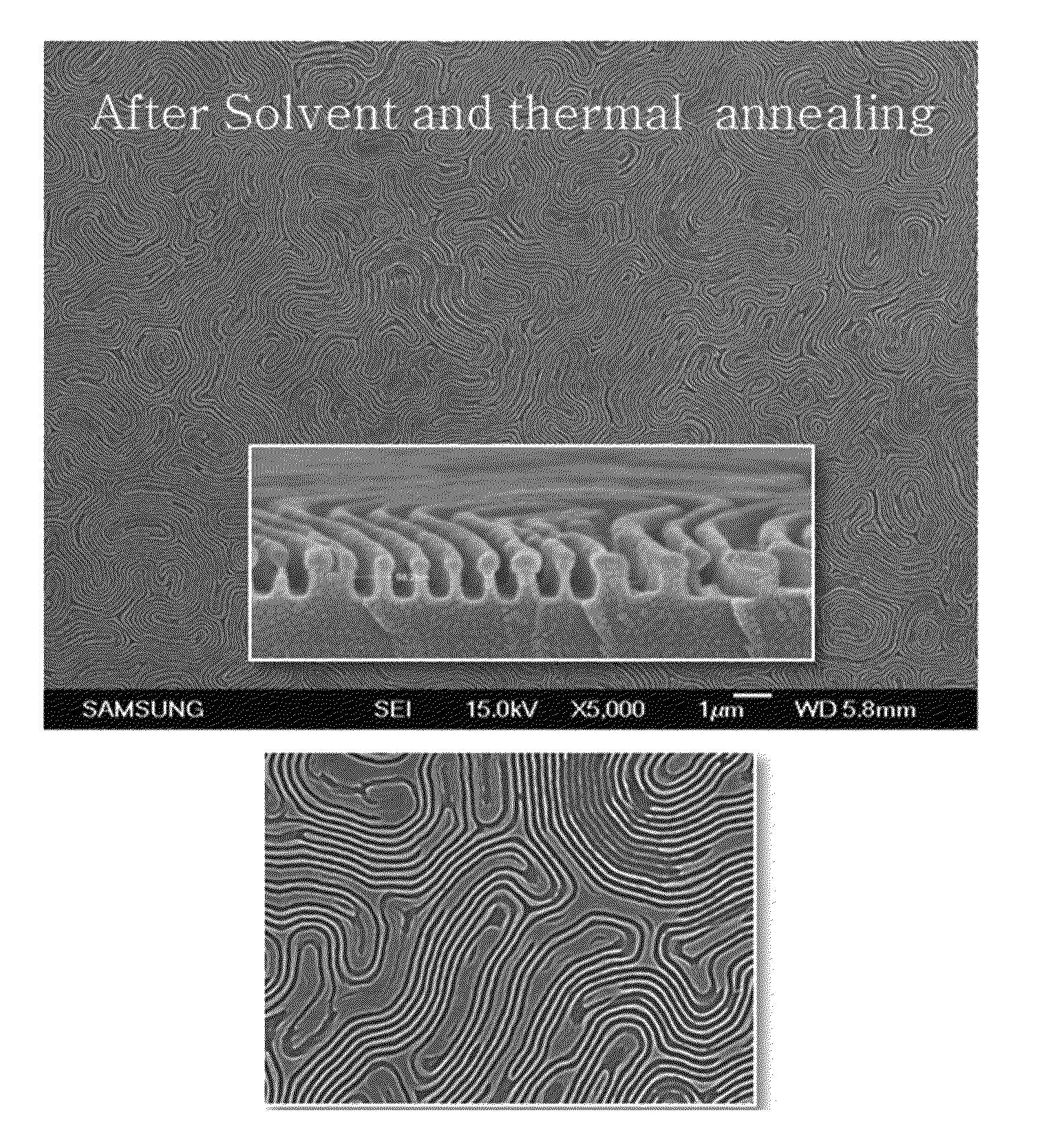
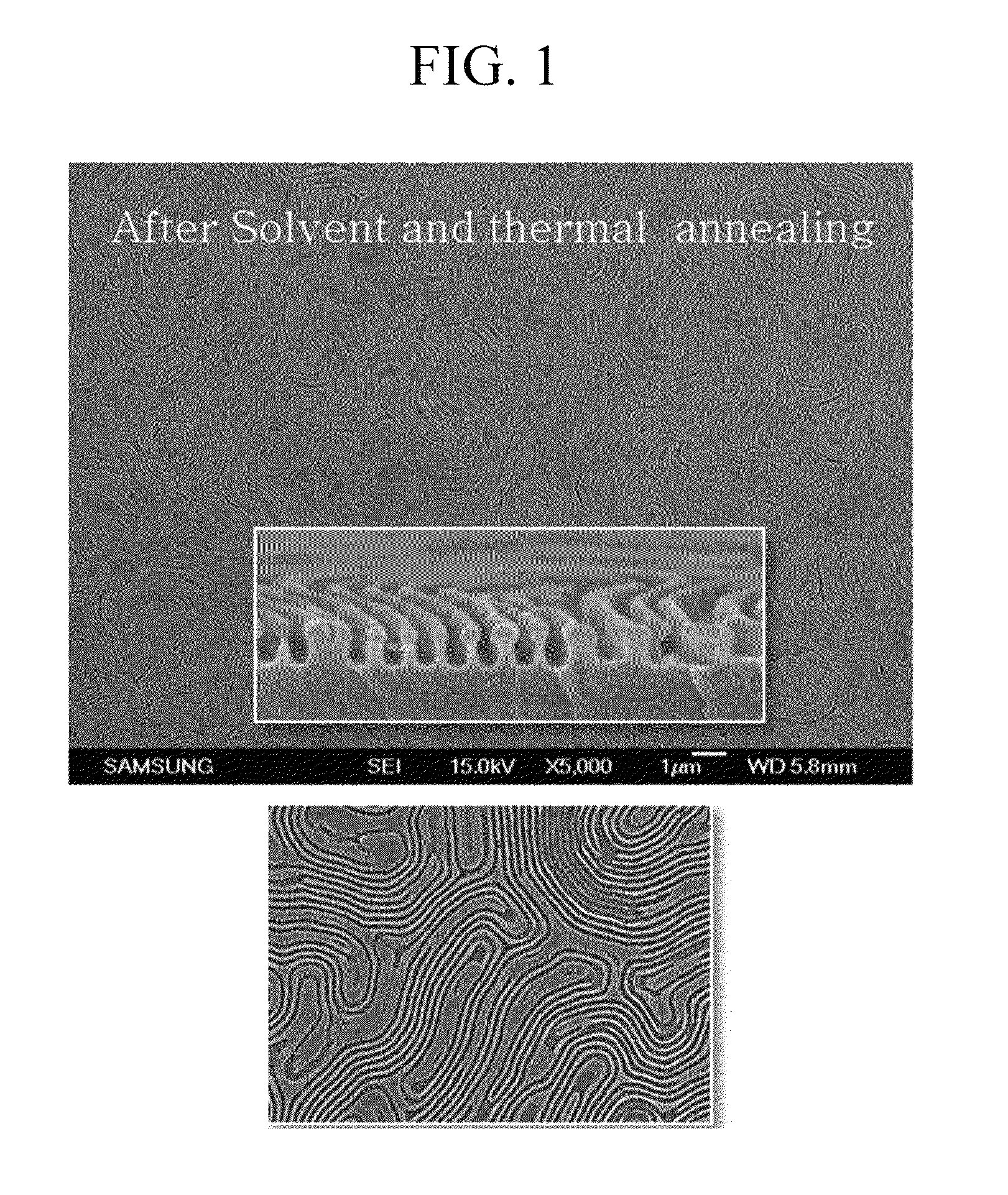
[0109]A neutralization layer is formed on a silicon substrate, and the bottle-brush type block copolymer comprising a first block represented by Formula 1 and a second block represented by Formula 2 is mixed with propylene glycol methyl ethyl acetate (“PGMEA”) to prepare a solution containing 5 wt % of the block copolymer. The solution is coated on the neutralization layer. Next, solvent annealing is performed for 40 minutes at a temperature of 21° C. Next, a heat treatment (thermal annealing) is performed for 60 minutes at a temperature of 240° C.

[0110]Referring to FIG. 1, FIG. 1 is a vertical lamella structure of the block copolymer having random directivity. It may be confirmed that phase-separation of the block copolymer is achieved.

experimental example 2

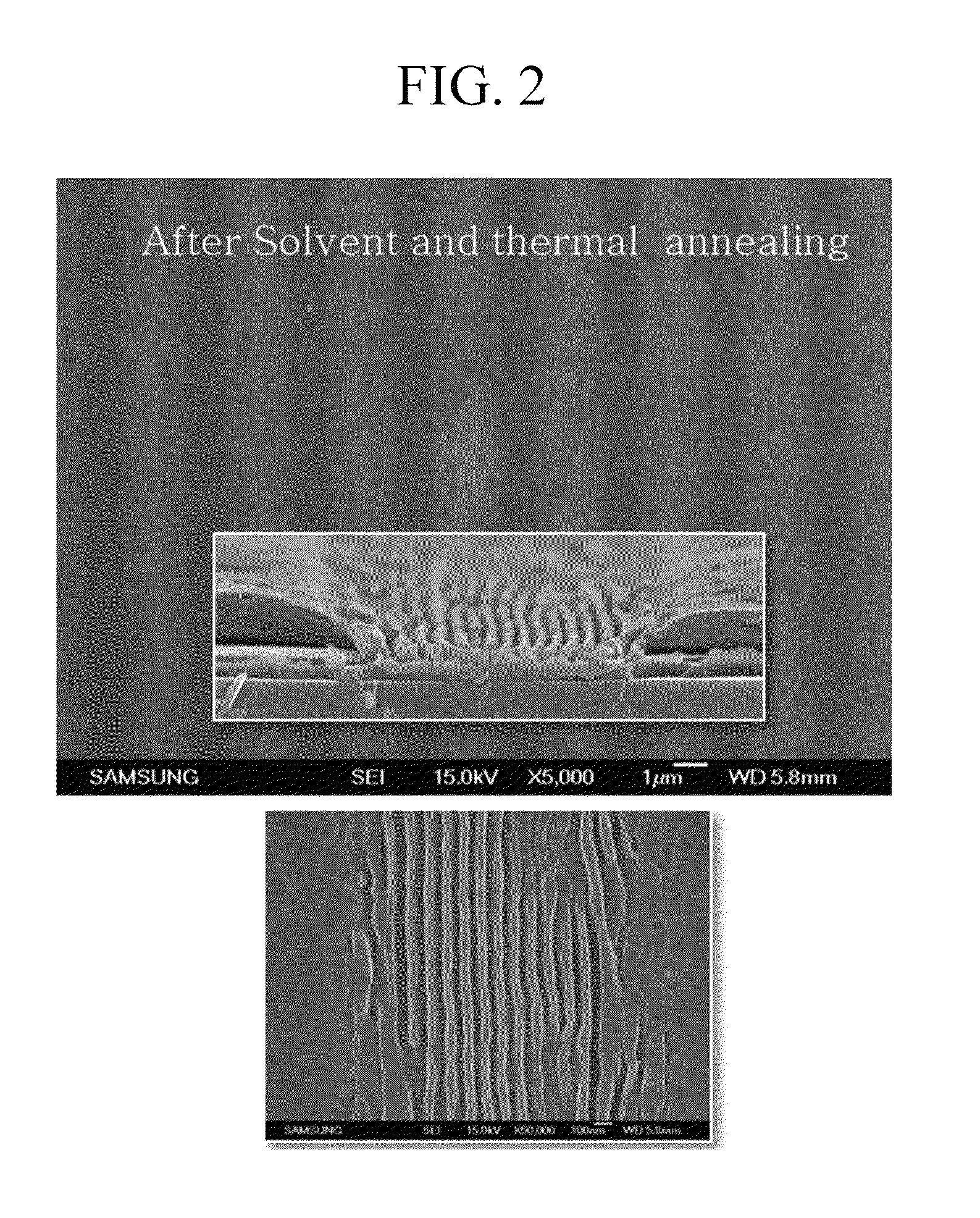
[0111]After forming the neutralization layer as described in Experimental Example 1, guide patterns having a width of about 1.5 μm are formed, and the bottle-brush type of block copolymer comprising a first block represented by Formula 1 and a second block represented by Formula 2 is coated between the guide patterns. The rest of the process is performed the same as in Experimental Example 1.

[0112]Referring to FIG. 2, FIG. 2 is a vertical lamella structure of a nanoline shape aligned between a guided pattern. It may be confirmed that the phase-separation of the block copolymer is generated thereby forming a linear pattern well.

[0113]Next, a block copolymer according to another exemplary embodiment will be described, in particular a linear block copolymer embodiment is described.

[0114]The linear block copolymer according to an exemplary embodiment of the present disclosure includes a first block represented by COM A in Structural Formula A, a second block represented by COM B in Stru...

experimental example 3

[0131]FIG. 5 shows a vertical lamella structure having random directivity.

[0132]A neutralization layer is formed on a silicon substrate, and three samples of the block copolymer, of which a volume fraction of the random block is respectively 8%, 12%, and 15% in the three samples is mixed with the PGMEA and is coated on the neutralization layer. Next, thermal annealing is performed for 12 hours at a temperature of 250° C. As a result, compared with the linear block copolymer without the random block, the period (i.e., distance between the repetition of the physical structure) is respectively increased by 28%, 67%, and 70%.

[0133]FIG. 5 shows a phase-separation phenomenon in which the linear block copolymer of which the volume fraction of the random block is 8% is thermal-treated, and it may be confirmed that the phase-separation of the block copolymer is generated well.

the structure of the environmentally friendly knitted fabric provided by the present invention; figure 2 Flow chart of the yarn wrapping machine for environmentally friendly knitted fabrics and storage devices; image 3 Is the parameter map of the yarn covering machine
Login to View More

PUM

PropertyMeasurementUnit
sizeaaaaaaaaaa
temperatureaaaaaaaaaa
Login to View More

Abstract

A block copolymer is provided. The block copolymer according to an exemplary embodiment includes a first block represented by Chemical Formula 1 and a second block represented by Chemical Formula 2:wherein COM1 and COM2 are independently selected from a polystyrene moiety, polymethylmethacrylate moiety, polyethylene oxide moiety, polyvinylpyridine moiety, polydimethylsiloxane moiety, polyferrocenyldimethylsilane moiety, and polyisoprene moiety, R1 is hydrogen or an alkyl group with 1 to 10 carbon atoms, Ph is a phenyl group, a is 1 to 50, R2 is hydrogen or an alkyl group with 1 to 10 carbon atoms, and b is 1 to 50.

Description

[0001]This application claims priority to Korean Patent Application No. 10-2013-0003439, filed on Jan. 11, 2013, and all the benefits accruing therefrom under 35 U.S.C. §119, the content of which in its entirety is herein incorporated by reference.BACKGROUND[0002](a) Technical Field[0003]The present disclosure relates to a block copolymer, a method of forming the same, and a method of forming a pattern.[0004](b) Description of the Related Art[0005]Recently, there has been interest in the scientific community to develop methods to form a pattern having a minute line width using a block copolymer. The pattern formation method controls molecular weight of the block copolymer to form a pattern of various sizes, and controls a molecular weight ratio of the blocks in the block copolymer to form a pattern of various shapes.[0006]A block copolymer is a polymer comprising two or more polymer blocks connected to each other through a covalent bond. In a diblock copolymer, which is the simplest...

Claims

the structure of the environmentally friendly knitted fabric provided by the present invention; figure 2 Flow chart of the yarn wrapping machine for environmentally friendly knitted fabrics and storage devices; image 3 Is the parameter map of the yarn covering machine
Login to View More

Application Information

Patent Timeline
no application Login to View More
Patent Type & Authority Patents(United States)
IPC IPC(8): C08F279/02C08F277/00C08F293/00C08G61/08C08G63/00C08F279/00C08F32/06
CPCC08F293/00C08G61/08C08G2261/1424C08G2261/1426C08G2261/3324C08G2261/418C08G2261/74A43B3/101A43B3/108A43B3/246A43B7/223A43B7/32C08F299/024
Inventor KANG, MIN HYUCKLEE, SU MIKIM, MYUNG IMKIM, TAE WOOPARK, SEUNG-WONLEI, XIEKANG, NA NAMOON, BONG-JINBANG, JOONAWOO, SANG HOONLEE, JIN YEONGJUNG, HYUN JUNGHUH, JUNE
Owner SAMSUNG DISPLAY CO LTD
Features
  • R&D
  • Intellectual Property
  • Life Sciences
  • Materials
  • Tech Scout
Why Patsnap Eureka
  • Unparalleled Data Quality
  • Higher Quality Content
  • 60% Fewer Hallucinations
Social media
Patsnap Eureka Blog
Learn More