Metal alloy nanoparticle synthesis via self-assembled monolayer formation and ultrasound

a technology of metal alloy nanoparticles and monolayers, applied in chemical/physical processes, transportation and packaging, chemical apparatuses and processes, etc., can solve the problems of limited composition range and product uniformity, and the synthesis of alloy nanoparticles is considerably more difficult. to achieve the effect of reducing the size of the nanoparticles

a technology of metal alloy nanoparticles and monolayers, applied in chemical/physical processes, transportation and packaging, chemical apparatuses and processes, etc., can solve the problems of limited composition range and product uniformity, and the synthesis of alloy nanoparticles is considerably more difficult. to achieve the effect of reducing the size of the nanoparticles

US9630161B2Active Publication Date: 2017-04-25RGT UNIV OF CALIFORNIA

Image

Smart Image Click on the blue labels to locate them in the text.
Viewing Examples
Smart Image
  • Metal alloy nanoparticle synthesis via self-assembled monolayer formation and ultrasound
  • Metal alloy nanoparticle synthesis via self-assembled monolayer formation and ultrasound
  • Metal alloy nanoparticle synthesis via self-assembled monolayer formation and ultrasound

Examples

Experimental program
Comparison scheme
Effect test

Embodiment Construction

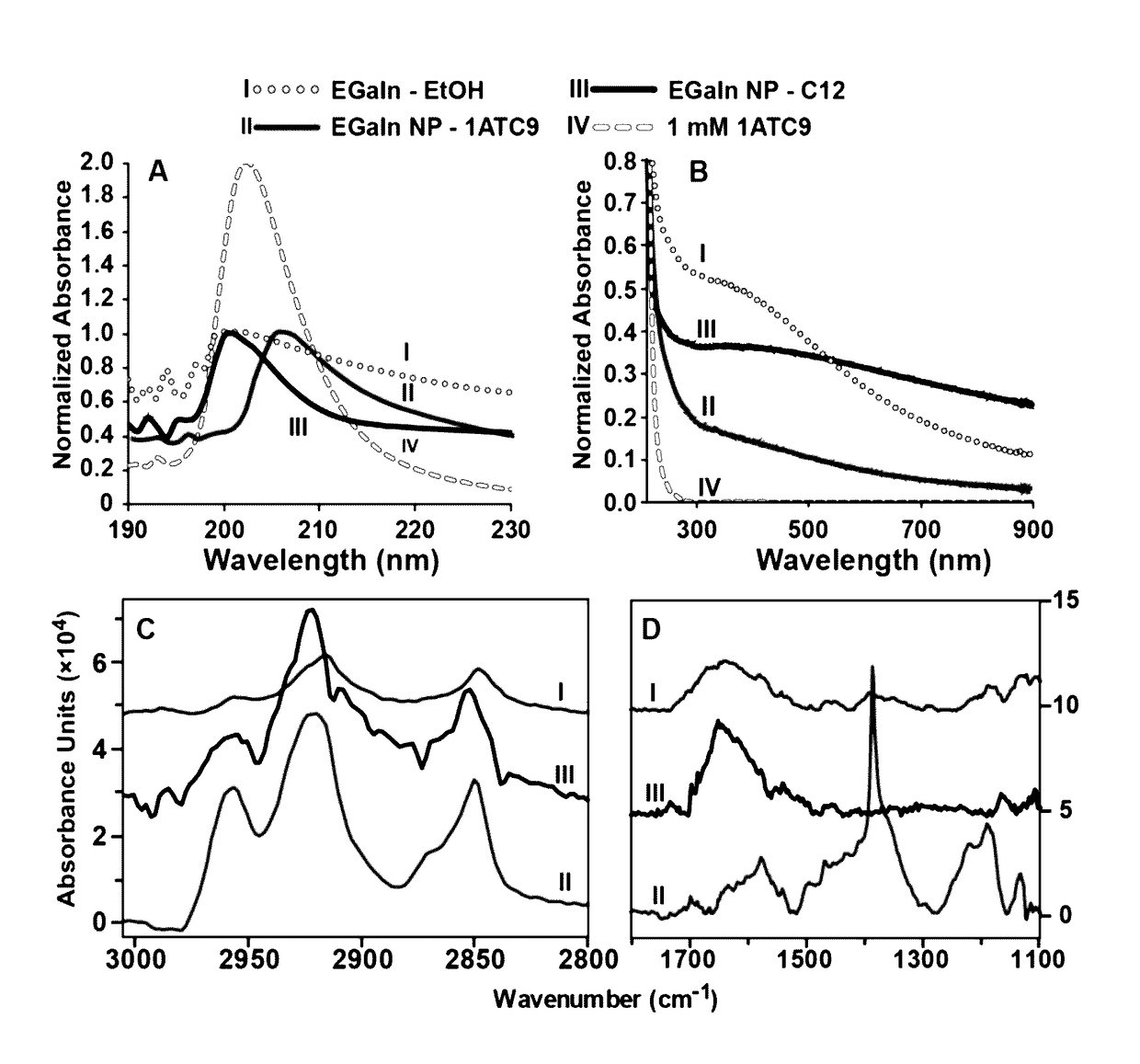
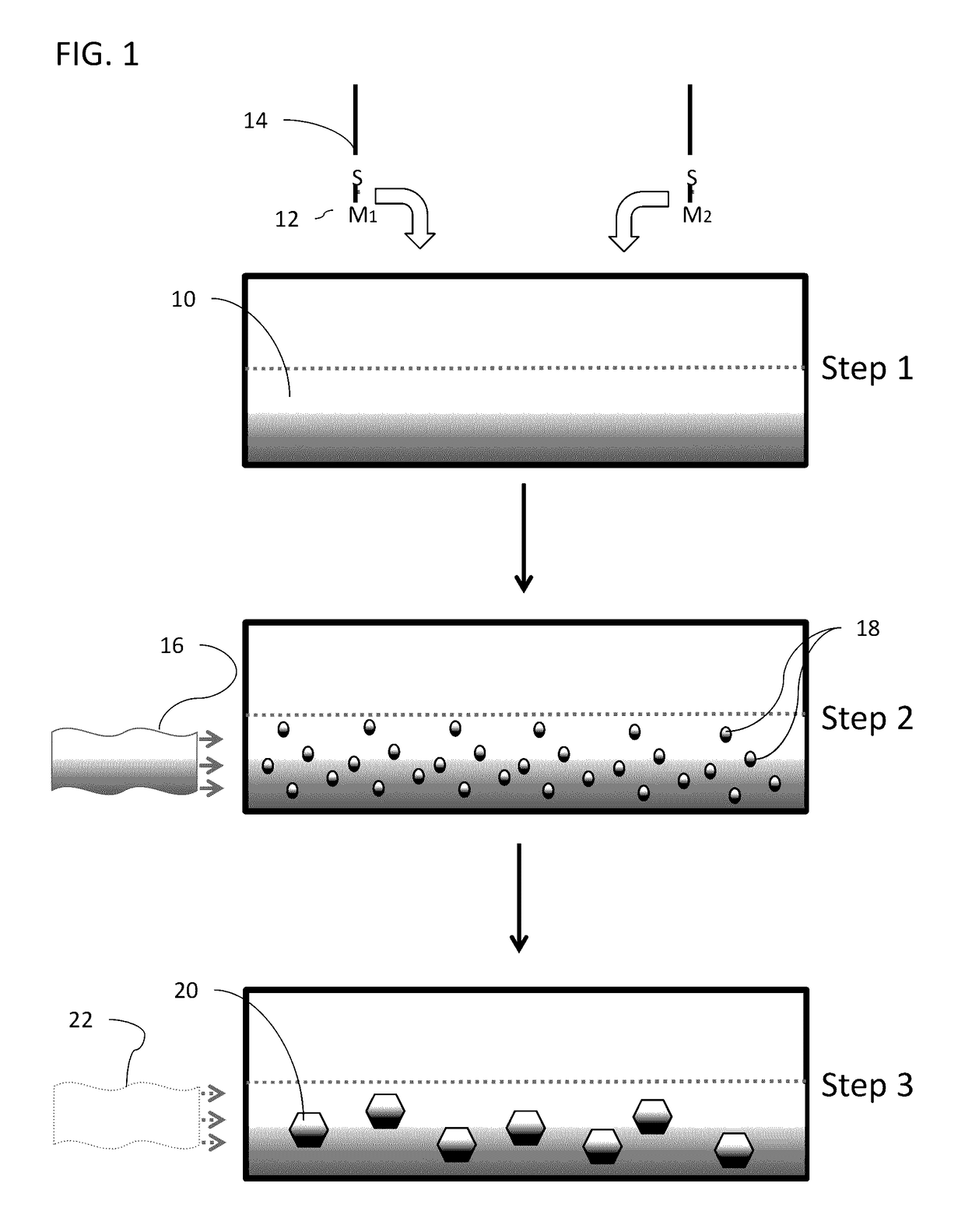
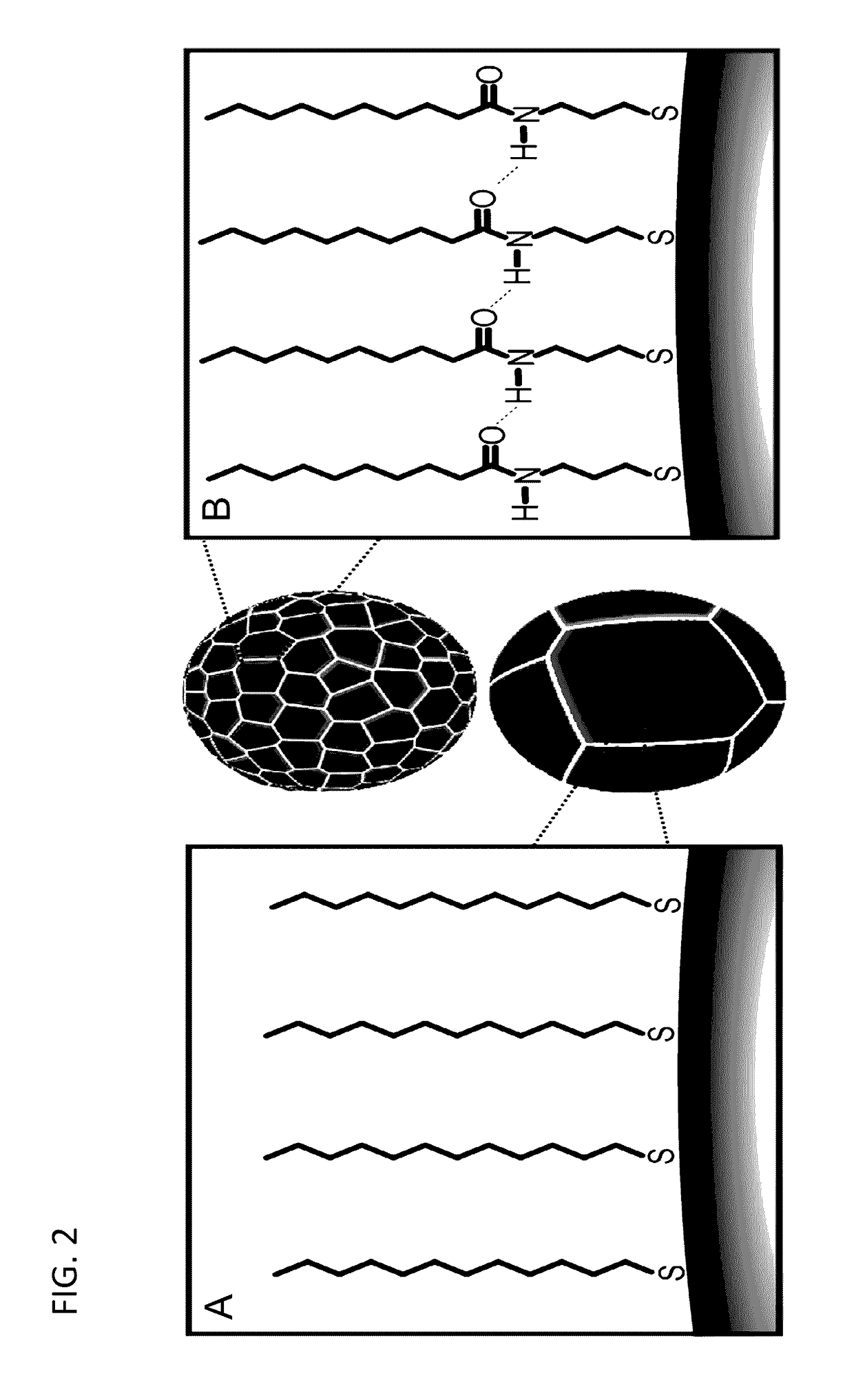
[0035]Turning now to the drawings, systems and methods for the facile self-assembly monolayer formation of ultrasonically dispersed liquid-phase metal alloy nanoparticles are described. Self-assembly has unmatched potential as a universal design principle for the development of new materials and technologies. (See, e.g. P. Wender et al., Nature 469, 23 (2011), the disclosure of which is incorporated herein by reference.) One example of useful self-assembly is the fast, spontaneous formation of self-assembled monolayers (SAMs) of amphiphilic molecules on bulk and nanoparticle surfaces has used to exert interfacial control. The molecules or ligands for such applications typically possess a surface anchoring functionality, such as sulfur with its high affinity for noble metals, at one end, and any other moiety of interest at the other end of any desired linker and can be chosen to produce specific chemical, physical, or mechanical properties in the formed surfaces. (See, e.g., J. C. Lo...

the structure of the environmentally friendly knitted fabric provided by the present invention; figure 2 Flow chart of the yarn wrapping machine for environmentally friendly knitted fabrics and storage devices; image 3 Is the parameter map of the yarn covering machine
Login to View More

PUM

PropertyMeasurementUnit
sizeaaaaaaaaaa
volumeaaaaaaaaaa
pore sizeaaaaaaaaaa
Login to View More

Abstract

Methods and assemblies for the construction of liquid-phase alloy nanoparticles are presented. Particle formation is directed by molecular self-assembly and assisted by sonication. In some embodiments, eutectic gallium-indium (EGaIn) nanoparticles are formed. In these embodiments, the bulk liquid alloy is ultrasonically dispersed, fast thiolate self-assembly at the EGaIn interface protects the material against oxidation. The assembly shell has been designed to include intermolecular hydrogen bonds, which induce surface strain, assisting in cleavage of the alloy particles to the nanoscale. X-ray diffraction and TEM analyses reveal that the nanoscale particles are in an amorphous or liquid phase, with no observed faceting.

Description

CROSS-REFERENCE TO RELATED APPLICATIONS[0001]This application claims priority to U.S. Provisional Application No. 61 / 611,343, filed Mar. 15, 2012, the disclosure of which is incorporated herein by reference.STATEMENT OF GOVERNMENT SUPPORT[0002]This invention was made with Government support under Grant Number 1013042, awarded by the National Science Foundation. The Government has certain rights in the invention.FIELD OF THE INVENTION[0003]Methods for the construction of liquid-phase alloy nanoparticles by molecular self-assembly, and self-assembled alloy nanoparticles are presented.BACKGROUND OF THE INVENTION[0004]Metallic nanoparticles are useful for a wide-variety of applications and have generated a great deal of scientific interest, because they effectively a bridge between bulk materials and atomic or molecular structures. Standard metallic nanoparticle synthetic approaches exploit controlled reduction from a homogenous reagent solution; control over reaction conditions yields ...

Claims

the structure of the environmentally friendly knitted fabric provided by the present invention; figure 2 Flow chart of the yarn wrapping machine for environmentally friendly knitted fabrics and storage devices; image 3 Is the parameter map of the yarn covering machine
Login to View More

Application Information

Patent Timeline
25 Apr 2017
Publication
US9630161B2
IPC
B01J8/16; B22F9/08; C22C1/04; B82Y30/00
CPC
B01J8/16; B22F9/082; B82Y30/00; C22C1/0491; B22F2999/00; Y10T428/2984; B22F1/0022; B22F2202/01
Inventors
HOHMAN, JAMES NATHAN; WEISS, PAUL S.